
Centrifugal pump impeller types describe several different features of a pump’s rotating hydraulic component. Open, semi-open and closed usually describe the presence of shrouds around the vanes; radial, mixed-flow and axial describe the main flow direction. These classifications answer different questions and should not be treated as a single list of interchangeable options. For water transfer, choose an impeller through the complete pump’s verified curve, liquid compatibility, solids handling and maintenance requirements. An exterior product photograph cannot confirm the internal design. This guide helps buyers compare options, identify missing information and request a defensible selection.
Start with the liquid and required duty
Define the liquid before choosing a hydraulic arrangement. Clean water, water with occasional grit, wastewater containing fibers and abrasive slurry present different problems. Record temperature, density where relevant, suspended solids, particle character and the possibility of changes during service. A nominal particle diameter is useful, but it does not describe a long flexible fiber or an abrasive concentration. Ask whether the liquid analysis represents the worst normal condition.
Use the pump duty-point guide to organize the selection inputs. Then establish required flow and total head across the expected operating range. The US Department of Energy pumping-system sourcebook explains why selecting equipment requires an assessment of the full system. An impeller type is only one part of that assessment. Two pumps using the same broad type can have different efficiencies, suction requirements, permitted flow ranges and maintenance arrangements.
Understand open, semi-open and closed descriptions
An open impeller has vanes without the two enclosing shrouds associated with a closed arrangement. A semi-open design generally has a backing shroud with the opposite side open. A closed impeller has shrouds on both sides of the vane passages. Terminology can vary between suppliers, especially for specialized designs. Request an approved section drawing or technical description rather than relying only on a short marketing label.
The degree of enclosure affects how the hydraulic passages interact with adjacent stationary surfaces. Clearances, wear parts and assembly condition can therefore influence performance. It is inaccurate to say that every open impeller passes all solids or that every closed impeller must be limited to perfectly clean water. Passage dimensions, vane arrangement, pump size and the specific service all matter. Use model-specific evidence when assessing a supplier’s claim.
| Design description | What the label tells you | What still needs verification |
|---|---|---|
| Open | The vanes are not enclosed between two shrouds | Approved clearance, wear adjustment, actual passage geometry and suitable liquid |
| Semi-open | A backing shroud supports the vanes with one side open | Stationary surface arrangement, wear limits and verified performance |
| Closed | Shrouds form enclosed vane passages | Passage size, wear-ring arrangement where present, liquid suitability and access |
| Recessed or vortex | The impeller is positioned to create a different interaction with the main passage | Verified solids-handling capability, efficiency and permitted duty |
| Channel or non-clog | The supplier describes a passage intended for a particular solids service | Actual channel arrangement, fibrous-material limitations and service evidence |
The Hydraulic Institute pump-principles reference explains the shroud and flow-direction classifications. This table is a qualitative terminology guide, not a performance ranking. Do not use it as a substitute for the supplier’s hydraulic drawing and curve. The shape of the inlet or exterior casing alone does not establish which internal arrangement is fitted.
Keep flow direction separate from shroud construction
In a radial-flow arrangement, the liquid leaves the impeller mainly outward from the shaft. Mixed-flow designs combine radial and axial components, while axial-flow designs move liquid mainly along the shaft direction. These terms concern the hydraulic path rather than whether the vanes have shrouds. They help explain why different pump families serve different combinations of head and flow, but they do not by themselves establish a model’s operating limits.
Single-suction and double-suction are another distinction: they concern how liquid enters the impeller. Do not confuse double-suction with a two-stage pump or assume that it guarantees redundancy. Likewise, multistage describes a sequence of stages, not a particular shroud arrangement. Separate these labels in the enquiry so the supplier can answer each question clearly.
Compare complete curves at the intended operating point
A buyer needs the curve for the offered speed and impeller diameter, including head, efficiency, input or shaft power as appropriate, and suction requirements. Review the expected operating range rather than selecting from maximum head or maximum flow displayed separately. Those maxima are not normally a simultaneous duty. The centrifugal pump curve guide explains how to relate these data to the system.
The Hydraulic Institute discussion of preferred and allowable operating regions explains why reliability depends on where a pump operates. An impeller that performs well at one duty can be unsuitable when demand changes substantially. Obtain the approved limits for the complete pump, including minimum-flow and suction-margin requirements, rather than assigning a universal percentage to an entire impeller category.
If efficiency is important, compare alternatives at the same actual duty with consistent definitions. A larger nominal efficiency number at a different operating point is not a fair comparison. Include drive and control losses where the project evaluates electrical consumption, and consider the number of operating hours. A reliable solids-handling solution may justify a different hydraulic tradeoff from a clean-water system running continuously.
Match solids, abrasion and maintenance access
For solids-bearing liquids, ask about both passage capability and the material being transported. A claimed solids diameter may describe a rigid sphere test rather than resistance to fibrous blockage. Record grit, rags, expected concentration and the potential for foreign objects. Where a specialist wastewater comparison is needed, use the vortex versus channel impeller guide; its scope is narrower than this general classification article.
Abrasive wear can increase clearances or change surface geometry. The consequences depend on the design and severity of service. Request inspection points, allowable limits, replacement parts and the approved adjustment procedure. Never invent an adjustment value from a general article. If the supplier cannot provide the relevant maintenance information, record that as a selection uncertainty instead of assuming the arrangement is maintenance free.
Consider access before purchase. Can the intended installation be isolated and drained? Can technicians remove the necessary parts without dismantling large sections of piping? Are lifting points and handling procedures documented? The cost of replacing a wear component includes access, labor and downtime as well as the component price. A design label alone cannot answer those practical questions.
Do not modify an impeller without approved engineering
Trimming diameter can change a pump curve, but it is not a casual workshop operation. The permitted trim range, resulting performance and balance requirements depend on the design. Request an approved revised curve for the offered diameter. The system sourcebook discusses impeller trimming as a system optimization option, with limits; it does not authorize cutting an arbitrary impeller to reach a guessed duty.
Swapping an open impeller for a closed one is also not simply a parts preference. Compatibility may involve the casing, shaft, clearances, thrust loading and wear components. Use the manufacturer’s approved assembly and instructions. Before dismantling, follow the site’s isolation procedure and the HSE guidance on electrical isolation. Opening a pump is a maintenance task for qualified personnel, not a way for an untrained buyer to verify a catalogue description.
Use product references without inventing internal details
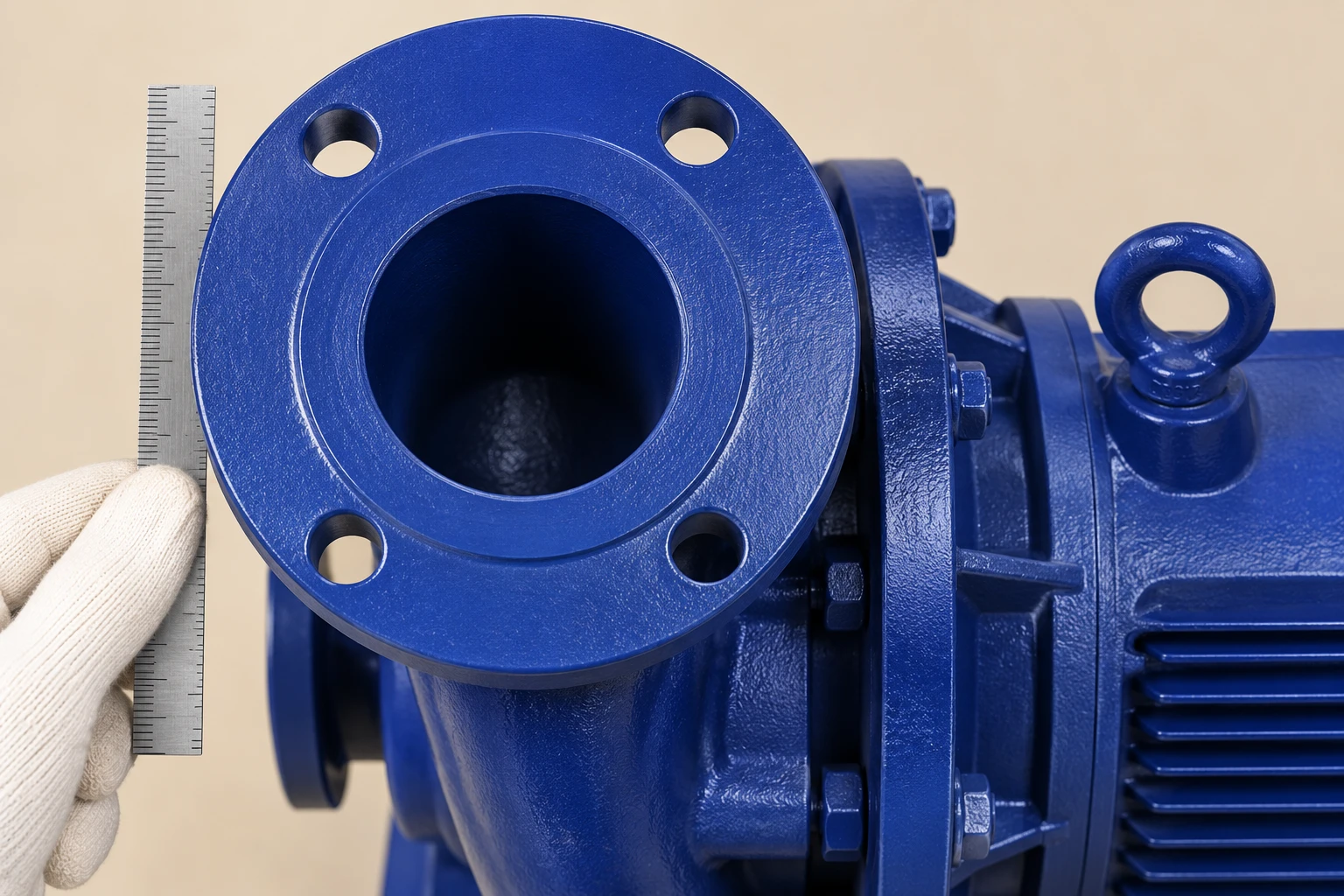
The BorraPumps ISW horizontal pump product page is a relevant starting point for a clean-water transfer enquiry. The images accompanying this article use its actual exterior product as a reference. They illustrate inspection and procurement preparation; they are not section drawings and do not claim that a specific unseen impeller is fitted. Confirm the offered internal configuration directly with the supplier.
Provide a concise request containing the liquid description, required flow and head range, suction conditions, supply frequency and voltage, operating hours and installation constraints. Ask the supplier to identify the exact model, speed, impeller diameter, construction and supporting curve. Also request the spare-parts list and any wear limits needed for the proposed service. Keep the final reply linked to the quotation revision so an informal answer does not become detached from the purchased configuration.

Inspect what was delivered
At receiving, compare the model identification and order documents with the approved selection. Record visible damage, supplied accessories and any configuration differences. Do not open a new unit unnecessarily if the purchase specification does not require it. Use documented factory information or an agreed inspection procedure to confirm internal parts. Preserve photographs and report discrepancies before installation.
Commissioning should then confirm the actual duty, protection and operating conditions through the approved project procedure. It should not be reduced to “motor runs.” If the delivered unit behaves differently from the approved curve, review instruments, speed, installation losses and configuration before assigning the problem to the impeller type. Good receiving records make this investigation much easier.
Learn how impeller selection connects to performance
This NPTEL lecture explains centrifugal-pump characteristics. It helps connect a discussion of internal design to curve interpretation, but it does not identify the internal parts of a particular BorraPumps unit or approve a parts change.

Frequently asked questions
Is a closed impeller always more efficient?
No universal ranking is reliable. Compare the complete pumps at the same actual duty and liquid conditions, using verified curves and consistent efficiency definitions.
Can an exterior image reveal the impeller type?
Usually it cannot. Obtain a technical description, approved section drawing or configuration record for the offered model.
Are open and radial-flow opposite categories?
No. Open describes shroud construction, while radial-flow describes the main hydraulic direction. They answer different questions.
Does a solids-passage claim guarantee freedom from clogging?
No. Fibers, concentration, foreign objects and operating conditions can create problems that a single particle-size claim does not describe.
What is the most useful purchase document?
A configuration-specific selection record linking the duty, liquid, exact model, impeller arrangement, diameter, speed, performance curve and maintenance information is more useful than a broad design label.