
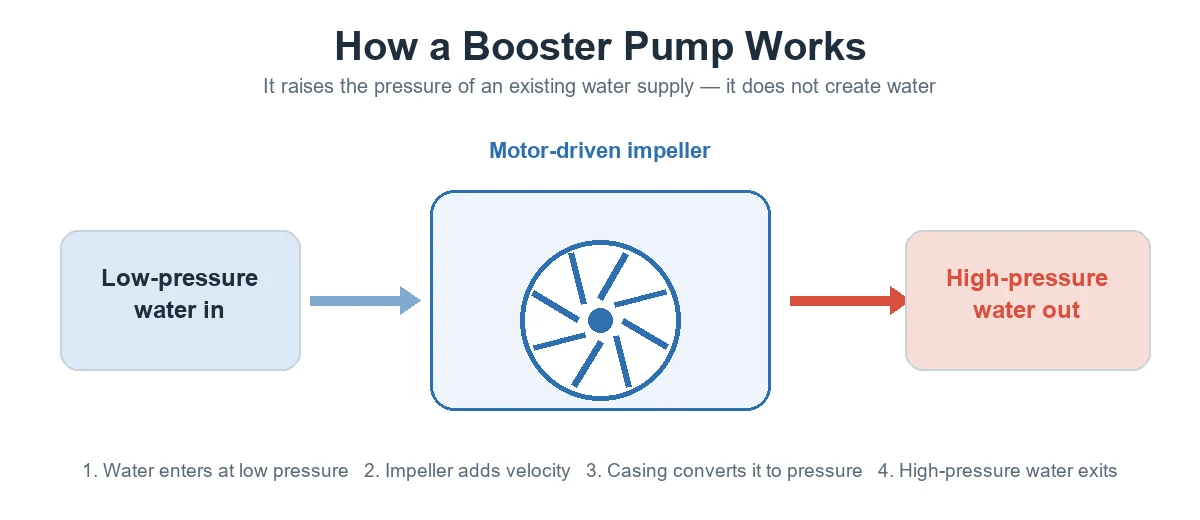
A booster pump is a pump that raises the pressure of an existing water supply when the incoming pressure is too low to do the job. It does not create water; it adds the pressure needed to push water to upper floors, distant outlets, or equipment that requires a steady, higher pressure.
This guide explains how a booster pump works, the main types, where they are used, how to size one, and the problems to avoid.
Part 1. What is a booster pump?
A booster pump increases the pressure of water already moving through a system. It sits on the supply line, takes water in at low pressure, and discharges it at a higher pressure. Because it works on an existing supply, it solves pressure problems rather than sourcing water from a well or tank.
Typical signs a system needs one: weak flow on the top floors of a building, a sprinkler or irrigation zone that cannot hold pressure, or a process line that needs constant pressure regardless of demand.
Tip: A booster pump fixes low pressure. If the problem is no water at all, the issue is supply or a source pump, not boosting.
Part 2. How does a booster pump work?
Most water booster pumps use a motor-driven impeller in a centrifugal design. The pressure gain follows four steps:
- Low-pressure water enters the pump inlet.
- The spinning impeller adds energy, increasing the water’s velocity.
- The pump casing converts that velocity into pressure.
- Higher-pressure water leaves the outlet and reaches fixtures or equipment.
Many modern systems add a pressure sensor and a variable-speed (VFD) drive. The pump then adjusts speed to hold a constant set pressure as demand changes, which saves energy and reduces pressure swings. A booster pump must have water at its inlet; it raises pressure on a supply rather than lifting from a dry source.
Tip: A constant-pressure (VFD) booster set keeps pressure stable when many outlets open and close, which suits hotels, apartments, and process lines.
Part 3. What are the main types of booster pumps?
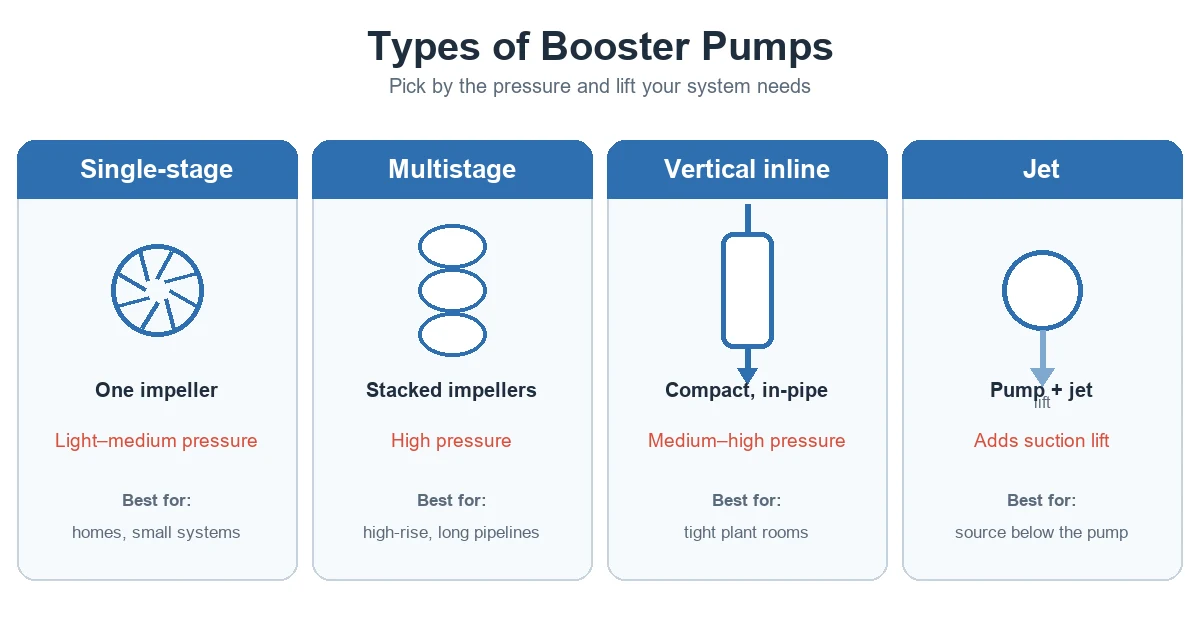
The right type depends on how much pressure and lift the system needs.
| Type | Impeller(s) | Pressure capability | Best for |
|---|---|---|---|
| Single-stage | One | Light to medium | Homes and small systems with modest pressure needs |
| Multistage | Several, staged | High | High-rise buildings and long pipelines |
| Vertical inline | Compact, in-pipe | Medium to high | Plant rooms with limited floor space |
| Jet | One plus a jet | Adds suction lift | When the water source sits below the pump |
Single-stage pumps are simple and suit lighter duties. Multistage pumps stack impellers to build the high pressure that tall buildings and long runs need. Vertical inline pumps save space in the pipework. Jet pumps add lifting strength when the source is below the pump.
Part 4. What is a booster pump used for?
| Setting | The problem | What a booster pump does |
|---|---|---|
| Multi-floor homes | Weak flow on upper floors | Restores usable pressure at every fixture |
| Hotels, offices, hospitals | Demand swings, pressure drops | Holds stable pressure across changing demand |
| Industrial / process | Equipment needs constant pressure | Maintains pressure for cooling, treatment, and processes |
| Irrigation | Pressure loss over large areas | Keeps steady flow across long runs |
| Fire / standby | Pressure must stay within spec | Maintains system pressure (jockey / pressure-maintenance duty) |
On new construction and retrofits, booster pumps commonly supply adequate pressure to the upper floors of high-rise buildings, where static head alone is not enough.
Part 5. Booster pump vs. a transfer pump
A transfer or supply pump moves water from a source such as a well, tank, or main. A booster pump works on water that already has some pressure and raises it to the level a building or process needs. The two often work together: a supply pump delivers water, and a booster pump fine-tunes pressure downstream.
Part 6. How do you size and choose a booster pump?
Sizing matches the pump to real demand. Collect these inputs before selecting:
- Flow rate at peak demand (gpm or m³/h).
- Pressure / head to add, including building height.
- Inlet pressure available from the existing supply.
- Power supply: voltage, phase, frequency.
- Control: fixed speed or variable-speed constant pressure.
- Installation: vertical, inline, or a packaged booster set.
How much pressure should it add? Most buildings target about 40–60 psi at the fixture, and boosters are commonly set around 30–50 psi; pressure above roughly 80 psi can stress pipes and fittings. Account for elevation and friction: water loses about 4.3 psi for every 10 ft (3 m) of vertical lift, plus roughly 10–20% for friction. So the required boost ≈ target pressure − available inlet pressure + elevation + friction losses. High-rise and process duties usually need multistage or packaged sets sized to the full head. (Engineering references: Xylem design manual; phcppros.)
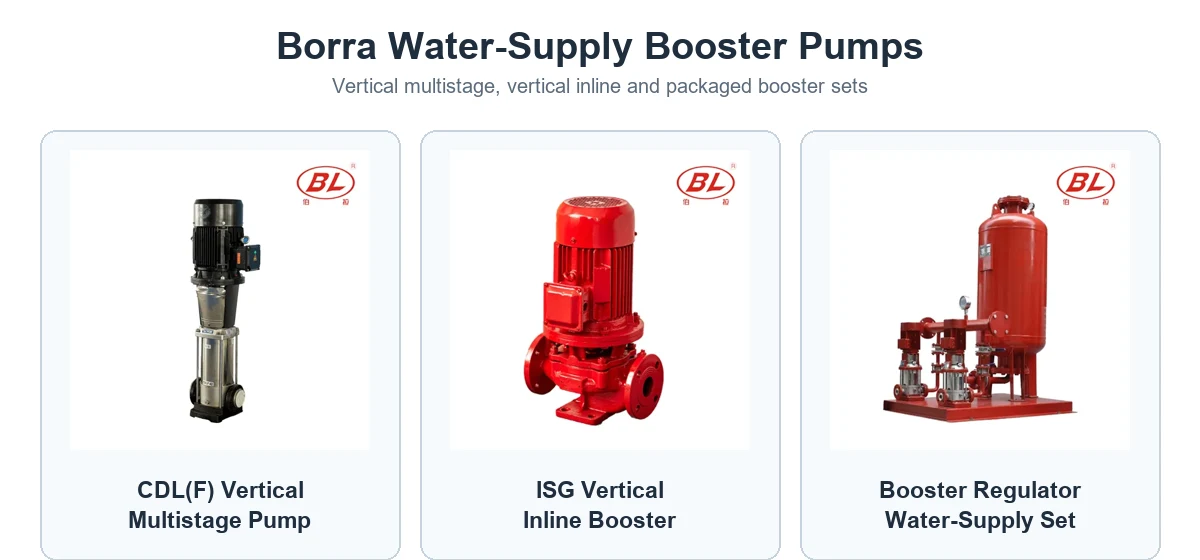
For high-rise and constant-pressure water supply, a vertical multistage pump or a packaged booster set is common. Borra builds water-supply booster pumps for these duties, including the CDL(F) vertical multistage pump, the ISG vertical inline booster pump, and packaged booster and water-supply equipment.
Tip: Size to actual peak flow and required head. An oversized booster pump short-cycles and wears faster; an undersized one cannot hold pressure at peak demand.
Part 7. Common booster pump problems
Buyers and installers most often report a few recurring issues. Most trace back to sizing, inlet conditions, or controls rather than the pump itself.
- Pressure still low: usually undersizing, low inlet pressure, or a partly closed valve.
- Short-cycling: the pump starts and stops too often, often from an oversized pump or a faulty pressure tank or switch.
- Air in the line: trapped air reduces performance; bleed the system and check the inlet.
- Check-valve or backflow faults: a stuck check valve causes pressure loss or backflow.
- Dry running: running with no inlet water can damage the pump.
Important: Do not run a booster pump dry. Most systems should include low-pressure or dry-run protection, and the pump must always have water at its inlet.
FAQ
Does a booster pump increase flow or pressure?
Primarily pressure. Higher pressure can improve flow at fixtures, but the pump’s main job is to add pressure to an existing supply.
Where should a booster pump be installed?
On the supply line where it can draw water with some inlet pressure, typically after the main supply or storage tank and before the zone that needs higher pressure.
Do I need a single-stage or multistage booster pump?
Single-stage suits modest pressure needs. Multistage suits high pressure for tall buildings or long pipelines. Match the choice to your required head and flow.
Will a booster pump work with no water at the inlet?
No. The pump must have water at its inlet, and running it dry can cause damage. Many systems add dry-run protection.
What size booster pump do I need?
Base it on peak flow, the pressure you need to add, available inlet pressure, and power supply. Share these with a supplier for a recommendation.
Can a booster pump be too powerful?
Yes. An oversized pump short-cycles, wastes energy, and wears faster. Size to real peak demand instead of the largest available model.
Do booster pumps save energy?
A variable-speed (VFD) booster set can, because it matches speed to demand instead of running at full speed continuously.
How long does a booster pump last?
Service life depends on duty, water quality, and maintenance. Correct sizing, clean inlet conditions, and dry-run protection extend it.
How much pressure should a booster pump add?
Enough to reach your target from the available inlet pressure. Homes typically aim for 40–60 psi and boosters often run 30–50 psi; above about 80 psi risks damage. High-rise and process systems need more once elevation (~4.3 psi per 10 ft) and friction are added.
Are booster pumps noisy, and do they use much energy?
Modern variable-speed (VFD) booster sets run quietly and can cut pumping energy by around half versus fixed-speed units, with typical service lives of several years. Mount the set away from occupied rooms and on vibration isolation where noise matters.
References
- Hydraulic Institute — pump standards and terminology
- Booster pump (Wikipedia)
- GlobalSpec — Booster Pumps Selection Guide
- U.S. Department of Energy — pumps and energy use
- phcppros — Pressure Booster System Basics
- Xylem — Domestic Water Pressure Booster Design Manual (TEH-1096A)
See more in our booster pumps guide. Need help sizing a booster pump? Share your flow, head, inlet pressure, and application, and Borra’s team will recommend the right water-supply booster pump.