
When a procurement manager in São Paulo encountered a three-part pump-sourcing problem during the retrofit of a commercial complex, he did what many experienced buyers would do: he compared familiar international brands, obtained a low-cost packaged-pump quotation, and approved the order against a compressed schedule. Eight months after delivery, the mechanical seal leaked, discharge pressure began to fluctuate, and the basement flooded during the rainy season. The original bid had also grouped a pool-cleaner booster, a domestic pressure unit, and a fire-pump package under the same purchasing label. The pumps were not simply “bad”; the underlying mistake was treating unlike duties, standards, and performance curves as interchangeable.
Summary: A buyer asking повысительный насос must first define the service. The Polaris PB4 60 booster pump is a 0.75 HP, 60 Hz pump designed for compatible pressure-side pool cleaners, while a Davey booster pump may refer to several domestic or commercial water-pressure products. Neither description, by itself, establishes suitability for an industrial water system or an NFPA 20 fire-pump duty. The sound buying process fixes the duty point, fluid, power supply, applicable standard, test documentation, and lifecycle support before comparing brands or prices.
What is a booster pump, and why does the service definition come before the brand name?
The practical answer to повысительный насос is a pump that raises pressure from an existing supply to the level required by downstream equipment. That broad definition covers very different machines: a small pool-cleaner pump, a packaged variable-frequency water-supply system, a vertical multistage pump, and a jockey pump can all “boost” pressure, but they are not substitutes.
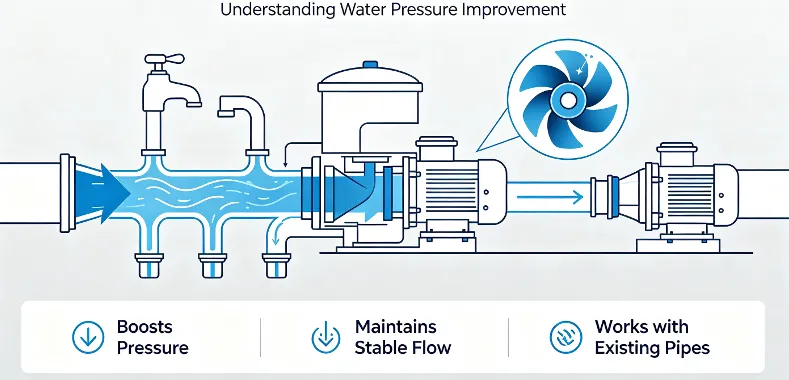
For procurement, the term becomes useful only when the following data are attached:
- Required flow in m³/h or L/s
- Total dynamic head, including static lift, friction loss, and residual pressure
- Liquid temperature, density, solids content, and corrosivity
- Suction conditions and available net positive suction head
- Site voltage, phase, and frequency
- Operating profile, including starts per hour and expected annual operating hours
- Applicable acceptance standard and authority having jurisdiction
A quick conversion helps expose vague enquiries: 1 bar of water pressure is approximately 10.2 m of head. A building requiring 4 bar at its highest outlet does not necessarily need “a 4-bar pump”; the engineer must add elevation and pipe losses, then subtract the dependable inlet pressure.
ISO 9906 provides the accepted framework for hydraulic performance testing of rotodynamic pumps. An ISO 9001 certificate, by comparison, addresses the supplier’s quality-management system rather than the performance of an individual pump.
The market context rewards this discipline. Grand View Research estimates that the global industrial-pump market will rise from USD 49.5 billion in 2026 to USD 72.9 billion in 2033, representing a 5.7% CAGR; Asia-Pacific accounted for 46.1% of 2025 revenue. More equipment choices do not make specification easier—they make a clear duty sheet more valuable.
How does a Polaris PB4 60 booster pump differ from an industrial water booster pump?
Этот Polaris PB4 60 booster pump is purpose-built to power compatible Polaris pressure-side pool cleaners. The manufacturer identifies it as a 0.75 HP unit and explains that its low-flow requirement allows operation alongside the low-speed setting of a two-speed or variable-speed filtration pump.
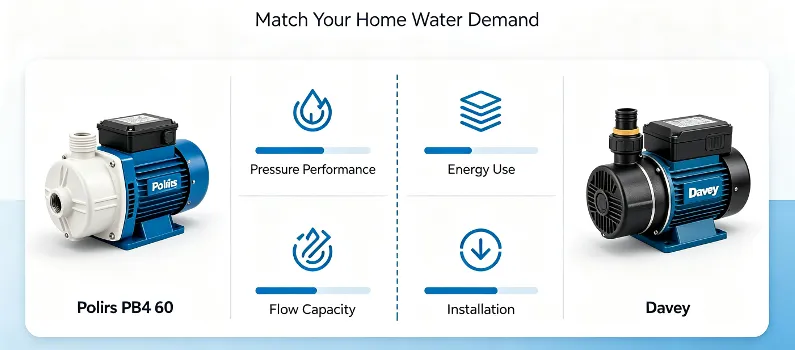
Distributor specifications commonly list 115/230 V, 6.4/12.8 A, and 60 Hz; the purchaser should still confirm the current nameplate and regional model before ordering.
Those numbers answer a narrow equipment question. They do not establish:
- A commercial-building water duty point
- Potable-water approval
- Continuous industrial-service suitability
- Fire-protection compliance
- Compatibility with a variable-frequency booster package
- Performance against a project-specific system curve
A Polaris PB4 60 booster pump should therefore be selected only when:
- The connected load is a compatible pressure-side pool cleaner.
- The site provides the voltage and 60 Hz frequency shown on the ordered unit.
- Installation follows the manufacturer’s manual.
- The booster is correctly interlocked with the filtration pump.
- Hydraulic connections, ventilation, drainage, and service clearances meet the manufacturer’s requirements.
- Local support is available for seals, motor parts, and warranty claims.
If the duty is to maintain pressure across a hotel, factory, municipal network, or high-rise building, the buyer needs a documented pump curve and control philosophy. A packaged water-supply booster system may use multiple pumps, pressure sensors, variable-frequency drives, and alternating control so that output follows demand. That architecture is fundamentally different from a single-purpose pool-cleaner unit.
The commercial risk is easy to miss because the product names overlap. A 0.75 HP motor is a verifiable rating; it is not proof that the pump can deliver the project’s required flow at its required head. The Polaris PB4 60 booster pump should never be proposed as a fire pump, and NFPA 20, EN 12845, UL, or FM compliance should not be inferred from a pool-equipment listing.
When is a Davey booster pump a valid alternative, and when is it a different product class?
A Davey booster pump is not one hydraulic specification. The name may describe a pressure-boosting package, a pump fitted with an electronic controller, or another model intended for a particular water service.
The honest answer to повысительный насос in this context is therefore model-dependent: the buyer must compare an exact data sheet, not a brand-level label.
Before a Davey booster pump is accepted, the technical submittal should identify:
- The model code and number of pumps
- The guaranteed flow and head at the scheduled duty point
- Motor voltage, phase, frequency, enclosure, and insulation class
- Wetted materials and mechanical-seal arrangement
- Controller type, pressure-vessel volume, and dry-run protection
- Hydraulic test tolerance and supplied certificates
- Minimum and maximum permissible inlet pressure
- Recommended operating range and maximum starts per hour
Frequency deserves special attention in cross-border purchasing. Brazil generally uses 60 Hz, while many Southeast Asian projects specify 50 Hz. A motor or pump selected for the wrong frequency can run at a different speed, shifting flow, head, absorbed power, and the actual operating point.
Under the centrifugal affinity laws:
- Flow changes approximately in proportion to rotational speed.
- Head changes approximately with the square of speed.
- Power changes approximately with the cube of speed.
A Davey booster pump offered for one electrical market should not be assumed suitable for another without written confirmation.
An industrial CDL(F) vertical multistage pump may be a more appropriate comparison when a project requires higher head, a defined duty curve, and integration into a packaged system. This does not make every multistage pump a direct replacement; suction conditions, wetted materials, controls, redundancy, and the applicable standard still govern.
How should engineers size a booster pump without hiding lifecycle cost?
Buyers who ask повысительный насос often receive a catalogue maximum rather than a selected operating point. A defensible selection starts with the system curve and checks where it intersects the pump curve. The preferred operating region is normally close to the manufacturer’s best-efficiency range, not at the far left or right of the curve.
The sizing sequence should be auditable:
- Calculate static head from the lowest credible inlet level to the highest or most remote outlet.
- Calculate friction loss at design flow, including pipe, valves, strainers, meters, and fittings.
- Add the residual pressure required by the terminal equipment.
- Subtract the minimum dependable inlet pressure—not an optimistic daytime average.
- Check available NPSH against required NPSH with an application-appropriate engineering margin.
- Check the full operating envelope rather than only one design point.
- Request an ISO 9906 hydraulic test basis and state the permitted tolerance grade.
For a variable-demand water system, two or three smaller pumps may provide better turndown and redundancy than one oversized pump. A 2 × 50% or 3 × 33% arrangement can also simplify maintenance planning, although the appropriate standby philosophy depends on the consequence of failure.
An ISG vertical inline booster pump can reduce floor-space demand in suitable clean-water duties, while a multistage arrangement may be preferred where head is the dominant requirement.
Hidden cost enters when a low purchase price creates:
- Off-curve operation
- Frequent starting and stopping
- Mechanical-seal failure
- Cavitation or unstable suction
- Excessive energy consumption
- Controller incompatibility
- Difficult-to-source spare parts
- Unplanned process or building downtime
The Polaris PB4 60 booster pump can be economical in its intended pool-cleaner role; used outside that role, its apparent saving disappears. A Davey booster pump may offer an effective packaged solution when its documented curve and controls match the project; without model-level evidence, the logo alone cannot establish total cost of ownership.
Which seven pump manufacturers belong on a serious project shortlist?
The following list is not a universal ranking. It is a procurement map: each supplier has a different portfolio, channel structure, engineering depth, and price position. The comparison should begin only after the buyer has decided повысительный насос for the scheduled duty.
| Manufacturer | Core strength | Typical buyer | General price position |
|---|---|---|---|
| Grundfos | Integrated building-water systems, controls, and extensive global service coverage | Commercial-building owners, consultants, utilities, and distributors | Premium |
| KSB | Engineered water, energy, industrial, and fire-protection pump portfolios | EPC contractors, utilities, and process plants | Premium |
| Sulzer | Large process, wastewater, and rotating-equipment applications | Municipal operators and heavy industry | Premium, project-led |
| Flowserve | Severe-service process pumps and engineered flow-control packages | Oil and gas, chemical, power, and major EPC projects | Premium, engineered-to-order |
| Wilo | Building services, water management, and digitally controlled systems | MEP contractors, property groups, and water operators | Mid-premium to premium |
| Ebara | Broad centrifugal-pump coverage, including compact water and industrial duties | OEMs, distributors, contractors, and facilities | Mid-range to premium |
| БОРРА | Integrated fire-pump, water-booster, drainage, and diesel-pump packages with export documentation | EPC contractors, system integrators, distributors, and value-focused project buyers | Project-dependent, value-oriented |
A brand table cannot replace a technical bid evaluation. Each shortlisted offer should be scored against:
- Hydraulic compliance
- Materials and seal compliance
- Control-system scope
- Factory testing
- Certification and documentation
- Delivery schedule
- Local service
- Recommended spare parts
- Warranty terms
- Technical and commercial exclusions
Price should be compared only after these deviations have been normalized.
Which booster-pump class fits each application and cost profile?
The following application matrix separates similar search terms before they become expensive purchase-order errors.
| Application | Appropriate product class | Essential selection evidence | Main cost drivers |
|---|---|---|---|
| Pressure-side pool cleaner | Polaris PB4 60 booster pump or another cleaner-approved model | Cleaner compatibility, 0.75 HP rating where specified, 60 Hz nameplate, installation manual | Dealer channel, motor version, and replacement parts |
| Domestic or light-commercial pressure improvement | Exact Davey booster pump model or equivalent packaged pressure unit | Duty curve, controller logic, potable-water suitability where required, voltage, and frequency | Controller, vessel, materials, and local support |
| Commercial-building water supply | Duplex or triplex VFD booster package | Minimum inlet pressure, peak flow, residual pressure, acoustic limit, and ISO 9906 test basis | Number of pumps, VFDs, stainless-steel scope, and control panel |
| Industrial transfer or process water | End-suction, inline, or multistage industrial pump | Fluid properties, operating envelope, materials, seal plan, and motor efficiency | Metallurgy, seals, testing, and hazardous-area requirements |
| Fixed fire protection | Listed or approved fire-pump package specified by the project and authority | NFPA 20 or EN 12845 basis, certified curve, controller, driver, accessories, and witnessing | Listing or approval, diesel driver, controller, and test scope |
| Stormwater or sewage removal | Drainage, self-priming, or non-clog sewage pump | Solids passage, suction lift, dry-run exposure, emergency flow, and cleaning access | Impeller type, solids handling, trailer or skid, and standby capacity |
Market pricing should be read through this matrix. A Polaris PB4 60 booster pump and a Davey booster pump may both appear in online “booster pump” results, but a complete industrial package includes controls, manifolds, sensors, protection, factory testing, documentation, and sometimes standby capacity. Comparing their web prices without defining the package boundary creates a false saving.
How do NFPA 20, EN 12845, ISO 9001, CE, UL, and FM change booster-pump procurement?
Standards do not become interchangeable because they appear on the same supplier profile. A buyer asking повысительный насос for a fire-protection project is actually asking about a life-safety system; the compliance path must be fixed before the equipment is selected.
- NFPA 20 addresses the selection and installation of stationary pumps for fire protection. For centrifugal fire pumps, the commonly specified performance envelope includes a shutoff head not exceeding 140% of rated head and at least 65% of rated head at 150% of rated flow. The adopted edition and local authority requirements must be checked.
- EN 12845 addresses automatic sprinkler systems, including design, installation, and maintenance requirements. It is not a general approval for domestic water boosting.
- UL and FM apply through product-specific listings or approvals. A supplier’s unrelated listed product does not make every pump package UL-listed or FM-approved.
- CE marking supports conformity with applicable European Union legislation. It is neither a global hydraulic-performance certificate nor a substitute for Brazilian approval.
- ISO 9001 demonstrates the operation of a quality-management system. It does not, by itself, prove that an individual pump meets NFPA 20, EN 12845, or its stated hydraulic duty.
For a São Paulo project, the specification should also be reconciled with the local fire authority, applicable ABNT requirements, electrical regulations, and project contract documents.
A Polaris PB4 60 booster pump is outside this fire-pump compliance pathway. A Davey booster pump intended for ordinary water-pressure service is also outside it unless an exact, documented product has the required fire-service approval—which should never be assumed from the brand.
Fortune Business Insights projects the global fire-pump market to increase from USD 659 million in 2026 to USD 1.084 billion in 2034, representing a 6.41% CAGR. As more suppliers enter the market, model-specific certificates, witnessed testing, and a clear deviation schedule become more—not less—important.
How should buyers compare a Polaris PB4 60 booster pump, a Davey booster pump, and an industrial package?
The procurement team should use five gates before issuing a purchase order.
The first gate confirms that the pump serves the stated application.
The team should write one sentence describing the service: “pressure-side pool-cleaner supply,” “potable-water pressure boosting,” “industrial process-water transfer,” or “fixed fire protection.”
If that sentence is missing, the answer to повысительный насос remains too broad to buy against.
The second gate fixes the hydraulic and electrical duty.
The enquiry should state:
- Flow
- Total dynamic head
- Minimum inlet pressure
- Fluid and temperature
- Solids content
- Voltage, phase, and frequency
- Starts per hour
- Operating schedule
- Ambient conditions
- Required motor enclosure
For the Polaris PB4 60 booster pump, cleaner compatibility and a 60 Hz supply are decisive. For a Davey booster pump, the exact model curve and controller must be included. For an industrial package, a certified system curve and documented control sequence are expected.
The third gate demands a project-specific compliance dossier.
Borra Technology Co., Ltd. provides industrial pump and packaged-system options supported, as applicable to the ordered scope, by quality-system and export documentation that may include ISO, CE, SGS, TUV, and inspection records.
The buyer should still request:
- Certificate number
- Issuing body
- Expiration or validity date
- Covered model and manufacturing location
- Test standard
- Inspection scope
- Technical exclusions
A brochure logo is not enough. For life-safety service, the fire-pump series must be evaluated against the project’s exact NFPA 20, EN 12845, UL/FM, and authority requirements.
The fourth gate normalizes price and delivery scope.
The comparison sheet should include:
- Pumps and drivers
- Base frame and coupling
- Suction and discharge manifolds
- Valves and accessories
- Controllers and sensors
- Pressure vessel
- Internal wiring
- Surface treatment
- Export packing
- Factory testing
- Witnessed testing
- Freight
- Commissioning
- Spare parts
- Warranty
A quotation 40% below another may simply omit the diesel controller, certified testing, site supervision, export packaging, or critical accessories. Delivery claims should be tied to approved drawings and document dates rather than to the purchase-order date alone.
The fifth gate protects serviceability after commissioning.
The team should request a recommended two-year spare-parts list, seal and bearing references, controller backup procedure, troubleshooting boundaries, response time, and warranty process.
If a one-year whole-unit warranty is promised, its start date, exclusions, labour coverage, and claims route should be written into the contract.
Founded in 1995, BORRA reports six manufacturing facilities and more than 161 product specifications across water boosting, drainage, diesel pumps, and fire-pump packages. That breadth allows a project to assess whether common documentation, coordinated interfaces, and consolidated support can reduce multi-vendor friction.
A single supplier is valuable only when every selected pump remains technically correct for its duty.
Which references support this booster-pump buying decision?
- Polaris PB4-60 official product page — intended application, 0.75 HP motor, efficiency features, and manufacturer documentation.
- Grand View Research: Industrial Pumps Market — market size, growth, and regional context.
- Fortune Business Insights: Fire Pump Market — fire-pump market estimates and forecast.
- Mordor Intelligence: Industrial Pump Market — industrial-pump market outlook and regional trends.
- NFPA 20: Standard for the Installation of Stationary Pumps for Fire Protection — fire-pump installation framework; the locally adopted edition should be confirmed.