
Centrifugal pump bearing lubrication depends on the bearing arrangement, housing design and operating conditions. Use the lubricant type, viscosity, quantity and service method approved for the exact assembly. A grease nipple, an oil sight glass or another pump’s maintenance schedule is not enough information to authorize a change. Before comparing service costs, establish whether the bearing is sealed, regreasable, oil-lubricated or part of another arrangement, and distinguish the pump bearing from the driver bearing.
This guide helps industrial water-pump owners prepare a lubrication specification and maintenance record. It does not recommend converting a housing, mixing lubricants or applying a universal grease quantity. Product selection and maintenance instructions must come from the equipment and lubricant documentation relevant to the installed machine.
Start with an inventory of lubrication points
Identify the pump, motor or engine and every bearing location that the maintenance team is expected to service. Give each lubrication point a unique label. Record the assembly drawing, bearing designation where available, housing identification and applicable maintenance document revision.
Some assemblies contain bearings that are not intended for routine replenishment. Others have accessible lubrication fittings connected to a particular bearing or cavity. Trace the point to its intended component before using it. A fitting’s position alone does not establish the correct material or quantity.
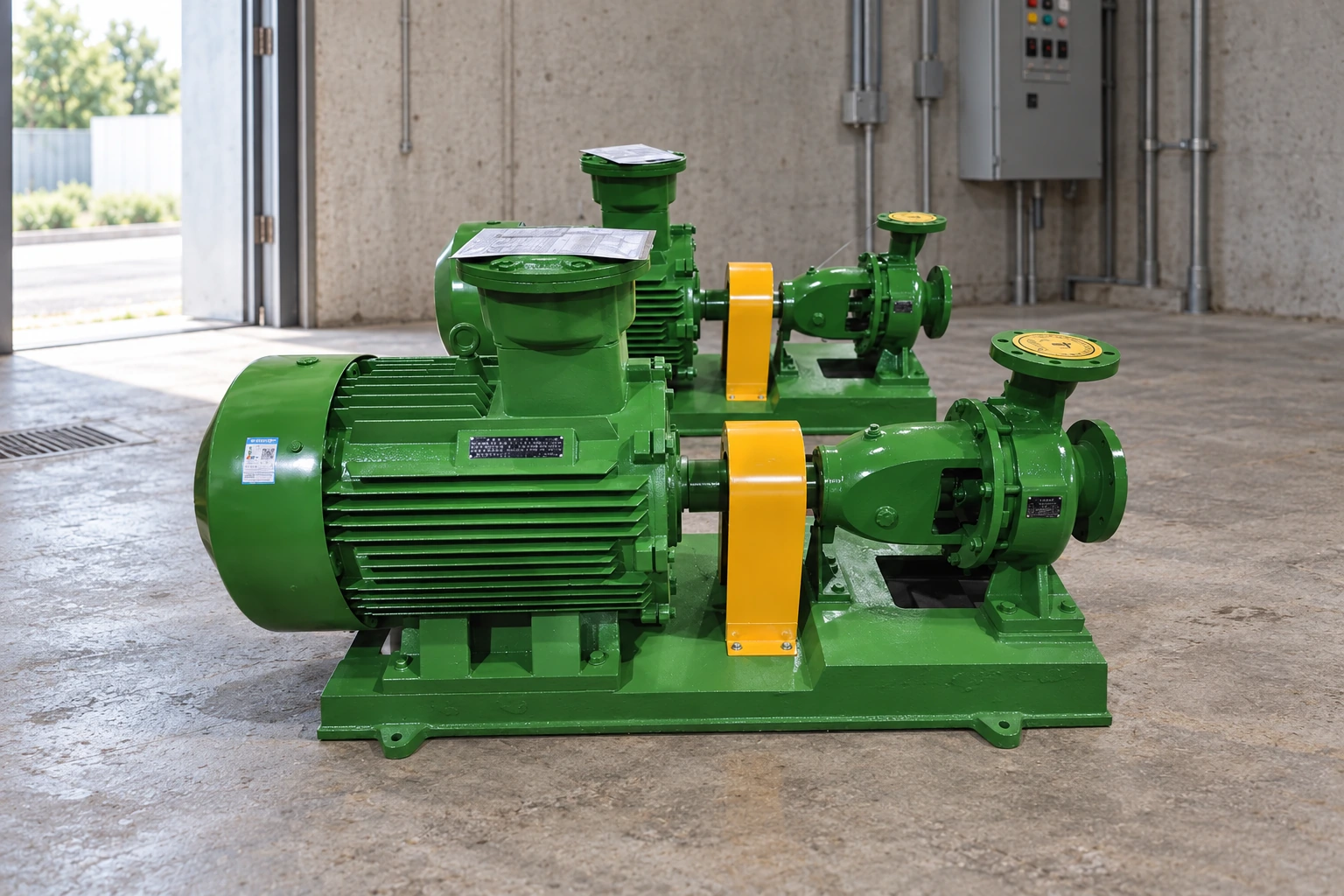
For an IS clean-water centrifugal pump installation, obtain the delivered assembly’s instructions rather than assigning a lubrication system from the product photograph. The pump and its separately supplied driver may have different service requirements even when they are mounted on the same base.
Understand what oil and grease have in common
The lubricant must support suitable conditions at the bearing contact surfaces. Its suitability depends on the bearing, speed, load, temperature and environment. Oil lubrication and grease lubrication are different ways of supplying lubricant; neither is inherently the correct choice for every industrial pump.
Grease contains base oil held within a thickening system, with additional formulation components. A grease consistency designation does not, by itself, describe the base-oil viscosity or establish compatibility with another product. For oil, a viscosity grade alone likewise does not define every relevant performance property.
Hydraulic Institute’s pump lubrication FAQs explain the importance of matching viscosity to the service. Use that general principle to request the manufacturer’s actual requirement, rather than copying the generic examples on a reference page into a site lubrication schedule.
Compare the complete maintenance arrangement
A grease-serviced bearing requires a defined lubricant, replenishment quantity, interval and method where relubrication is permitted. The maintenance plan should identify how excess material is managed according to the housing design. Repeatedly adding grease without knowing the existing condition can create an additional problem rather than correct one.
An oil-lubricated housing requires attention to its specified oil level, fill and drain arrangement, contamination protection and inspection method. Oil-level observations must be made under the condition stated by the manufacturer. A reading taken while stopped is not automatically interchangeable with one taken during operation.
A circulating or other specialized oil system includes equipment beyond a simple sump. Its alarms, flow conditions and auxiliary components need their own instructions. Do not describe every oil-lubricated pump as though it had the same maintenance needs.
Use a comparison table without treating it as a conversion rule
The following table identifies questions for a supplier or maintenance review. It does not approve a change from one lubricant system to another.
| Decision question | Grease-serviced arrangement | Oil-serviced arrangement |
|---|---|---|
| What document defines the service? | Approved grease, quantity, method and interval | Approved oil, level, inspection condition and replacement method |
| How is the point identified? | Label the fitting and intended bearing | Label the fill, drain, level device and housing |
| What can make an apparently simple task unreliable? | Unknown grease history or uncontrolled replenishment | Incorrect level interpretation or contamination during filling |
| What must be checked before changing products? | Formulation suitability and compatibility procedure | Required specification and changeover procedure |
| What evidence belongs in the record? | Product identity, amount, date and observed response | Product identity, level condition, date and inspection findings |
A cost comparison should include access, technician time, contamination control, monitoring and the consequences of an incorrect service task. The cheapest container is not necessarily the lowest-cost maintenance system.
Match the lubricant to the operating envelope
Document normal speed, variable-speed range, loading and actual bearing operating conditions. Note frequent starts, long standby periods, outdoor exposure, humidity, washdown and airborne contamination. The supplier needs this information to confirm the lubricant and maintenance method.
Temperature changes should be interpreted in context. A hotter housing may reflect lubrication condition, but it may also reflect a changed operating point, alignment problem, bearing damage or measurement difference. Do not switch to a thicker product solely because a surface temperature rose during one inspection.
SKF’s bearings in centrifugal pumps handbook provides broader application guidance. Its selection information should be applied through a qualified review of the actual bearing arrangement; it is not a substitute for the pump and driver instructions.
Prevent contamination during storage and application
Keep lubricant containers closed, clearly identified and stored under the supplier’s recommended conditions. Use clean, dedicated transfer equipment where required by the site’s contamination-control plan. A correct lubricant can become unsuitable if dirt or water is introduced during the maintenance task.
Label service tools so that products are not confused. Do not assume color identifies a lubricant reliably. If the content of a grease gun or transfer container is uncertain, resolve its identity before servicing the machine. The cost of pausing a task is usually easier to manage than investigating an unknown mixture in a housing.
Clean the accessible service point and use the approved connection method. Avoid opening a housing unnecessarily in a dirty environment. Record damaged caps, breathers, seals or other ingress paths as defects requiring correction, rather than compensating by changing lubricant more often without investigation.
Treat mixed or unknown lubricant history as a change-control problem
If previous service records are missing, do not assume that the material inside is compatible with the product now available. Ask the equipment and lubricant specialists for an approved inspection or changeover procedure. Compatibility depends on more than whether both containers say grease or oil.
A product change may require a planned shutdown, cleaning or other defined actions. Record the old product if known, the approved replacement, who authorized the change and when it was completed. Update all point labels and service instructions together so that the next shift does not reintroduce the previous material.
Do not convert an oil housing to grease, or the reverse, by simply changing what is put inside. Housing geometry, passages, seals and heat-management provisions can be relevant. Such a conversion requires engineering approval and documented component suitability.
Set quantities and intervals from the right documents
Use the manufacturer’s quantity and method for the specific lubrication point. If the approved instruction is expressed as mass, establish how the service tool delivers that mass rather than assuming every stroke supplies the same amount. Record the tool and its verified delivery where the procedure requires it.
Start from the documented interval and account for the actual duty through the approved maintenance program. Calendar time, operating hours and standby exposure may matter in different ways. Do not extend an interval just because the pump ran for fewer hours if the environment or storage condition introduces another concern.
For oil service, follow the specified level and inspection condition. Adding oil until an unrelated sight glass appears full is not a general rule. Investigate a falling level and correct the cause through the approved repair process instead of turning repeated top-ups into the permanent maintenance plan.
Investigate abnormal condition before adding more lubricant
Record the symptom, time, operating speed and duty condition. Compare temperature, sound and vibration with the last accepted baseline. An apparent lubrication problem may require a different inspection path, particularly after a coupling adjustment or bearing replacement.
Our centrifugal pump bearing failure guide addresses diagnosis and evidence preservation. This lubrication guide supports preventive decisions; it does not claim that every noisy or hot bearing can be corrected by replenishment. Preserve removed components and observations when a failure investigation is required.
ใช้ pump vibration measurement route to make condition comparisons repeatable. If alignment is under investigation, consult the separate shaft alignment methods guide. Avoid changing several conditions simultaneously and then assigning improvement to the lubricant without evidence.
Ask for a usable supplier and service package
Request a point-by-point lubrication schedule with the equipment order or repair handover. It should identify product requirements, quantities or levels, inspection conditions, replenishment permissions, intervals and the applicable safety procedure. Ask the supplier to distinguish the pump requirements from those of the motor or engine.
Include the available ambient and operating information in the request. State whether the pump is continuous duty, variable speed, intermittent or standby, and whether there are restrictions on lubricant handling or contamination. Obtain an explicit answer where the standard instructions do not fit the site conditions.
For maintenance purchasing, retain the complete approved specification rather than only a brand name. A substitute product should be reviewed against that requirement and the changeover procedure. Keep the approval with the service record so procurement does not make an undocumented engineering decision later.
การเรียนรู้เพิ่มเติม
The SKF bearing lubrication lesson below introduces lubrication principles and maintenance considerations. It comes from a bearing and lubrication specialist rather than a competing pump supplier. It does not specify a lubricant, quantity or interval for a particular BORRAPUMP assembly; use the relevant equipment instructions for those decisions.

คำถามที่มักถูกถาม
Is grease always simpler than oil for pump bearings?
No. Compare the complete housing and service arrangement, including access, replenishment controls and contamination protection. The correct choice is the arrangement approved for the actual bearing and duty.
Can I grease a sealed bearing as preventive maintenance?
Only if the equipment instructions explicitly permit the required service. Do not assume a bearing needs replenishment because another bearing on the same machine has a grease fitting.
Can two greases be mixed if their colors match?
Color does not prove compatibility. Confirm the existing material and obtain an approved compatibility or changeover procedure before introducing a different product.
Does a hot bearing need more lubricant?
Not necessarily. Record the operating condition and investigate the cause. Incorrect quantity, contamination, mechanical loading or other defects can require different action, so repeated additions are not a reliable diagnosis.
What should a lubrication record contain?
Identify the equipment and point, approved product, amount or level condition, date, operating hours where relevant, service method and observations. Record exceptions and authorized changes so the next service can reproduce the intended condition.