
Pump casing crack inspection should establish whether an observed line is a real discontinuity, where it extends, which material is affected and whether an approved repair can restore the pressure boundary. A photograph or a successful leak stop cannot answer all four questions. Remove a suspect casing from service under the site’s isolation procedure, preserve the initial evidence and ask a qualified inspector to define the examination. Repair approval then belongs to the manufacturer or responsible engineer, using the identified material, operating conditions and applicable acceptance requirements.
For maintenance teams, the useful output is a documented disposition: investigate further, replace, or repair under an approved procedure. This guide explains how to prepare that decision without turning a general workshop article into a welding instruction.
Establish that the leak comes from the casing
A puddle beneath a pump does not prove the casing is cracked. Liquid can travel from a flange, drain connection, casing joint or shaft seal before reaching the floor. Record the apparent origin and operating circumstances before cleaning, provided observation can be made safely. Identify the exact component involved: volute, removable cover, nozzle, joint face or an adjacent pipe fitting.
A joint leak belongs in a different investigation from a wall indication. The casing gasket replacement guide addresses static joint identification. Do not tighten a leaking joint indefinitely while a nearby casting line remains unexplained. Excess force can introduce another problem and destroy useful evidence about the original condition.
Photograph the assembly identification plate and a wide view showing the suspected location. Follow with closer images using a scale where access is safe. Record whether the line was visible before the latest maintenance event and whether fluid appeared during operation, during shutdown, or after a cold period. These observations guide inspection; they do not establish a failure mechanism by themselves.
Isolate, drain and preserve the evidence
Before touching the casing, apply the equipment-specific isolation plan. Include the driver, automatic starting commands, liquid pressure, connected reservoirs and any hazardous process contents. The Health and Safety Authority isolation guidance explains why controlling electrical power alone does not deal with every stored energy source. Follow the site’s procedure and verify the isolated condition before work begins.
Tell the inspector what cleaning has already occurred. Grinding, blasting, peening or aggressive polishing may change the surface and obscure a small opening. Initial photographs should therefore precede destructive preparation. Retain relevant deposits or fragments when the investigation plan requires them, using suitable handling for the process liquid.
Do not run the pump simply to make the leak more visible. A pressure-boundary assessment should not rely on exposing personnel to a suspected defect. If a controlled test is necessary, its method, containment and acceptance criteria must be specified by the responsible personnel. A maintenance team should not improvise a compressed-air test from a generic pressure rating.
Identify the material and operating history
The inspector needs more than the pump’s sales description. Obtain the serial number, casing material record, drawing revision, previous repairs and service history. Paint color, weight or a spark observation does not provide a traceable material specification. If identification remains uncertain, record the uncertainty and ask how it will be resolved before selecting a repair process.
List the normal liquid, temperature range, pressure conditions and unusual events. Relevant events may include freezing, a blocked discharge, repeated starts, vibration changes, transport damage or piping modifications. Treat each as an investigation lead. Finding that a pump froze does not eliminate the need to inspect a damaged joint or determine the actual crack extent.
Also collect nozzle support information and recent alignment records. The pump nozzle-load verification guide explains the documentation needed when connected pipework may impose external loads. A repaired casing can fail again if the original installation load remains. Conversely, a visible crack does not prove that piping caused it; the engineering review must connect evidence to the proposed explanation.
Select an examination method for the question
Visual inspection establishes location, surface condition and accessible geometry. Further examination must match the casing material, surface preparation, defect orientation and required inspection depth. Ask the examiner to state both the method’s capabilities and its limitations, including areas that cannot be reached.
เดอะ UK HSE overview of nondestructive examination describes why method choice and surface condition matter. Penetrant examination can reveal discontinuities open to a suitable surface; it does not automatically establish how deep a crack extends. Magnetic-particle methods require appropriate magnetic material. Subsurface questions need a justified technique rather than an assumption that one surface check is complete.
The following is a planning table, not a pass/fail standard. The qualified examiner and responsible engineer must specify the actual procedure and acceptance basis for this component.
| Inspection question | Information to collect | Decision that remains open |
|---|---|---|
| Is the observed line a relevant indication? | Cleaned visual record and specified surface examination | Whether it meets the applicable rejection criteria |
| Does it continue beyond the visible area? | Mapped endpoints, inaccessible regions and additional examination scope | Full affected extent and inspection coverage |
| Is wall condition suitable for assessment? | Relevant dimensions and thickness measurements where specified | Required minimum condition for the actual duty |
| Can the component be repaired? | Traceable material, geometry, previous repair and process conditions | Approved repair procedure or replacement |
| Why did the damage occur? | Operating events, support changes and component evidence | Corrective action needed before return to service |
Map the indication without inventing a cause
Assign an identification number to each indication and mark it on a drawing or photograph. Use fixed reference features so another examiner can find the same place later. Record the observed length, direction, nearby holes, thickness transitions, joint faces and nozzle intersections. Keep measurements separate from interpretive statements.
For example, “linear indication adjacent to the discharge nozzle, photographed before cleaning” is a useful observation. “Thermal fatigue caused by operator error” is a conclusion requiring considerably more evidence. A line’s appearance alone cannot distinguish every manufacturing feature, mechanical damage mechanism or service-related crack.
Review related rotating-part damage separately. An eroded impeller may explain a performance change without explaining a casing crack. The impeller erosion and corrosion article provides a framework for preserving those observations without mixing them into one unsupported diagnosis. Keep separate component records linked through the same work order.
Compare repair with replacement on the same basis
A low welding quotation is not necessarily a low-risk repair proposal. Ask what examination, material verification, preparation, qualified procedure, dimensional restoration and final testing are included. Confirm who approves the method and who releases the component. Each quotation should address the same identified casing and service conditions.
Replacement also requires checking interfaces. A casting that looks similar may differ at the impeller clearance, cover face, nozzle, mounting or drain arrangement. Compare the original serial number and part revision against the replacement documentation. Do not assume that matching flange size proves full interchangeability.
Set an explicit hold point before material removal or repair. If the crack extends into a critical interface or the material cannot be established, the engineer may need more investigation or may choose replacement. This article does not approve stop-drilling, sealing compounds, welding parameters or a return-to-service pressure. Those actions require a component-specific decision.
Define the release record before work starts
Agree on the evidence required after repair before authorizing it. The release record should identify the repaired locations, approved procedure, examinations performed, dimensional checks and test results. Record deviations and how each was accepted. A photograph of fresh paint cannot substitute for that record.
The installation review should then address any contributing conditions: freezing protection, restraints, support changes or operating transients, as appropriate to the investigation findings. Schedule the necessary recommissioning checks and decide who will compare their results against the acceptance criteria. Keep the repair release and installation release connected, while making clear which organization owns each decision.
For routine follow-up, use a กำหนดการบำรุงรักษาที่ได้รับการบันทึกไว้ to preserve repeatable observations. The interval and scope should reflect the actual service and approved recommendations. Do not use a generic monthly interval to override special inspection requirements imposed on a repaired pressure boundary.
Prepare a useful BORRAPUMP service inquiry
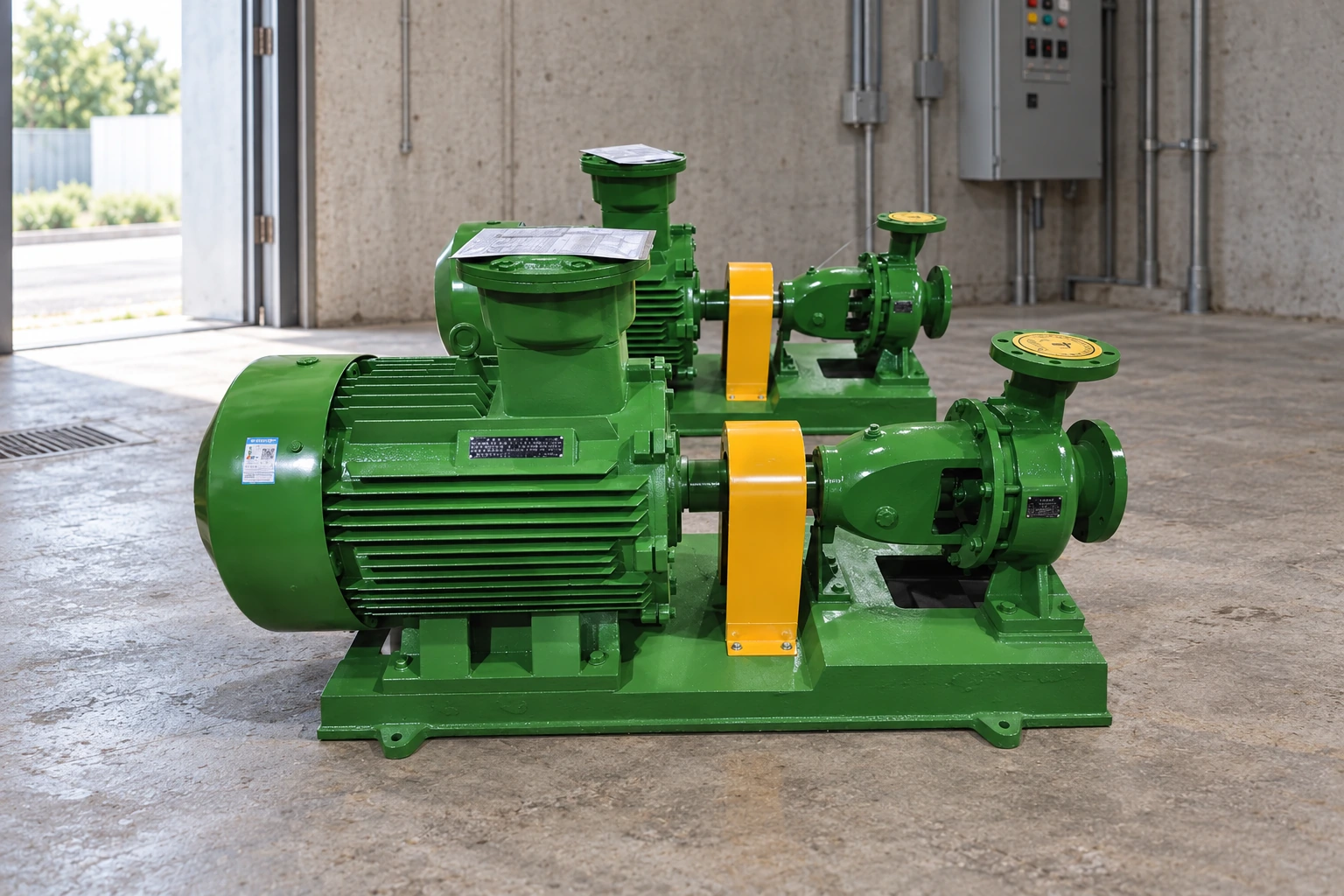
เดอะ IS clean-water centrifugal pump range is a relevant product starting point for a clean-water pump inquiry. Its product photograph identifies the pump family; it does not show a damaged casing or establish the construction of every supplied unit. Send the actual model, serial number and available component drawings with any replacement request.
Include the marked photographs, inspection report, material identification, liquid conditions and required shutdown date. State whether you need an original replacement casing, a complete pump comparison or technical clarification. If documentation is missing, list it as an open item rather than filling the gap with an assumed material grade.
A practical inquiry distinguishes the symptom from the requested decision. “Please quote this identified casing revision and confirm the necessary interface checks” is actionable. “Please repair the crack shown in this picture” leaves the assessment, scope and responsibility uncertain. Clear records make supplier responses easier to compare and reduce repeated clarification during an outage.
Educational background: cyclic loading and crack growth
The Efficient Engineer’s video, Understanding Fatigue Failure and S-N Curves, explains how cyclic stress can produce crack growth. It is useful background when reviewing an inspection report that discusses fatigue. It does not diagnose this casing or provide allowable defect dimensions, and its general examples cannot replace an engineering assessment of the actual casting and service history.

คำถามที่มักถูกถาม
Does a leaking pump always have a cracked casing?
No. A flange, casing joint, drain or shaft seal can leak and wet another area. Identify the source safely and record the exact component before defining the inspection scope.
Can dye penetrant tell me the full crack depth?
A surface indication does not by itself establish crack depth. Ask the qualified examiner what the selected method can reveal and what further examination is required for the engineering decision.
Can a cracked cast casing always be welded?
No universal approval is possible. Material, geometry, damage extent, service conditions and the available qualified repair process all affect whether repair is acceptable or replacement is required.
Is a leak-free pressure test enough to release the pump?
A test result must be considered with the approved repair procedure, examination and dimensional records. It does not independently prove that the cause was corrected or that all acceptance requirements were met.
What should I send with a replacement casing request?
Provide the pump serial number, original casing identification, drawing revision, material record, interface details and inspection findings. Include operating conditions and clearly identify any missing information.