A self-priming pump for muddy water must be selected from the liquid and solids duty, not from the word “self-priming” alone. First define design flow and head, source level, suction lift, particle size distribution, concentration, hardness, shape, and whether fibers or debris are present. Then confirm that the exact pump model can pass those solids, that its casing and impeller materials tolerate expected wear, and that the suction and discharge pipes keep solids moving without excessive loss. A self-priming dirt pump may suit intermittent drainage with modest solids, while a dense abrasive slurry may need a different pump class altogether. Never infer an allowable solids size or wear life from a photograph or product category label.
Describe the water before selecting a pump
“Muddy water” can mean fine silt in irrigation runoff, sand from an excavation, clay in a sump, or mixed grit and organic material. These have different effects on a pump. Collect representative samples at the beginning, middle, and end of a pumping event. Note particle size and shape, settling rate, solids concentration, density, temperature, pH, and whether long fibers, stones, or trash can enter. A brief clear-water sample from the surface may miss the abrasive layer at the bottom.
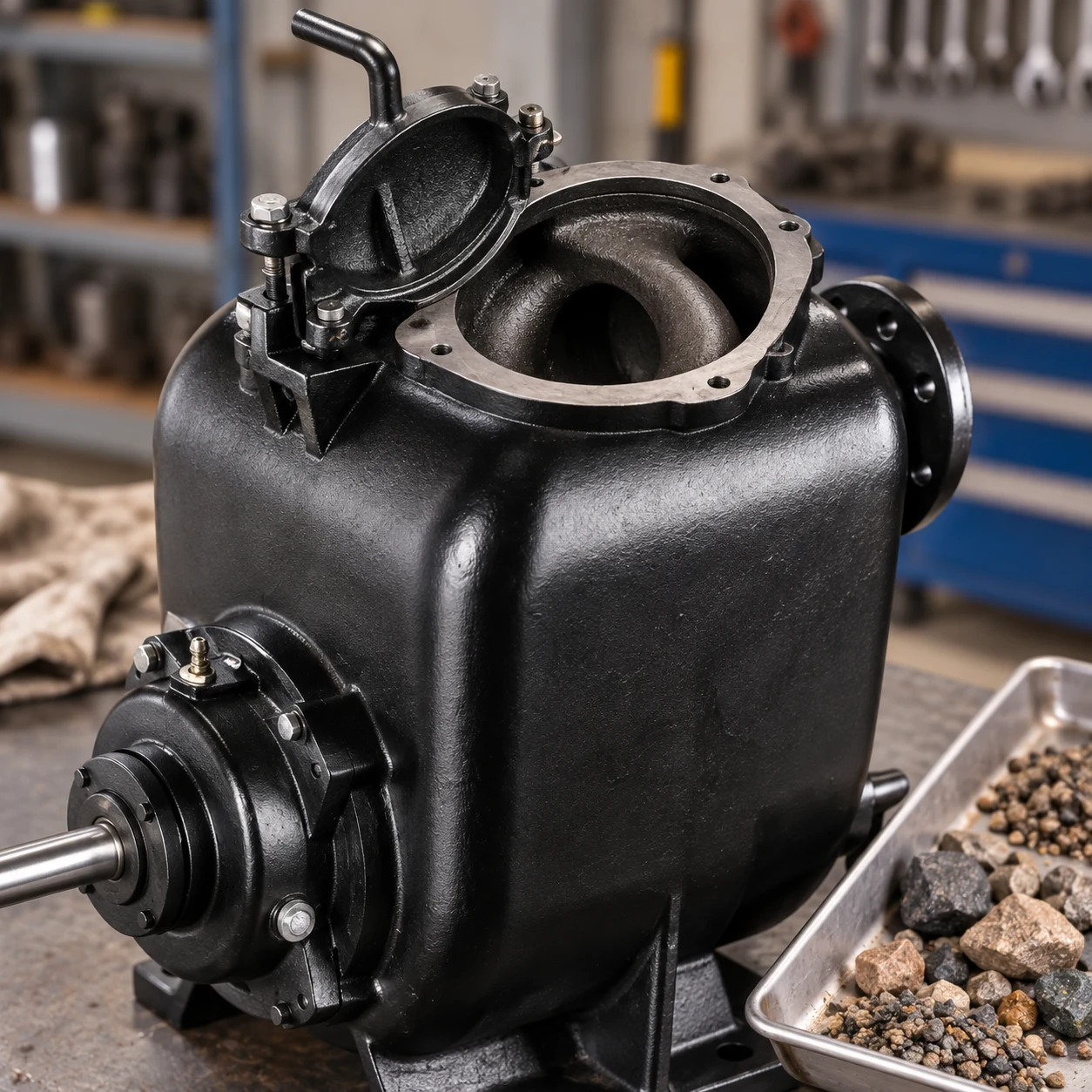
เดอะ BorraPumps SP self-priming dirt-drain pump is the site product reference. Its library image shows a bare-shaft dark pump casing, not an assembled motor or verified solids passage. Ask for the selected model’s impeller arrangement, maximum solids size, material options, seal arrangement, and performance curve. The broader drain-pump range may provide a better alternative for a specific site. Treat the product image as identification, not a performance certificate.
Separate a dirt-water duty from a true slurry duty
A liquid carrying occasional small particles is not automatically equivalent to an abrasive, high-concentration slurry. As solids concentration increases, mixture density, viscosity behavior, pipeline friction, settling tendency, and wear can change. A clean-water curve may not predict the same duty in a slurry. The Hydraulic Institute’s slurry pump standard overview explicitly addresses pumps transporting solid-liquid mixtures and the possibility of shortened life from abrasive service.
For a site with substantial sand or gravel, ask the supplier whether the SP model is genuinely suitable or whether a purpose-designed slurry or trash pump is needed. Do not use a fine strainer to force an unsuitable pump to handle abrasive water if the strainer will clog and starve the suction. Conversely, a large solids-handling pump may be inefficient or difficult to prime for mostly clean water. Define the worst expected material and the duration of exposure.
Check solids passage and blockage risk
The limiting passage may be the impeller, volute, suction hose, foot valve, check valve, elbow, or discharge connector. A pump advertised to pass a certain particle does not guarantee that an undersized hose or valve will pass it. Verify the complete path at the same particle size and shape. Fibers can bridge an opening even when their individual thickness is small. Round grit and sharp stones of the same size do not cause the same wear.
Locate the intake above the heaviest settled layer when the duty allows, but keep adequate submergence to avoid pulling air. A screened intake can reject large debris, yet too fine a screen increases loss and needs frequent cleaning. Provide a safe access route for clearing a blockage. The self-priming check-valve selection guide explains how an external valve can become a restriction or fail to seat when grit is present.
Estimate the required hydraulic duty with solids in mind
Specify flow at the receiving point and calculate static lift, suction and discharge friction, bends, valves, and any elevation changes. The pump must meet the operating point after all losses, at the lowest source level and realistic pipe condition. Do not choose a larger pump merely because the water looks muddy; oversizing can increase wear, recirculation, and starts. The exact curve may need correction for mixture properties, and the supplier should identify the assumptions used.
Review suction lift carefully. A self-priming casing can clear air during start-up only within its approved arrangement. Sediment in the casing, a leaking joint, or a long air-filled hose can lengthen priming. After prime, an inadequate suction margin can cause cavitation and more wear. The suction pipe sizing guide shows how pipe diameter and route affect both priming air volume and running loss.
| Duty characteristic | ทำไมจึงสำคัญ | Evidence to obtain |
|---|---|---|
| Largest and typical particle size | Limits passage through pump and valves | Screen or sample analysis, model solids rating |
| Solids concentration | Changes mixture behavior and wear | Representative sample over the duty cycle |
| Particle hardness and shape | Affects erosion of impeller and casing | Material description and wear history |
| Fibers and trash | Can wrap or bridge clearances | Source survey and intake plan |
| Required flow and head | Determines operating point and speed | Full system calculation and pump curve |
| Suction lift and source level | Controls priming and cavitation margin | Lowest level, pipe route and maker limit |
| Run hours and interruptions | Affects lifecycle wear and restart reliability | Operating schedule and maintenance plan |
The table is a specification checklist. No numerical solids rating is assumed for the BorraPumps product until the exact configuration is confirmed.
Understand wear mechanisms
Abrasive particles can erode the impeller, volute, casing, wear surfaces, and seal chamber. Higher local velocity often increases wear, but lowering speed without checking the system can allow solids to settle in the pipe. Hard, angular particles can cause more severe cutting than rounded material. Corrosion can compound mechanical wear when the liquid chemistry is aggressive. A seal damaged by grit or dry running may leak before a dramatic loss of pump head appears.
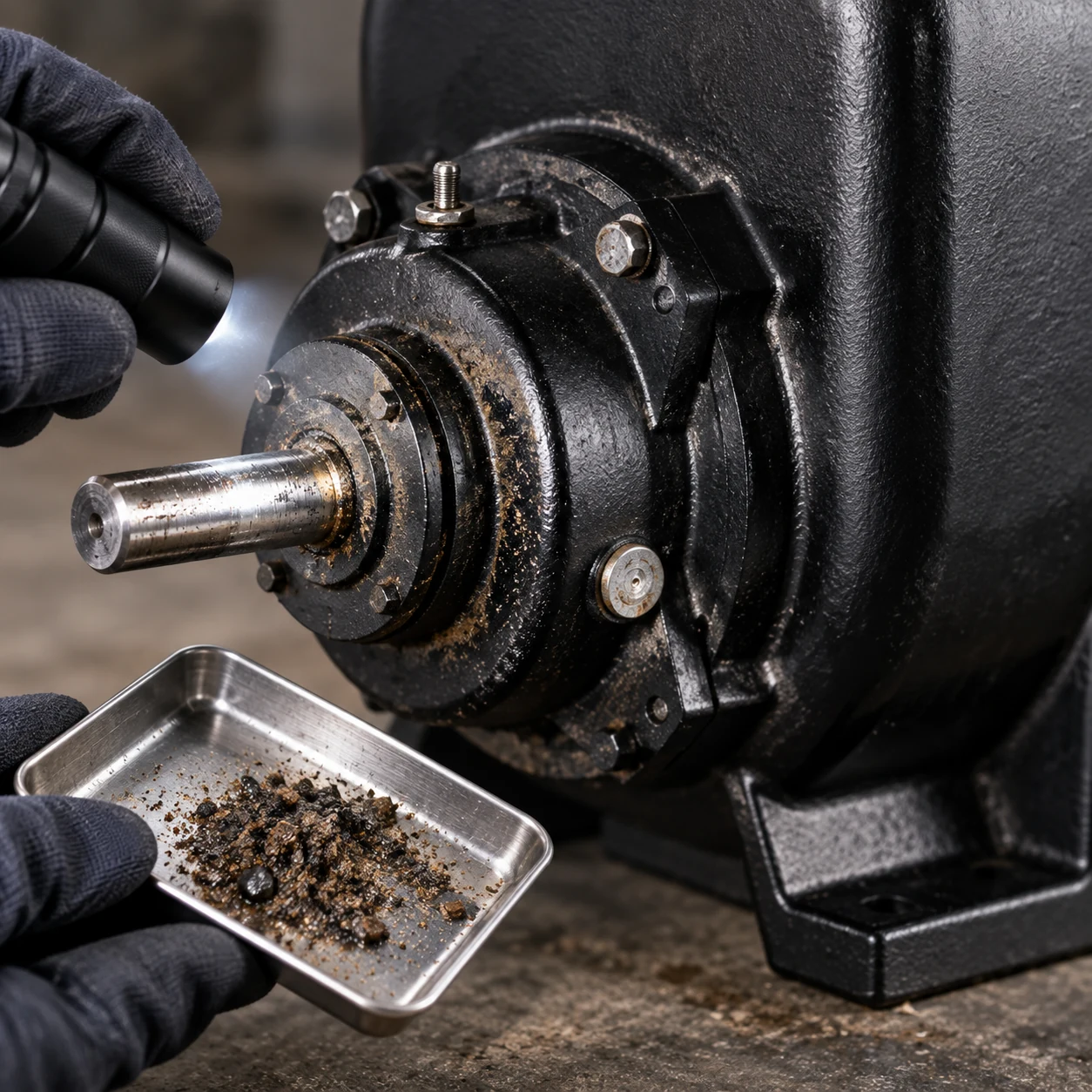
The Hydraulic Institute’s engineering data library includes slurry and solids references for assessing concentration and transport. The US Department of Energy pumping-system sourcebook discusses how wear changes clearances and performance. Apply those principles to the selected model and liquid; do not promise a universal material or replacement interval.
Choose materials and seals for the real mixture
Ask for the casing, impeller, wear plate, shaft sleeve, seal faces, elastomers, and fasteners in the quoted configuration. A corrosion-resistant alloy does not automatically resist sand abrasion, and a hard wear component may be vulnerable to impact or the actual chemistry. Material selection is a tradeoff informed by particle hardness, concentration, temperature, corrosion, and cost. Ask for serviceable wear parts when the duty is known to be abrasive.
Confirm whether the seal can be protected from solids and how it is flushed or cooled, if applicable. Do not invent a seal-flush plan for a model without one. The spare-part and inspection plan should reflect how quickly performance may deteriorate. Keep a baseline for flow, head, power, vibration, and leakage so wear can be detected before a sudden failure.
Design the intake and discharge route
The source may contain floating trash, settled grit, and changing water levels. Choose an intake location that avoids both surface air and excessive bottom sediment. Keep the suction line airtight and short enough for the pump’s priming capability. A hose rated for positive pressure may collapse under suction. Elbows, valves, and reducers should pass the expected material and remain accessible for cleaning. Avoid pockets where heavy solids settle when flow stops.
On the discharge side, check whether the selected velocity keeps solids in motion for the actual mixture; the minimum transport condition is not a single value for every mud. A long discharge line may need flushing before shutdown. Provide a safe location for expelled slurry and meet the site’s sediment-control requirements. These downstream needs can decide the pump duty as much as the suction lift.
Commission and monitor
Commission first with the actual liquid or a representative safe test, not only clean water. Record source level, flow, suction and discharge pressure, motor input, priming time, noise, vibration, and any sediment accumulation. Inspect for leakage and rapid wear after an initial operating period. If the duty varies, test at both high and low solids load. Stop and diagnose a repeated loss of prime rather than allowing extended dry runs.
After service, compare the same measurements with the baseline. A falling flow at similar speed and head may indicate blockage or wear. Rising power with unchanged delivery may point to friction, a jam, or a different mixture. The self-priming troubleshooting guide gives the broader fault sequence. Confirm each diagnosis before changing impeller or motor size.
What to request from a supplier
Send the liquid and solids profile, sample photos or analysis, source level range, flow and head, suction and discharge layout, run hours, permitted noise and power, and maintenance access. Request confirmation of maximum particle size, expected solids concentration range, materials, seal and wear-part details, priming capability at actual lift, corrected performance for the mixture if required, and inspection intervals. If the supplier cannot verify suitability for the mud, select a different pump class rather than relying on a generic self-priming label.
คำถามที่มักถูกถาม
Can any self-priming pump handle muddy water?
No. Self-priming describes air removal during start-up. Solids passage, abrasion resistance, and seal suitability are separate requirements.
Is particle size alone enough to select the pump?
No. Concentration, hardness, shape, fibers, liquid chemistry, flow, head, and duration also affect blockage and wear.
Should I always slow the pump to reduce wear?
Not without checking the system. Slower flow may let solids settle in the pipe or move the pump outside its useful region.
Does a strainer make a clean-water pump suitable for mud?
Not necessarily. A fine strainer may clog and starve the suction, while fine abrasive particles can still pass through.
Further learning
NPTEL IIT Kharagpur’s Fluid-Solid Transport lecture explains how suspended particles behave in flowing liquid. It supports the solids-transport discussion; use the actual pump and mixture data for selection.