
Dewatering pump hose restraint must be selected for the actual hose, coupling, pressure, temperature and anchoring arrangement. A secondary restraint helps control movement after a connection failure; it does not repair a worn coupling, prevent every hose rupture, or make an unsuitable discharge assembly safe. Verify the complete hose assembly and its operating conditions before choosing a restraint by appearance or cable diameter.
This guide supports planning for temporary water-transfer and construction drainage systems. It is not an anchor-design calculation or instructions for installing an unspecified restraint. Use the hose and restraint manufacturers’ instructions and a competent site assessment. Concrete pumping, compressed air and high-pressure jetting have different hazards and requirements; do not copy their hardware or pressure limits into a water-pump system.
Define the line being assessed
Document the pump discharge connection, hose sections, reducers, valves and final discharge point. Identify which joints can separate and where a failed connection could move. Include workers, traffic, excavations, electrical equipment and public access in the assessment. A line that is normally unattended can still endanger someone approaching during a fault.
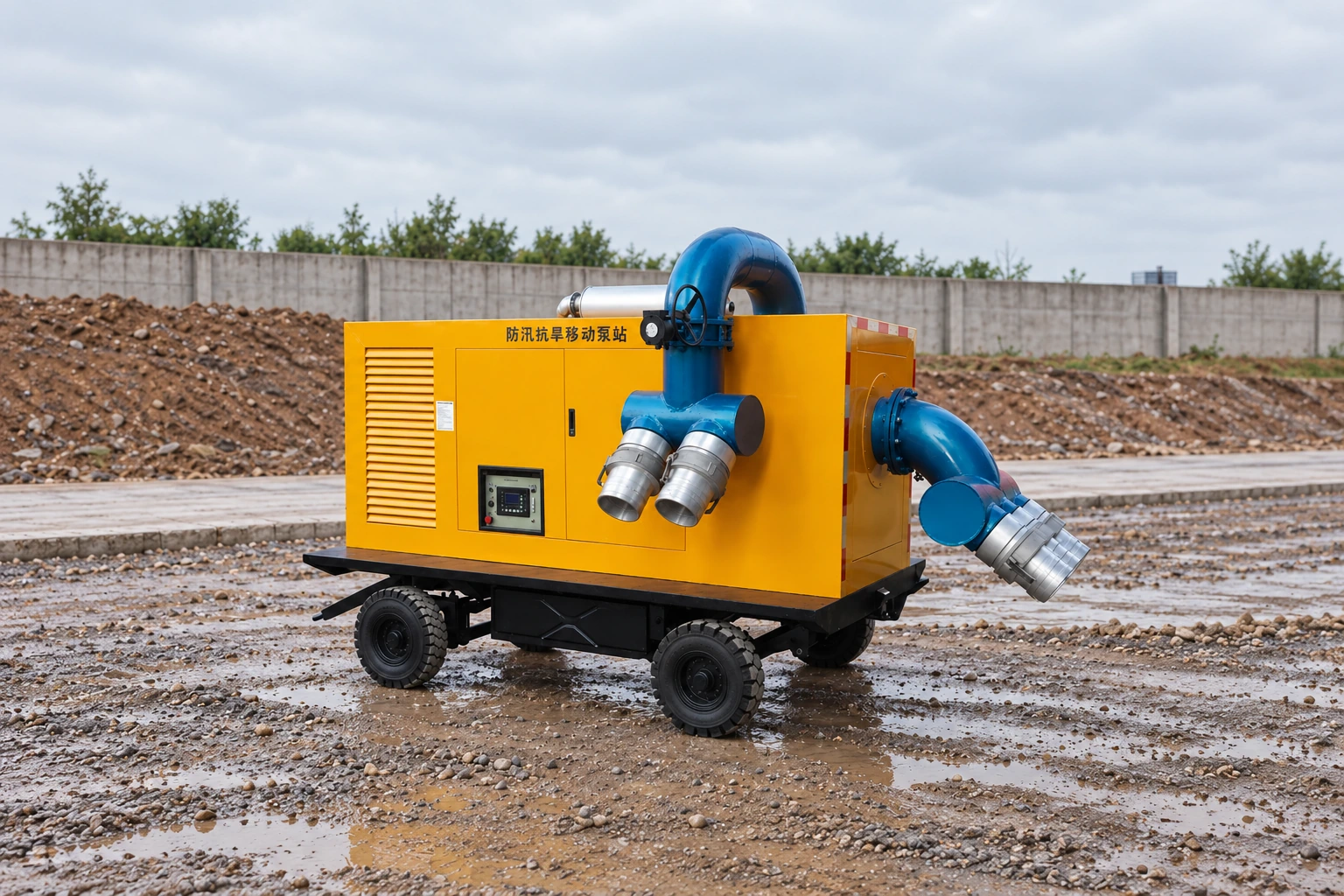
A ZBCY mobile diesel trailer pump is a relevant pumping-platform example. Its photograph does not specify a hose restraint, anchor capacity or approved hose layout. Those items depend on the actual assembly supplied and the site arrangement.
Start with the broader คู่มือการเลือกปั๊มระบายน้ำแบบรถพ่วง when coordinating the complete pumping package. Separate hose restraint from hose support and from discharge-end positioning. A support may carry the filled hose but offer no useful control if a coupling separates. A restraint may limit movement at a connection while leaving the outlet free to erode a bank. Each function needs an identified component or design detail.
Establish the maximum credible pressure condition
Normal operating pressure is not necessarily the highest pressure the assembly can encounter. Review the pump curve, source pressure, elevation profile, closed-valve conditions and potential transients. The pressure rating must apply to the complete hose assembly, including end fittings, rather than just the hose tube.
A long discharge route may retain pressure after the driver stops, especially where a check valve, elevated section or closed valve traps liquid. Stopping the engine is therefore not proof that the line is depressurized. Identify how the operator will isolate, release and verify stored pressure under the approved procedure.
เดอะ HSE pressure-testing guidance addresses stored-energy precautions in testing. Its testing context should not be presented as a universal installation standard for dewatering hoses. The transferable principle is to identify the pressure boundary, control access and use an appropriate planned method rather than expose people to an uncontrolled release.
Inspect the primary connection first
Check that mating coupling types and sizes are compatible. Similar-looking parts may have different profiles, locking arrangements or pressure ratings. Obtain identification from markings and supply records rather than assuming that parts which can be pushed together form an approved connection.
Inspect sealing faces, gaskets, locking components, pins, clamps and hose attachment. Reject or quarantine damage according to the supplier’s limits. A secondary cable must not become the justification for continuing with missing locking parts, an unknown clamp arrangement or a deteriorated hose end.
Review the assembled line for bending and pull at the coupling. Hose weight, settlement and movement can load a joint even before the pump starts. Arrange suitable support and alignment so the coupling is not used as a structural hanger. For route planning, see the separate discharge-hose layout guide.
Select restraints as engineered components
Ask the restraint supplier which hose sizes, end configurations, fluids and operating conditions the product is designed for. Confirm where and how it attaches, whether it needs a dedicated anchor and what inspection or replacement criteria apply. Product instructions should identify the installation geometry; a generic photograph is not sufficient.
Do not substitute a compressed-air whip check or an improvised chain merely because it fits around a water hose. The restraint’s capacity, engagement and termination details must match the application. A device intended to limit separation between two hose ends may not be suitable for anchoring a hose to a fixed structure.
IMCA’s hose-restraint guidance identifies restraint types, anchoring and coupling as separate considerations. It is marine-industry guidance, so confirm its relevance rather than treating it as certification of a construction-site assembly. The responsible designer and product supplier must resolve application-specific questions.
Check the entire restraint load path
The load path includes the hose contact point, restraint body, end fittings, connecting hardware, anchor and supporting structure. The arrangement is only as dependable as its weakest part. An apparently substantial cable attached to an unsuitable guard or temporary railing does not provide an assessed anchor.
Locate attachments according to the manufacturer’s instructions. Avoid sharp edges, heat, abrasion and an arrangement in which the restraint can slip off the hose end. Confirm that ordinary hose movement will not damage the restraint before it is ever needed. Document the final installation so routine inspections can identify a changed attachment.
Do not estimate anchor adequacy from a photograph or the size of a nearby object. Where calculations are required, the competent designer needs the relevant load case, geometry and component capacities. No single pressure-times-area calculation proves the full dynamic response of a separating hose assembly.
Use a site inspection table
| รายการ | Evidence to check | Action if uncertain |
|---|---|---|
| Hose assembly identity | Hose and end-fitting specification, service history | Obtain records or replace with a traceable assembly |
| Coupling compatibility | Matching type, size, rating and locking parts | Stop assembly and confirm with supplier |
| Pressure condition | Pump curve, elevation, valves and transient review | cURL Too many subrequests by single Worker invocation. To configure this limit, refer to https://developers.cloudflare.com/workers/wrangler/configuration/#limits |
| cURL Too many subrequests by single Worker invocation. To configure this limit, refer to https://developers.cloudflare.com/workers/wrangler/configuration/#limits | cURL Too many subrequests by single Worker invocation. To configure this limit, refer to https://developers.cloudflare.com/workers/wrangler/configuration/#limits | cURL Too many subrequests by single Worker invocation. To configure this limit, refer to https://developers.cloudflare.com/workers/wrangler/configuration/#limits |
| cURL Too many subrequests by single Worker invocation. To configure this limit, refer to https://developers.cloudflare.com/workers/wrangler/configuration/#limits | cURL Too many subrequests by single Worker invocation. To configure this limit, refer to https://developers.cloudflare.com/workers/wrangler/configuration/#limits | cURL Too many subrequests by single Worker invocation. To configure this limit, refer to https://developers.cloudflare.com/workers/wrangler/configuration/#limits |
| cURL Too many subrequests by single Worker invocation. To configure this limit, refer to https://developers.cloudflare.com/workers/wrangler/configuration/#limits | cURL Too many subrequests by single Worker invocation. To configure this limit, refer to https://developers.cloudflare.com/workers/wrangler/configuration/#limits | Correct the outlet arrangement before startup |
| Pressure release | Defined isolation, draining and verification points | Do not loosen a coupling to find out |
This is an assessment checklist, not a pass certificate. Record the actual product identifiers and the person resolving each uncertain item. A tick beside an unidentified cable does not demonstrate suitability, even if an earlier crew used the same arrangement without incident.
Plan startup and observation
Establish a controlled area around exposed connections and the discharge end. Agree the communication method and emergency stop responsibilities. Operators should be able to stop pumping promptly without entering the potential movement path of a failed connection.
Start and load the system according to the supplied pump procedure. Observe from a safe position for leaks, unexpected hose movement, support settlement and outlet erosion. Do not approach a leaking joint to tighten it while pressurized. Shut down, isolate and verify a safe condition before corrective work.
Record the operating pressure and flow where practical. An unexpected change can indicate a blocked outlet, changed elevation condition or line damage. The trailer-pump hose-sizing guide addresses the hydraulic consequences of hose diameter and length; restraint selection is a separate equipment-safety task.
Control shutdown and disconnection
Stop the pump through the approved sequence and isolate energy sources before work. Account for the water column, backflow and sections that may remain trapped. Use designated release points and verify pressure as required by the site procedure. Do not rely solely on a gauge that may be isolated, damaged or installed elsewhere.
Contain drainage so that released water does not undermine the trailer, flood an excavation or expose workers to contaminated liquid. Open couplings only after the responsible person confirms the safe condition. Maintain the exclusion area during draining and handling because heavy water-filled hoses can still move or fall.
IMCA’s sewage-transfer incident report illustrates the importance of appropriate connections and communication. The fluid and setting differ from clean-water dewatering, but the lesson supports planning the entire transfer operation rather than inspecting hardware alone.
Maintain records through relocation
Inspect after relocation, coupling replacement, unusual movement, pressure events or environmental damage. Temporary systems change frequently, so an assessment from yesterday may no longer describe today’s route. Record which hose sections and restraints moved and recheck the affected load paths.
Quarantine questionable components with clear identification. Do not return damaged fittings to a shared equipment pile where another crew may use them. Keep replacement parts compatible with the approved assembly, and update the record when a different coupling or restraint is introduced.
For a supplier inquiry, provide the pump curve, maximum assessed pressure, hose type and dimensions, coupling details, fluid, route and proposed anchor arrangement. Ask for documented suitability and installation instructions. This information is more useful than requesting a generic safety cable by nominal hose size.
Further learning: hose materials
The NPTEL rubber-products lecture below provides materials background relevant to flexible hose construction. It does not rate any hose assembly or restraint. Use the actual hose manufacturer’s service limits and inspection instructions for the installation.

คำถามที่มักถูกถาม
Does a restraint make a damaged coupling acceptable?
No. The primary connection must be suitable, complete and in serviceable condition. A secondary restraint is additional protection and must never be used to justify operating an assembly with missing locking parts or known damage.
Can an air-hose whip check be used on a water hose?
Only if its manufacturer confirms suitability for the exact water-hose assembly and conditions. Matching the nominal hose diameter is insufficient. Pressure, attachment geometry, end configuration and the intended load path also matter.
Is a trailer frame always a suitable anchor?
No. The anchor and its supporting structure need assessment for the intended load case. Attaching to a guard, handle or convenient frame member without evidence of capacity does not establish a dependable restraint arrangement.
Is the line safe to disconnect when the engine stops?
Not necessarily. Elevation, valves and trapped water can retain pressure. Follow the approved isolation and pressure-release procedure and verify the condition before opening a coupling. Do not use loosening the joint as the verification method.
What changes require another check?
Recheck after relocation, altered hose length, different fittings, changed outlet elevation, pressure events or visible damage. Temporary systems need records that match their current configuration, including the actual restraints and anchors in use.