
A sewage pump drawdown test estimates pump output from a measured change in wet-well volume over time. When wastewater continues entering the wet well, the pump removes both the observed stored volume and the incoming flow. Therefore, pump output equals the net drawdown rate plus the estimated inflow rate. Ignoring inflow understates the output; subtracting a positive inflow rate gives the wrong result.
This guide explains a field calculation and the evidence needed to trust it. It is intended for trained wastewater operators and engineers. It does not authorize wet-well entry, uncontrolled level changes or bypassing protective controls. Use the station’s approved procedure, maintain service continuity and keep the test within the pump’s permitted operating range.
Decide what the test can establish
A drawdown test measures output at the conditions prevailing during that test. It can reveal a change from an earlier baseline or help cross-check a flow meter. It does not independently measure hydraulic efficiency, guarantee the entire pump curve, or prove that a replacement pump is correctly sized.
Identify the pump, impeller configuration, speed, valve arrangement and discharge destination. A changed downstream level or another station discharging into a shared main can alter the result. Record these conditions before attributing a lower rate to wear or blockage.
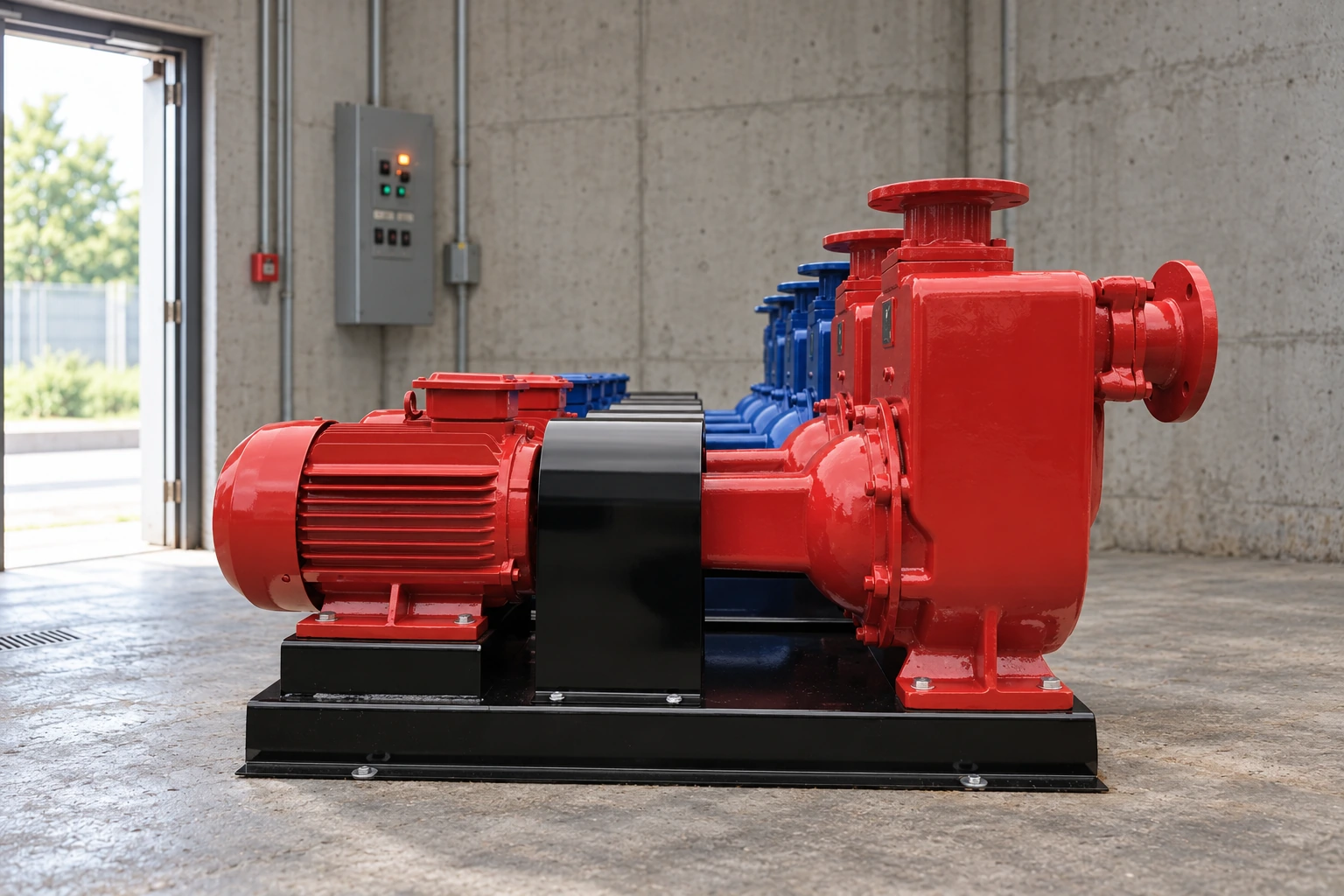
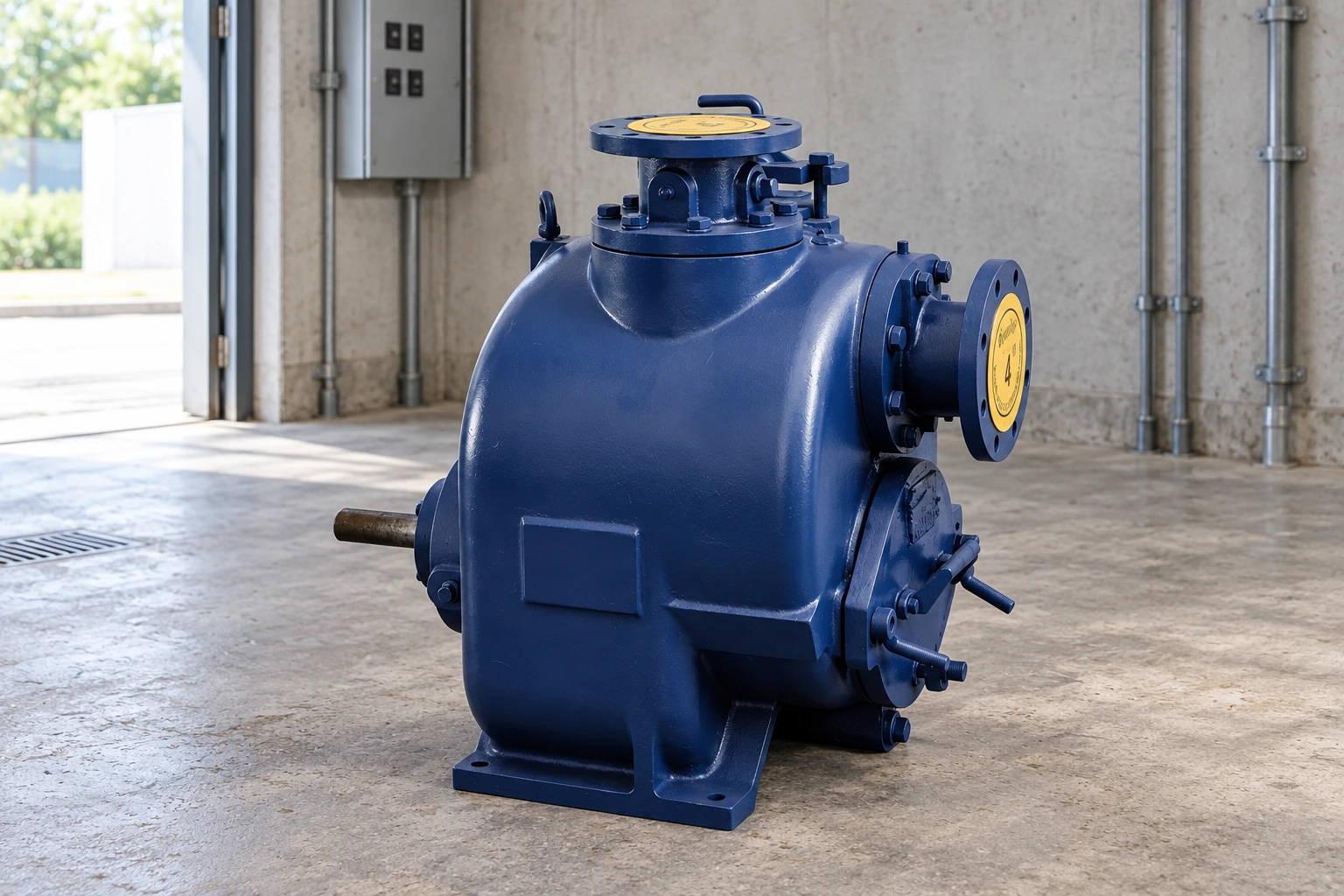
For an existing ปั๊มบำบัดน้ำเสีย WQ submersible, use its supplied curve and station documents when interpreting output. The test does not establish solids passage, motor rating or construction from a product photograph. Those details require the actual equipment schedule.
Establish a safe observation method
Measure from outside the wet well using an approved level instrument and a fixed reference. Opening access covers can introduce fall and atmospheric hazards even when no entry is intended. Apply the site’s barriers, gas precautions and rescue arrangements appropriate to the work. Never enter or lean into a wet well to improve a reading.
Plan the available storage and allowable level band. The test must not cause upstream surcharge, overflow, operation below required submergence, or loss of essential standby protection. Arrange observation of the incoming system and identify who can stop the test. Uncontrolled rainfall or a rapidly changing inflow may make the chosen window unsuitable.
Use the station’s approved manual or test mode, with qualified personnel controlling pump operation. Restore automatic control afterward. Do not defeat alarms or low-level protection merely to obtain a longer timing interval. If the volume band is too small to measure reliably, use a different approved flow-measurement method.
Measure effective wet-well volume
For a vertical cylindrical section with internal diameter D and a measured level change h, the changed volume is V = πD²h/4. For a rectangular section, V = LWh. Use consistent length units. If dimensions are metres, volume is cubic metres; multiply by 1,000 to obtain litres.
These equations assume constant usable cross-sectional area through the observed band. Benching, sloping walls, pipes, platforms and other displaced volume can invalidate a simple cylinder calculation. Use a surveyed level-volume relationship when geometry changes. Nominal outside diameter is not the same as usable internal diameter.
Confirm the direction of the level reading. A depth measured downward from the cover increases as the liquid falls, while a level above the floor decreases. Label the datum and units on the sheet. Reversed signs can produce a plausible-looking but incorrect spreadsheet result.
เดอะ Ontario sewage-pumping design guidance places flow measurement in its wider station-design context. The Minnesota wastewater operator workbook provides additional calibration exercises. Use these as calculation references, while applying your own approved station procedure.
Calculate inflow and net drawdown separately
With the tested pump stopped under a controlled procedure, measure the time for the level to rise through a known volume band. Estimated inflow is Q_in = V_fill / t_fill. The observation should represent the inflow during the pump-on test; a distant measurement during a different demand period is a weak correction.
Next measure the time for the running pump to lower the level through a known volume. The net stored-volume removal rate is Q_net = V_drop / t_drop. If inflow remains approximately constant, estimated pump output is Q_pump = Q_net + Q_in.
If another pump operates, the simple result no longer belongs to the tested pump alone. Either prevent that condition through the approved test arrangement or record and analyze the combined output. Test each machine separately before interpreting a combined duty-assist run. Two pumps in parallel rarely produce exactly twice the single-pump output in the same main.
Worked example with consistent units
Suppose a straight cylindrical wet well has an internal diameter of 2.0 m. The measured band is 0.40 m high. The volume is π × 2.0² × 0.40 / 4 = 1.257 m³, or approximately 1,257 L. These are illustrative dimensions, not a recommended station design.
A controlled refill through that band takes 300 seconds. Estimated inflow is 1,257 / 300 = 4.19 L/s. A pump-on drawdown through the same band takes 100 seconds, so net drawdown is 1,257 / 100 = 12.57 L/s. Estimated pump output is 12.57 + 4.19 = 16.76 L/s.
| ปริมาณ | Illustrative observation | การคำนวณ |
|---|---|---|
| Effective band volume | Diameter 2.0 m; height 0.40 m | 1,257 L |
| Refill rate | Band fills in 300 s | 4.19 L/s incoming |
| Net drawdown rate | Band drops in 100 s | 12.57 L/s removed from storage |
| Corrected pump output | Inflow remains representative | 16.76 L/s |
| Equivalent hourly output | Same calculated operating condition | About 60.3 m³/h |
The example follows a volume balance, not a manufacturer rating. Adding the estimated incoming flow follows directly from conservation of the measured wet-well volume. Do not turn the result into a percentage efficiency by dividing it by a nominal flow and calling that hydraulic efficiency.
Reduce uncertainty before diagnosing the pump
A short test magnifies timing error. If an operator starts a stopwatch late, a few seconds can materially change a small-volume result. Use clearly defined level marks, synchronized records and instruments appropriate to the expected accuracy. Record actual times instead of rounding every run to convenient values.
Repeat comparable observations and investigate inconsistent results. Check level-sensor lag, turbulence, incoming surges, non-return valve leakage and changing discharge conditions. A visible wave near the inlet is not necessarily the average wet-well surface. If possible, use an approved instrument location that avoids local disturbance.
Do not average away a known invalid run. Mark the cause, preserve the raw observation and repeat after conditions stabilize. A clean table of averaged values is less useful than an honest record explaining which run was disturbed by another pump starting or an upstream discharge arriving.
Compare results at the same operating condition
Compare current output with a baseline only when speed, wet-well levels, valve positions and discharge conditions are reasonably comparable. A higher static lift or increased common-main pressure can lower flow without new internal damage. The pump system curve guide explains this interaction.
If output has declined under comparable conditions, inspect the appropriate branches: obstruction, changed rotation after electrical work, worn hydraulic components, valve restriction and measurement error. Refer ragging concerns to the sewage-pump clogging guide, rather than assuming every low result requires a larger machine.
Use the approved pump curve with pressure and level information to assess the duty point. For replacement selection, combine the measured evidence with peak inflow, storage, solids handling and system-head requirements. The คู่มือการกำหนดขนาดปั๊มน้ำเสียแบบจุ่ม addresses that separate design task.
Record the test and return the station to service
Keep internal dimensions or the level-volume table, instrument details, timing data, inflow observations, pump speed and the full calculation. Record uncertainty and any limitations. Name the operator and reviewer so that a later technician can ask about the conditions rather than guessing from a final number.
Restore automatic operation and verify the intended lead, assist and standby arrangement. Confirm that alarms, level controls, access covers and isolation valves are in their approved operating state. Record the restoration time. A successful calculation does not complete the job if a pump remains unintentionally in hand mode.
When requesting engineering support, send the raw level and timing data with the curve and operating conditions. An isolated statement that a pump delivers a certain flow is insufficient for selecting an impeller or deciding whether a machine has deteriorated. Good records reduce unnecessary dismantling and improve replacement decisions.
Further learning: what determines pump output
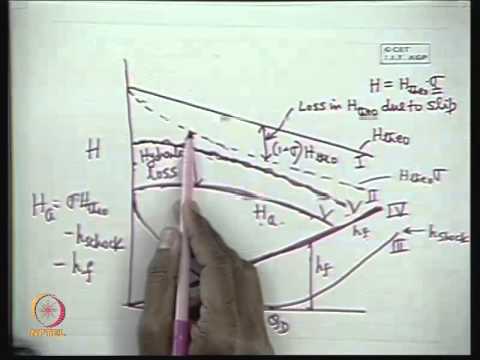
The following NPTEL lecture explains centrifugal-pump characteristics. It helps place a measured drawdown result on a hydraulic performance curve. It does not replace operator training, confined-space procedures or the station-specific test method.
คำถามที่มักถูกถาม
Do I add or subtract incoming flow?
ให้นำอัตราการไหลเข้าที่เป็นบวกไปบวกกับอัตราการลดลงของปริมาตรสุทธิที่กักเก็บไว้ ปั๊มจะต้องสูบน้ำเสียที่ไหลเข้ามาระหว่างการทดสอบออกด้วย รวมถึงปริมาตรน้ำที่ลดลงตามระดับน้ำที่ลดลงด้วย ต้องใช้เครื่องหมายและหน่วยให้สอดคล้องกัน.
Is the wet-well diameter enough for the calculation?
Only if the test band is a straight cylindrical section with a known internal diameter and no significant volume displacement. Benching, tapering walls and internal structures may require a measured level-volume table instead.
Does a drawdown test measure pump efficiency?
It estimates output at the observed operating condition. Hydraulic or overall efficiency also requires suitable head and power measurements. A ratio of measured flow to rated flow is not a complete efficiency calculation.
Can I test two pumps together?
Yes, under an approved station procedure, but record the result as combined output. Test individual machines as well. Shared discharge resistance means combined output should not automatically be divided equally between the two pumps.
What makes a previous test unsuitable for comparison?
Different speed, discharge pressure, wet-well level range, valve positions, inflow behavior or measurement geometry can change the result. Reconstruct those conditions before concluding that a difference proves pump wear or selecting replacement equipment.