
A diesel fire pump that fails to crank receives a start demand but its engine does not rotate. Investigate the starting demand, controller state, battery supply paths, connections and starter system using the installed engine and controller documents. Distinguish complete silence from clicking, slow rotation and normal cranking without firing; these observations lead to different investigations. Treat unavailable fire protection through the site’s impairment procedure and involve qualified service personnel. Do not bridge starter terminals, defeat interlocks or keep repeating start attempts without an approved diagnostic plan.
Define what failed before ordering parts
This guide addresses an electrically started diesel fire pump that does not turn over on demand. An engine that rotates normally but never fires needs a different fuel, engine-management or combustion investigation. An engine that starts and then stops also has a different event boundary. Avoid describing every unsuccessful start simply as a bad battery.
Write the observed sequence in plain terms: demand present, controller indication, sound heard, shaft rotation observed from a safe location, and alarm generated. Record the time between events if the monitoring system provides it. Do not remove guards to watch the coupling or stand near moving parts during a start attempt.
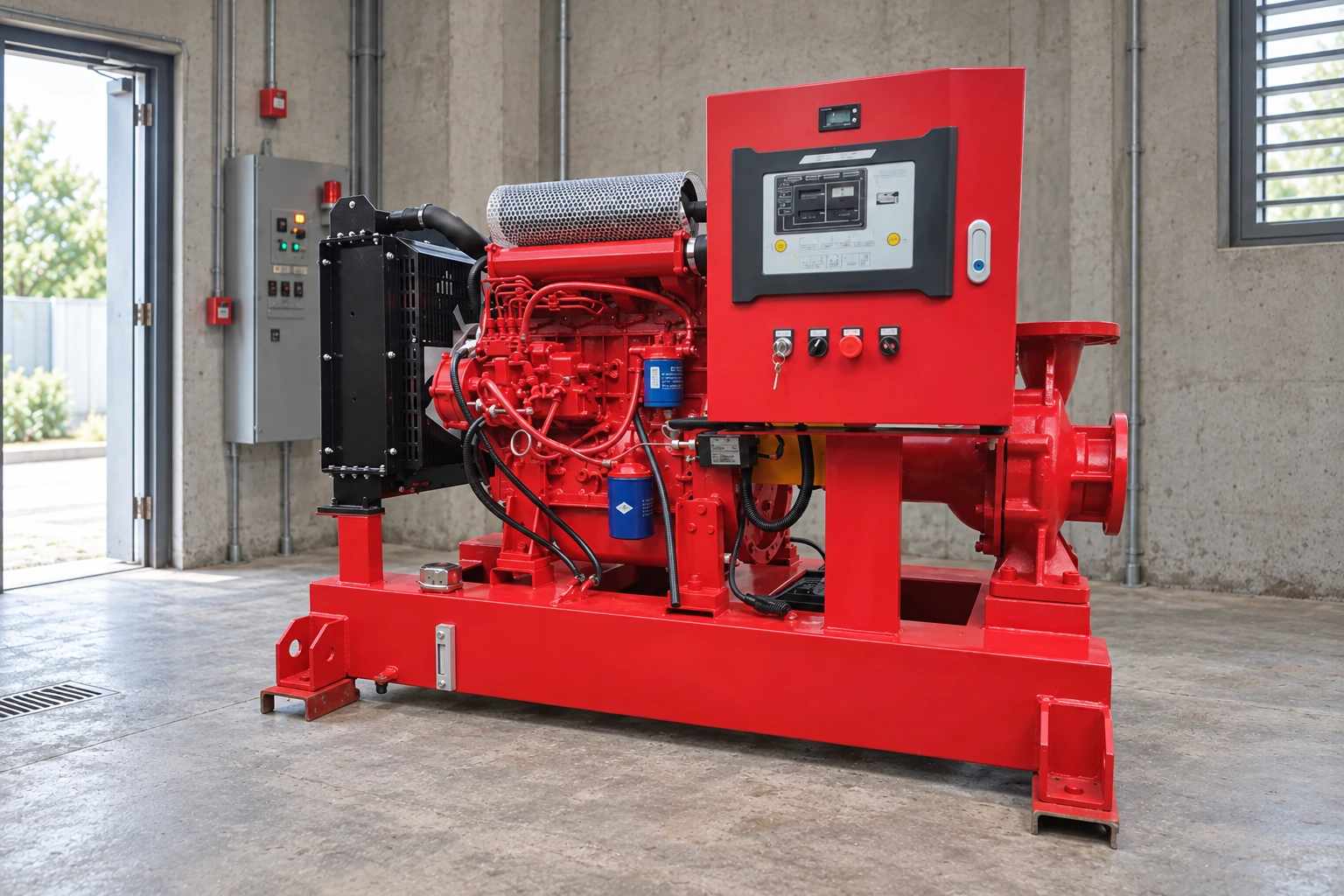
Borra’s XBC dizel motorlu yangın pompası establishes the relevant product category. Obtain the actual engine model, controller identification and approved wiring documents for the installation. Photographs of another set cannot confirm battery voltage, starter architecture, terminal assignments or fault-reset logic for the installed equipment.
Manage the unavailable protection first
Notify the responsible fire-protection manager and apply the site’s impairment arrangements. Establish who can authorize testing and how alternative protection, notifications and restoration will be managed. A fault investigation should not silently leave a building believing that automatic fire-pump service remains available.
Collect the last successful test record and note any battery replacement, controller work, engine servicing or extended shutdown since that test. Check whether the event happened during a planned test or a genuine demand. Retain the original controller history before acknowledging alarms, because later attempts may obscure which condition occurred first.
The City of Mobile’s fire pump acceptance inspection checklist illustrates the importance of approved plans, controller arrangements and documented diesel starting-system checks. It is a local acceptance document, not a universal maintenance schedule or a substitute for the authority responsible for this site. Apply the actual adopted requirements.
Confirm that a valid demand reached the controller
Identify how the start demand was generated and whether the controller recorded it. Review mode selection, supply indications, engine fault indications and any authorized local controls. Do not assume that a pressure change elsewhere in the building reached the installed sensing connection or met the approved start logic.
A technician should compare the event with the controller’s documented sequence. Where more than one starting battery path is provided, record which path was called and how the controller indicated it. Do not impose a generic alternation order or crank duration taken from an unrelated controller manual.
Check for unresolved engine conditions that the installed system documents as affecting restart. A previous overspeed event, for example, needs the appropriate engine-specific review rather than a casual reset. Preserve the evidence and use the separate diesel fire pump overspeed alarm guide when that condition is part of the event history.
Use observations to narrow the starting path
| Observed behavior during an authorized attempt | Investigation boundary | Talep edilecek kanıt |
|---|---|---|
| No demand appears in the event history | Demand generation or signal path | Approved cause-and-effect description and sensing records |
| Demand is recorded but there is no rotation or starter sound | Control output, connection or starting supply | Controller sequence and qualified electrical assessment |
| Repeated clicking occurs without rotation | Starting supply or switching path may be inadequate | Battery-path and connection tests under the approved procedure |
| Engine rotates unusually slowly | Available cranking performance or mechanical resistance | Engine-specific starting tests and condition history |
| Engine rotates normally but does not fire | Outside the no-crank boundary | Engine specialist’s fuel and combustion investigation |
| One documented starting path works and another does not | Difference between the separate paths | Individually identified batteries, cables and switching components |
The table identifies what to investigate, not what to replace. Similar sounds can arise from different electrical or mechanical conditions. A recorded demand also does not prove that the complete power path to the starter was healthy.
Assess batteries as separate identified components
Record each battery’s identification, type, rated information, installation date where known and visible external condition. Note corrosion, damaged cable insulation, loose restraints or evidence of leakage without touching suspect connections. Damaged or leaking batteries require the appropriate battery-handling procedure and protective equipment.
Resting voltage and a charger indication are limited observations. They do not demonstrate that the battery and connections can deliver the required starting performance. Qualified personnel should use the engine and battery manufacturer’s specified checks, instruments and acceptance criteria. Avoid a universal voltage-drop limit, test duration or replacement age borrowed from another application.
İstediğiniz değeri seçin diesel fire pump battery-sizing guide when a replacement specification needs review. A capacity or rating decision is separate from diagnosing a failed path. Replacing a battery without investigating the charging and connection conditions can leave the cause unresolved and the new component exposed to the same problem.
Examine cables, switching and starter condition safely
The starting circuit includes both the outgoing and return paths. An apparently clean positive connection does not establish that the return connection is sound. Compare the actual routing with the approved diagram and keep the identity of each battery path clear throughout the investigation.
High-current starting circuits can cause severe burns, sparks and fire if shorted. Electrical isolation also needs to account for automatic starting and any independent supplies. The HSE’s Electrical safety and you supports competent electrical work and appropriate precautions; the engine and controller documents define the equipment-specific method.
A qualified technician may need to assess connections, switching outputs and starter performance under controlled conditions. Do not provide an improvised jumper path to see whether the engine turns. If a mechanical obstruction or internal engine problem is suspected, stop repeated attempts and refer the engine to the appropriate specialist before further damage occurs.
Review charger faults without confusing the symptom
A previous charger alarm may explain depleted starting capability, but it does not prove which component is defective now. Compare charger history, battery condition and the start-event record. A recently restored AC supply may clear one indication while leaving a battery unable to meet the specified starting requirement.
Mevcut battery charger failure guide addresses charger-side evidence. Keep the current investigation centered on why engine rotation did not occur. A successful charger repair and a successful starting-system verification are related but separate acceptance records.
If a battery replacement is necessary, verify the approved specification, polarity, cable arrangement and compatibility with the installed charging system. Follow the specified connection and isolation sequence. Retain removed-part identification and test evidence so the work record supports the decision rather than merely listing parts supplied.
Plan a controlled restoration test
Agree the restoration sequence before reconnecting equipment or clearing a fault. Confirm that tools and temporary connections have been removed, guards and covers are restored, and all people are clear. Identify the person controlling the test and the person observing the required indications.
Test the functions required by the installed design and applicable procedure. Where separate starting paths exist, verify them as specified rather than treating one successful start as proof of all paths. Record whether the engine cranked, started, reached the expected operating state and produced the required local and remote indications.
Do not invent an overcrank simulation or disconnect a starter based on a generic web article. Such tests can require a specific manufacturer procedure to avoid starter damage. Clearly distinguish a simulated alarm test from evidence that the actual engine can start from the required supply path.
Video: understand the engine sequence
Thomas Schwenke’s neutral diesel-engine animation explains the difference between initial engine rotation and the combustion cycle that sustains running. It is an educational aid, not a fire-controller wiring or emergency-start tutorial. The installed engine manual remains the source for permitted starting procedures, and a no-crank diagnosis must be complete without relying on the animation.
Sık sorulan sorular
Sessizlik her zaman marş motorunun arızalandığı anlamına mı gelir?
No. The demand may not have reached the controller, a required control state may be absent, or the electrical path may be incomplete. Establish the recorded sequence before concluding that a starter needs replacement. An unexplained silent attempt still requires impairment management.
Tek bir sağlam akü sistemi kabul edilebilir hâle getirebilir mi?
Böyle olduğunu varsaymayın. Gerekli akü düzenlemesi ve marş devresinin doğrulanması, onaylı kurulumdan ve geçerli gerekliliklerden kaynaklanır. Bir devre çalışmazken diğeri çalışıyorsa arızalı devreyi kaydedin ve korumanın kullanılabilirliğini ve eski hâline getirme yükümlülüklerini belirlemesi için sorumlu ekibe başvurun.
Bakım personeli otomobiller için kullanılan bir takviye marş cihazı kullanmalı mı?
Doğaçlama bir otomotiv çalıştırma düzeneği, onaylı yangın pompası çalıştırma sisteminin yerine geçmez. Uyumluluk, akım kapasitesi, kutup yönü ve kontrol sistemi üzerindeki olası etkiler, ekipmana özel olarak değerlendirilmelidir. Belgelenmemiş bir acil durum bağlantısı eklemek yerine yetkili servis prosedürünü izleyin.
Manuel olarak başarıyla çalıştırılması, otomatik çalıştırma işlevinin yeniden sağlandığını kanıtlar mı?
Hayır. Bu yalnızca söz konusu deneme sırasında fiilen test edilen işlevlerin çalıştığını kanıtlar. Otomatik talep oluşturma, kontrol ünitesinin tepkisi, gerekli her bir çalıştırma yolu ve uzaktan gösterge işlevi için ayrıca doğrulama yapılması gerekebilir. Genel bir başarılı sonuç bildirmek yerine testin kapsamını ve sınırlarını doğru şekilde kaydedin.
What belongs in the service handover?
Orijinal olay sırasını, arıza kaydını, motor ve kontrol ünitesi kimlik bilgilerini, batarya hattı tanımlamasını, ölçüm kanıtlarını, onarılan bileşenleri, değiştirilen ayarları veya modları ve restorasyon testi sonuçlarını ekleyin. Kalan sınırlamaları açıkça belirtin ve otomatik servise dönüşü kimin onayladığını tanımlayın.
Kaynakça
- City of Mobile Fire-Rescue Department — Fire Pump Acceptance Inspection.
- UK HSE — Electrical safety and you.
Restore confidence through a complete starting record
A defensible repair explains why rotation failed and demonstrates the required starting functions after correction. Close the impairment only through the responsible site’s process. When requesting equipment support, provide the actual engine, controller and battery configuration so the response addresses the installed starting path rather than a generic diesel-pump assumption.