Select a hotel booster pump set from the hotel’s probable simultaneous water demand, pressure-zone requirements, lowest available inlet pressure, and required service continuity. Do not use guest-room count alone to choose a pump. A hotel can combine showers, kitchens, laundry, public restrooms, irrigation, and event spaces, with peaks that occur at different times. Determine which loads actually share the domestic-water booster, calculate their credible coincidence, then check the selected operating and standby pumps at the required head. The final arrangement must follow local plumbing rules and the hotel’s water-management and maintenance plans.
Map what the booster serves
Begin with a floor-by-floor water schematic. Identify guest-room risers, kitchens, laundry, banquet facilities, spa or pool areas, public restrooms, staff areas, and any leased spaces. Mark their pressure zones and whether they have dedicated tanks or separate pumps. A central hot-water recirculation pump is not automatically a domestic pressure booster; the systems may share a source but perform different jobs. Fire protection must also be evaluated separately and cannot be assumed to be covered by a domestic booster package.
The EPA’s commercial-facility water guidance treats hotels as a distinct facility type and highlights restroom and laundry use among their water end uses. That supports inventorying those loads, but it does not provide a universal hotel booster capacity. A restaurant or conference center within the same building can change the governing use period substantially. Ask the owner for occupancy and event schedules, not just the number of keys.
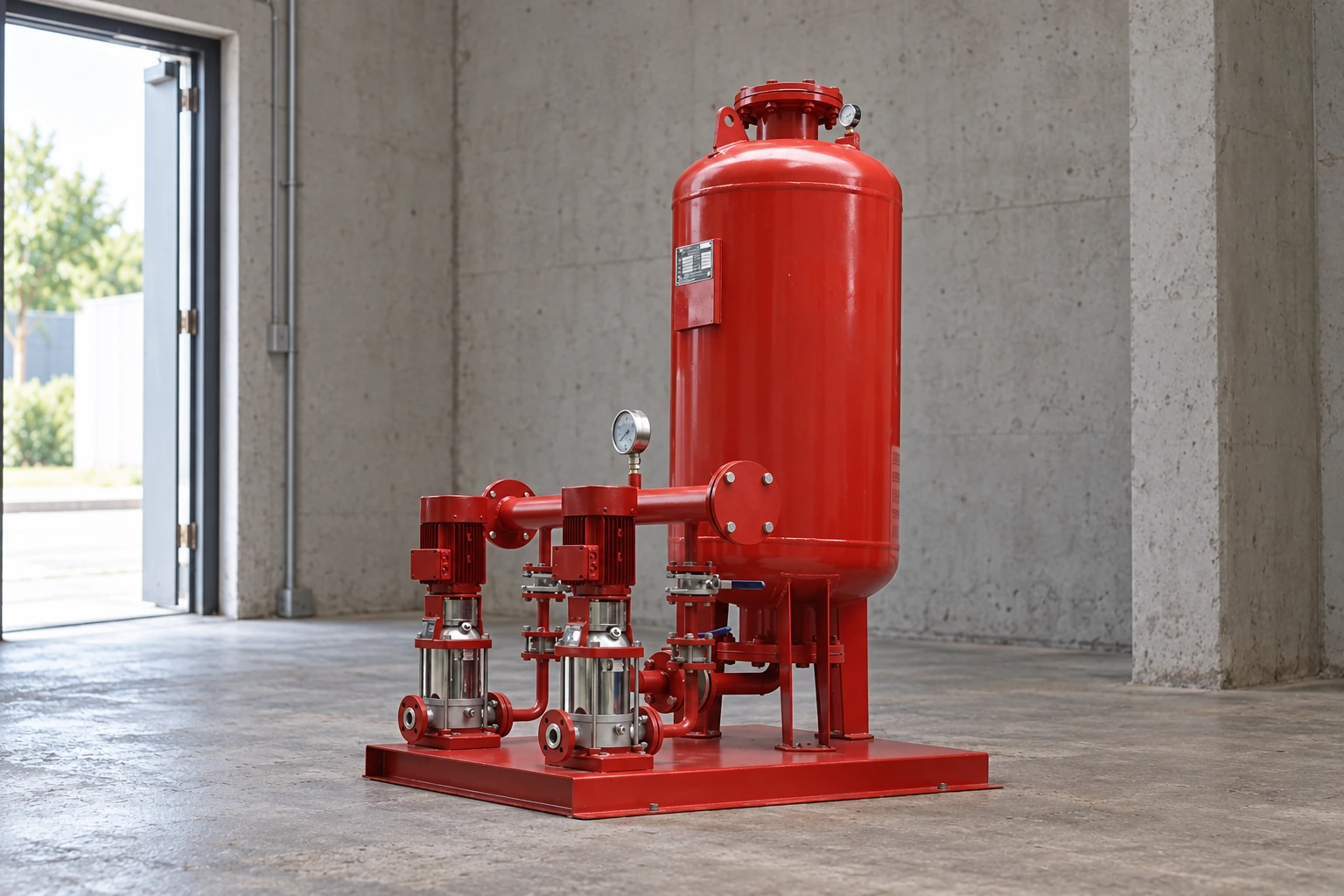
A packaged BorraPumps booster-regulator water supply set is one product type for clean-water pressure boosting after the duty is established. Its product page asks for flow, head, inlet and outlet pressure, medium, temperature, voltage, and control mode because the package must be matched to the project. Do not assume its pictured tank volume, pump quantity, or controls are universal specifications.
Estimate the realistic peak flow
Prepare a fixture schedule for every area served by the booster. Use the water-supply fixture unit or other approved demand method required by the jurisdiction to convert the domestic fixtures to probable peak flow. A fixture unit is a demand weight, not gallons per minute; use the correct conversion curve and fixture classifications for the adopted code edition. Confirm flush-valve fixtures, commercial kitchen equipment, and laundry machines against their actual specified rates and operating patterns.
For an existing hotel, measured interval consumption and pressure trends can improve the estimate, provided the measurement covers representative occupancy and event periods. Hourly or daily totals can miss short shower peaks. Look for simultaneous morning guest-room use, laundry start times, banquet preparation, kitchen cleanup, and any storage-tank refill. Ask whether controls or operating procedures genuinely prevent coincidence; a verbal assumption is weaker than an interlock or documented schedule.
The EPA WaterSense assessment worksheets can help assemble fixture inventories and consumption history. They are an audit aid, not a pump-sizing code. For a transparent load worksheet, separate the contributions shown below.
| Hotel load | Include in shared booster calculation when… | Verify before adding it |
|---|---|---|
| Guest rooms | Their cold-water risers are supplied by this set | Fixture mix and occupancy basis |
| Public toilets | They share the same pressure zone | Flush-valve classification and peak events |
| Laundry | Its equipment receives boosted domestic water | Machine fill rates and operating schedule |
| Kitchen and banquet service | They share the booster during guest peaks | Equipment data and event coincidence |
| Pool or spa fill | The fill connection uses this set | Fill-control limits and separate treatment system |
| Süsleme | The branch is connected downstream | Seasonal timing and any interlock |
Avoid adding the nameplate flow of every connected fixture as though all operate at once. Avoid the opposite mistake of using average daily liters per guest as the short-term pump flow. An engineer should reconcile approved probable-demand calculations with site evidence and separately justified special loads. The apartment booster flow guide explains this distinction for residential fixtures; do not copy its occupancy assumptions into a hotel.
Calculate pressure at the worst-served fixture
Guest comfort depends on adequate pressure during peak flow, especially at upper floors and distant branches. Determine the residual pressure required by the actual fixtures and equipment, then add static elevation and calculated friction/device losses along the controlling path. Subtract usable inlet pressure at the chosen reference point, using a low supply-pressure case. If the booster takes suction from a break tank, use the lowest normal tank level. If a city main feeds it directly, confirm that direct boosting is permitted and that backflow and low-inlet protection comply with the project requirements.
The booster pump head calculation guide gives the detailed energy balance. Do not quote a pump from “hotel height” alone; low-floor pressure limits, pipe diameters, meters, backflow devices, strainers, and pressure-reducing valves can materially alter the design. The ABD Enerji Bakanlığı pompalama sistemi kaynak kitabı treats pump head and system head as connected characteristics. The selected pump should meet the system curve at the required flow, not merely have a high advertised shutoff pressure.
Hotels with many floors often use more than one pressure zone. A single very high discharge pressure with downstream reducing valves can create avoidable losses and maintenance burden; a different zoning arrangement may be more appropriate. The designer must compare capital cost, efficiency, service access, and fixture pressure limits. A package that works for a small low-rise property may not be suitable for a tower with a roof-level spa.
Decide how the pumps share the load
Define what happens at low overnight demand, ordinary occupancy, event peaks, and pump failure. A duty/standby pair can provide full-capacity redundancy only if either individual pump can carry the defined duty by itself. A duty/assist pair may require both pumps at peak and therefore have reduced service if one fails. A three-pump arrangement can stage smaller capacity increments while leaving a spare machine, but the exact benefit depends on each curve and control sequence. See the duty and standby configuration guide for the capacity distinction.
Ask the hotel operator what level of service must survive one failed pump. “No guest notices a failure” and “essential service continues at reduced flow” are different requirements. Specify how the controller alternates lead pumps, starts assist pumps, detects failed starts, and reports alarms to staff. If variable-speed drives are proposed, check the operating range and pressure sensor location. A VFD does not remove the need to verify minimum flow, inlet adequacy, and failure response.
The Department of Energy sourcebook cited above emphasizes matching equipment and controls to the complete system. Request energy and curve information across typical operating points rather than comparing only full-load motor ratings. Hotel demand can spend many hours below the design peak, so part-load behavior matters.
Keep water quality and maintainability in view
Pressure performance is only one part of a hotel water system. Coordinate tank turnover, stored-water management, and stagnant branches with the property’s water-management program. The CDC’s building water-system guidance addresses management of complex building water systems to reduce Legionella risk. Pump selection alone does not establish microbiological safety. Do not add oversized storage merely to smooth demand without a water-quality review.
Design enough access to remove a pump, service valves, inspect a sensor, and maintain the pressure vessel. Consider noise transmission to guest rooms, flooding/drainage paths, electrical access, and the practical ability to isolate a machine without shutting the entire hotel. Ask for a clear piping and instrumentation diagram. A polished skid photograph does not prove that the installed site will have safe access or a proper floor drain.
At commissioning, trend suction and discharge pressure, flow, active-pump count, drive speed, and alarms during a high-occupancy period. Test lead/lag changeover and a failed-pump scenario. Verify the farthest fixture while a representative peak occurs. Record baseline readings so a future complaint can be distinguished from a changed utility supply, clogged strainer, or worn component.
What to include in the supplier inquiry
Send a fixture and zone schedule, design flow, required pressure at the controlling fixture or sensor, minimum and maximum inlet pressure, tank arrangement, water temperature and quality, voltage and frequency, control and alarm requirements, redundancy objective, space constraints, and destination. State whether the hotel includes laundry, kitchens, spa, or event facilities on the same set. Ask for the selected duty point, combined operating points, electrical load, and maintenance-clearance drawings.
For a mixed-use property, compare the commercial-building booster selection guide so that tenant and public-area loads are not hidden inside a guest-room rule of thumb. BorraPumps can review an inquiry against its water-supply booster product range, but an actual product recommendation requires the project data, not just the building label “hotel.”
Frequent specification errors
Common errors are multiplying rooms by one assumed gpm value, ignoring a laundry or banquet facility, adding noncoincident loads without explanation, forgetting the minimum inlet-pressure case, confusing hot-water recirculation with domestic boosting, and calling an assist pump a full standby. An undersized suction line or poorly managed tank can also defeat a pump that appears correctly sized on paper. A robust selection shows the source and destination boundaries, calculated operating point, and failure case in the same schedule.
Sık sorulan sorular
Is there a standard booster flow per hotel room?
No universal value is appropriate for final selection. Fixture mix, common areas, operating schedule, storage, and the adopted plumbing method determine probable demand.
Should laundry be included?
Include it if the laundry receives water from the same booster and can operate during the design peak. Use equipment data and a justified coincidence assumption; do not count it twice.
Are two pumps automatically enough for standby capacity?
No. Either pump must individually meet the specified duty to provide full-duty standby. If both are required for peak flow, the second is an assist pump at that condition.
Does a VFD solve low water pressure by itself?
No. The pump curves, inlet supply, required head, sensor position, and pressure-zone layout must be suitable. A VFD changes speed and control behavior; it cannot create an adequate source of water.
Gelişmiş öğrenme
NPTEL IIT Kharagpur’s pump-curve lecture helps explain why a hotel’s selected flow and head must be checked on the actual operating curve. It is general engineering education, not a hotel occupancy model.