A roof tank supplies fixtures mainly by gravity after water has been lifted to storage, while a booster pump system raises pressure when demand occurs. Neither arrangement is universally better. Compare the pressure available at the highest and lowest fixtures, the building’s peak and low-demand pattern, space and structural limits, power-outage expectations, water-quality management, maintenance access, and local plumbing rules. A roof tank can provide a limited gravity reserve during a pump outage, but it adds roof loading and stored-water responsibilities. A direct pressure booster can reduce roof equipment and keep pressure under active control, yet its service depends on the inlet source, controls, and power supply. Many buildings use a hybrid.
Define the service requirement before choosing equipment
Start with the number of pressure zones, highest fixture elevation, minimum residual pressure at the controlling fixture, allowable pressure at the lowest fixture, and expected simultaneous flow. Include the loss through meters, backflow devices, strainers, valves, and distribution piping. The multi-story booster head guide explains why elevation and friction must be added to the outlet requirement and why available inlet pressure must be treated consistently.
State the outage requirement separately. Does the owner need potable water for a short power interruption, reduced service for several hours, or simply safe shutdown until utility power returns? A roof tank offers only the usable volume above the outlet and below the overflow, at a pressure set by water level and elevation. It is not an indefinite reserve. A booster set with standby pumps can tolerate one pump failure, but common electrical or inlet failures remain. The iki pompa karşı üç pompa kılavuzu helps turn a vague redundancy request into a testable duty case.
How a roof tank supplies pressure
Water is pumped or otherwise delivered to an elevated tank. The elevation difference between the tank water surface and a fixture creates static pressure. Available pressure changes as the tank level falls and as flow loss increases. Upper floors may see modest pressure, while lower floors can see too much pressure if the elevation difference is large. Pressure zones and reducing valves may still be necessary. The designer should check both high and low tank levels at peak flow, not only the full-tank static condition.
The tank requires a structural support and a secure route for filling, overflowing, draining, cleaning, inspecting, and sampling. Account for the full water weight and maintenance loads rather than assuming an existing roof can carry it. Provide protection against freezing or excessive heat as appropriate to the climate. Define the low-level alarm and the response if the fill pump fails. A tank with inaccessible fittings can be expensive to maintain even when its pump energy is acceptable.
Water storage also affects hygiene. The CDC’s potable-water systems guidance recommends appropriately sized storage and regular maintenance as part of a water-management program. Its building-water program overview emphasizes identifying hazards and reviewing controls. The exact health controls and sampling plan depend on the building, jurisdiction, and owner.
How a pressure booster supplies pressure
A booster draws from an approved water source and raises pressure as needed. A sensor, controller, pressure vessel, and staged or variable-speed pumps may be used to keep a target pressure. The actual configuration must be confirmed from the supplied package; it should not be inferred from a product photograph. The BorraPumps booster-regulator water-supply equipment illustrates a relevant packaged route, while the water-supply booster product range helps identify alternatives for project review.
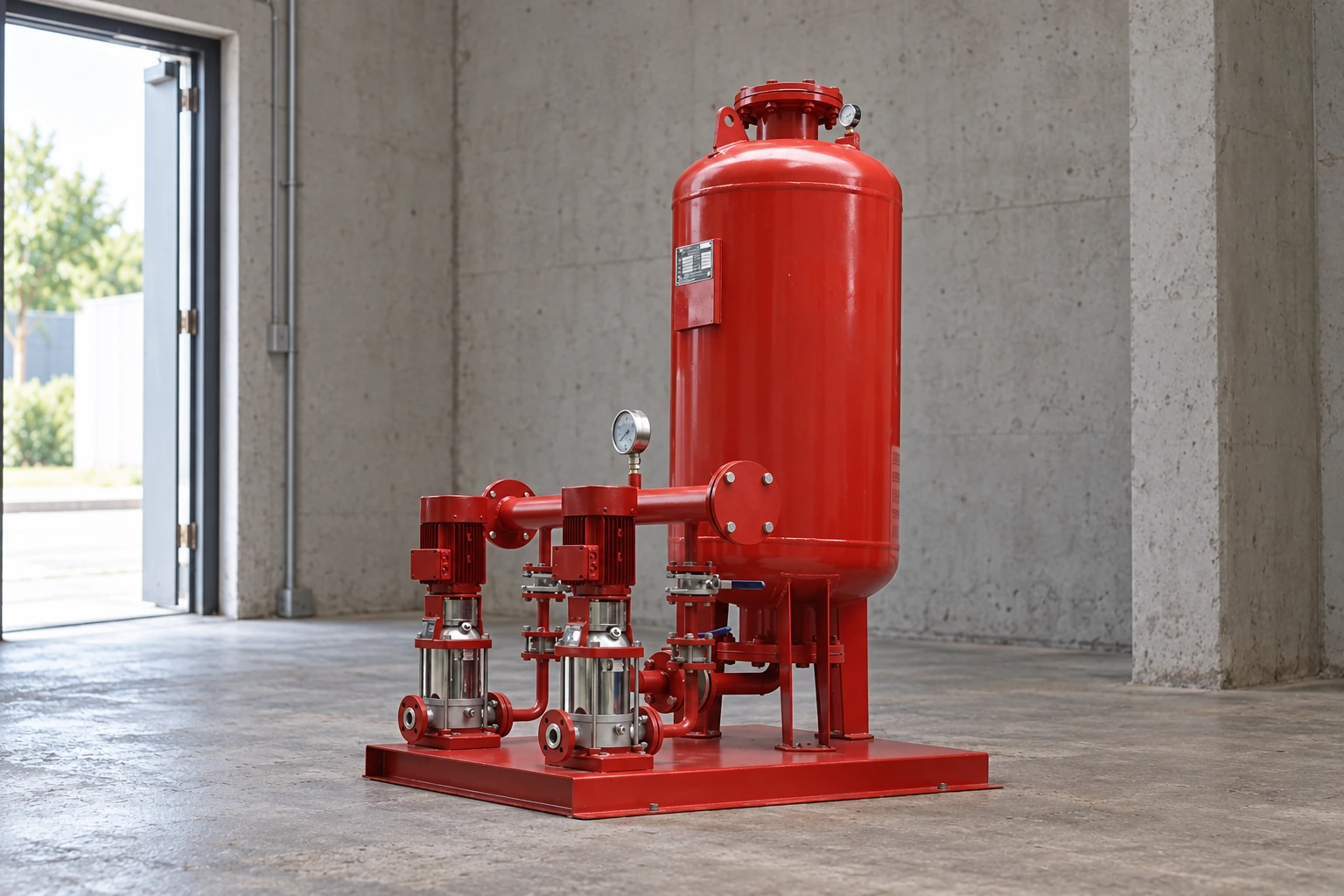
An active booster can adjust to changing demand and may avoid a large roof tank. It still needs a reliable inlet. If it draws directly from a public main, obtain utility permission, acceptable residual pressure, and required backflow protection. If it draws from a break tank, that tank’s usable storage and hygiene remain part of the design. A pressure vessel can buffer small demands, but it is not equivalent to a large emergency water reserve.
Controls should limit high pressure at low flow and avoid repeated starts. A second pump should join only when the lead pump cannot maintain the target, and the sequence should respond safely to sensor failure, low inlet, overpressure, and power loss. The pressure sensor placement guide explains why the sensed point must represent the service objective rather than merely a convenient pipe location.
Compare the arrangements at the same duty
| Karar faktörü | Roof-tank route | Pressure-booster route | Project check |
|---|---|---|---|
| Pressure source | Gravity head varies with water level | Pump differential head varies with demand and control | Lowest and highest fixtures at worst conditions |
| Outage service | Limited by usable stored volume and gravity pressure | Depends on backup power, source, and control resilience | Written duration and minimum service definition |
| Structure and space | Roof load, access, drainage, screening | Plant-room footprint, pipework, electrical clearance | Structural and maintenance drawings |
| Water quality | Requires storage hygiene and monitoring | Direct route may avoid tank; break-tank route does not | Building water-management plan |
| Bakım | Tank inspection plus fill pump and controls | Pumps, sensors, valves, vessel, and drives | Access and spare-part strategy |
| Pressure zoning | Often needs reducing or supplementary boosting | Can be divided into controlled zones | Maximum pressure on lower floors |
This table is a decision framework rather than a numerical claim. The US Department of Energy’s Pompalama sistemi kaynak kitabı shows why operating points across the demand range affect energy and maintenance. The final comparison must use each design’s real pump curves, tank levels, control sequence, and local requirements.
Check pressure at both ends of the building
For a roof tank, calculate gravity head from the lowest operating water surface to the highest fixture and subtract pipe and device loss at peak flow. Then calculate the highest pressure at a low fixture when the tank is full and little water is moving. These two cases often drive different protective measures. A tall building may need multiple tanks, zones, or a small upper-floor booster; a single tank does not automatically provide a suitable pressure range everywhere.
For a booster system, calculate the discharge setpoint that satisfies the remote critical point at peak flow. Then confirm what happens at low flow, high inlet pressure, and the lowest floor. If a single header serves several elevations, pressure-reducing valves or separate zones may be required. Do not simply increase the setpoint until the top floor is satisfied; lower floors may exceed fixture ratings. Record the values and verify with gauges during commissioning.
Compare energy over a duty cycle
Both routes use energy to lift water. A roof-tank fill pump may run in longer batches, perhaps at a more stable operating point, but it may also lift all water higher than the fixtures actually need. A booster can match pressure and flow more closely with staging or speed control, but oversizing or throttling can waste energy. The installed system curve, static lift, pressure zones, and hourly demand matter more than a label such as “gravity” or “constant pressure.”
Prepare an hourly or representative duty profile. For each route, estimate the pump operating point, hours at that point, motor input, and any bypass or throttling losses. Include standby consumption where material. The DOE pump-systems resources provide a neutral starting point for assessing system performance. The comparison should also include tank cleaning, valve service, pressure-reducing devices, and replacement access rather than electricity alone.
Plan for faults and maintenance
For a roof tank, test high-level shutoff, low-level alarm, overflow, fill-pump failure, blocked or leaking outlet, and maintenance isolation. Decide what the building receives while the tank is drained for cleaning. If there is a bypass, document its backflow and pressure implications. A full tank may mask a failing fill pump until the level drops, so alarm routing and response time matter.
For a booster, test one pump out of service, low inlet pressure, a failed pressure sensor, power restoration, stuck check valve, and pressure-vessel isolation. Record the control sequence and actual duty points. A standby pump is not useful if one common controller or closed suction valve disables the whole package. Maintain a safe access route around both the pump set and electrical equipment.
When a hybrid makes sense
Some buildings retain a ground or roof storage tank for a defined reserve, then use boosters for pressure zones that gravity cannot serve well. Others use a tank-fed booster to separate the public main while avoiding a large roof load. A hybrid is justified only when each element has a specific function. Adding a tank and pumps without a clear outage, pressure, or regulatory need increases cost and maintenance.
Define where water enters, where it is stored, where pressure is added, and what happens at each failure boundary. Mark pressure zones on the riser diagram. Verify the water-age and turnover assumptions against the actual demand profile; an oversized reserve can make hygiene management harder. Confirm the scheme with plumbing, structural, electrical, and water-quality specialists before choosing product sizes.
Send a complete supplier brief
Give the supplier the design and low-flow duties, highest and lowest fixture elevations, required residual pressures, available inlet pressure, water source and quality, acceptable outage service, room or roof dimensions, electrical supply, and zoning concept. For a roof-tank route, specify minimum/maximum operating level and structural constraints. For a booster route, specify sensor location, staging, vessel intent, required standby duty, and inlet protection. Ask for curves, control narrative, dimensional drawings, and service clearances. Compare options against the same boundary assumptions.
Sık sorulan sorular
Does a roof tank remove the need for a pump?
Usually water must still be lifted to the tank unless the source is already above it. Gravity then supplies downstream pressure within the limits of tank level and elevation.
Can a booster provide water during a power outage?
Only if its power and water source remain available, or if a separate backup arrangement is provided. A pressure vessel alone is not a large reserve.
Is a roof tank automatically better for a tall building?
No. High and low floor pressures, roof structure, water quality, maintenance access, and zoning must be checked. A hybrid or multiple zones may be preferable.
Which arrangement is easier to maintain?
It depends on access and equipment. A tank needs inspection and cleaning; a booster needs pump, valve, sensor, vessel, and control service. Compare the complete maintenance route.
Gelişmiş öğrenme
The NPTEL IIT Kharagpur lecture on centrifugal-pump characteristics helps explain the pump operating point used when comparing the two hydraulic routes. It is educational background, not a design approval.