Select a tunnel dewatering pump from the water-control plan, not from a headline maximum flow. Identify groundwater seepage, drilling and wash water, storm or shaft inflow, the lowest sump level, the route to the permitted outlet, sediment and debris, and the time available before water blocks access or creates a hazard. Then check the pump curve at the required flow and total head, its solids capability, electrical or engine arrangement, installation access, monitoring and standby duty. A submersible unit can keep a local low point drained, while a surface pump or groundwater-control system may be needed elsewhere. The exact arrangement must suit the tunnel method, depth, ventilation, power distribution and emergency plan.
Define the tunnel water-control boundary
Map the face, shafts, cross passages, drainage channels, sumps, treatment area and discharge outlet. Separate routine seepage from construction water and exceptional events. A pump that keeps a small working sump clear is not necessarily capable of lowering groundwater outside the tunnel lining. Where drawdown or pressure relief is required, the geotechnical design determines whether wells, wellpoints, grouting, drainage or a combination is appropriate. Do not use a single sump-pump calculation as a substitute for ground-control analysis.
OSHA’s underground construction standard addresses access, communications, flood-control instruction, ventilation and electrical safety in underground work. Its applicability depends on the project and jurisdiction; the responsible site team must establish the actual requirements. The pump specification should state which water levels threaten workers, equipment or escape routes and how much response time exists after a failure.
Choose a product that matches the duty
The BorraPumps WQ submersible sewage pump for dewatering is a real product reference for a local tunnel sump. Its library image shows a blue ribbed vertical body, a lower volute, lifting eye and power cable. The photograph does not prove a particular flow, head, solids size, cable length, explosion rating or suitability for every tunnel atmosphere. Obtain the exact model’s documentation. The drain-pump serisi gives alternatives for different water and installation conditions.
Do not place an ordinary pump in a hazardous atmosphere on the basis of its appearance. Tunnel conditions can include dust, fumes or gases requiring specific equipment and procedures. Check the underground electrical classification and ventilation plan. Engine-driven pumps may be more suitable at a surface shaft than deep underground where exhaust and access constraints dominate. The diesel versus electric self-priming comparison explains drive logistics, but an underground decision also needs the site’s safety and ventilation review.
Calculate routine and peak inflow separately
Estimate groundwater seepage from investigation and observation, process water from the construction schedule, and surface inflow from shafts or portals using the site drainage plan. Do not add unrelated peak values if they cannot coincide, but do include the combinations that can occur during a storm or equipment washdown. The excavation dewatering flow calculation guide explains a time-based inflow and sump-storage balance. For a tunnel, the available storage is limited by the actual channel and sump geometry and by the level at which water obstructs access.
Monitor real inflow as tunneling advances. Rock fractures, faults, new shafts or a changed groundwater boundary can alter it abruptly. A pump selected from the first month’s water volume may not cover later reaches. Provide a process for reassessing capacity when observed inflow or sediment increases. The pumping plan should specify alarm setpoints and the number of pumps that may be unavailable while work continues.
Calculate head along the complete route
Measure elevation from the lowest sump level to the outlet or treatment tank, then add loss through discharge pipe, hose, bends, valves, check valves and treatment equipment at the required flow. Long tunnel runs can make friction important even when static lift is modest. A discharge line may climb a shaft and then travel over ground. The construction dewatering head guide gives the head calculation. Use one common datum and the actual route at each construction stage.
The Hydraulic Institute’s pump and system curve tutorial explains that actual flow is where the selected pump curve meets the installed system curve. A WQ model’s maximum flow at very low head is not the flow delivered at the top of a deep shaft. Request the exact curve, motor input and allowable operating range. Check start frequency as well as peak duty; an oversized pump in a small sump can cycle rapidly.
| Tunnel condition | Tasarım sorusu | Talep edilecek kanıt |
|---|---|---|
| Routine groundwater seepage | What inflow persists without construction water? | Investigation, measured level and flow trends |
| Process water | Which drills, washdown or cutting systems run together? | Shift schedule and supply rates |
| Sump and channel | How much usable volume exists below alarm level? | Dimensioned drawings and level setpoints |
| Tahliye rotası | What head is required at design flow? | Survey, pipe schedule and treatment loss |
| Sediment and debris | Can the wet end and hose pass the mixture? | Samples, model solids rating, service access |
| Power and atmosphere | Is equipment suitable for the location? | Electrical and ventilation review |
| Pump failure | How long until access or work is threatened? | Standby curve, alarm and response plan |
The table contains project inputs, not universal tunnel-pump specifications. Each site must validate its own ground and safety conditions.
Match solids and wear protection
Tunnel water may carry rock flour, sand, grout residue, cuttings or construction debris. Particle size and concentration can change with the excavation method. A label such as “sewage pump” does not guarantee tolerance of dense abrasive slurry or hard stones. Confirm the WQ model’s solids passage, impeller, seal and materials against representative samples. Use screens or settling only when they can be maintained without starving the sump. The muddy-water pump selection article explains the separate solids and wear checks; its self-priming product is a different installation type.
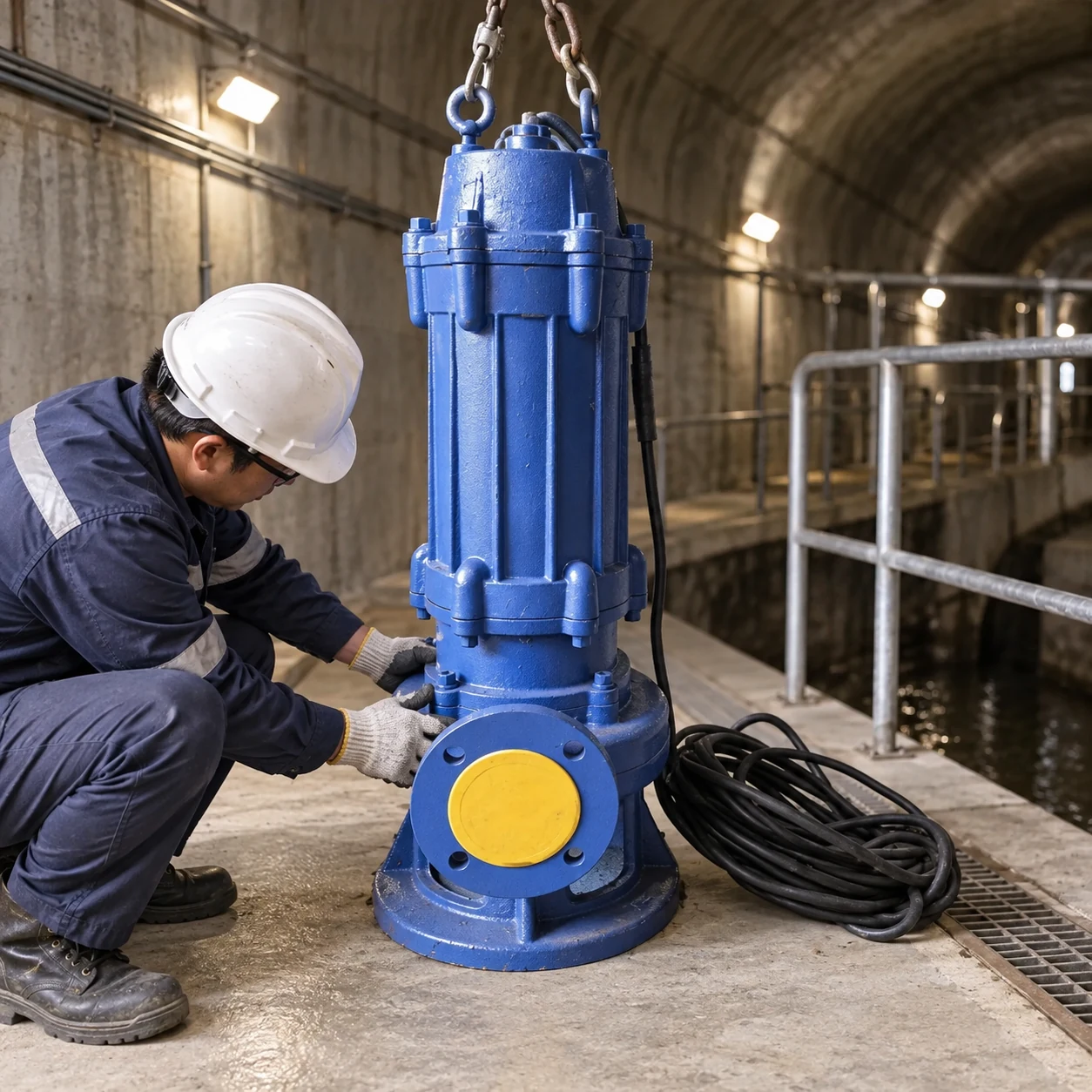
Place the sump intake where it remains submerged but does not ingest the heaviest settled material if the duty allows. Provide a safe lift route to remove the pump for cleaning. A unit that can pass particles hydraulically may still have a cable, hose or lifting arrangement unsuitable for the tunnel geometry. Keep the discharge protected from vehicle and rail movement and from abrasive contact with sharp edges.
Plan electrical and mechanical installation
For a submersible unit, route and support the power cable so it cannot be cut, crushed or submerged at a connection. The lifting eye is not a substitute for approved rigging; use the maker’s lifting instructions. Confirm the pump can be placed and removed without exposing workers to an unsafe sump. Locate control and isolation equipment where it remains accessible during a high-water event. Electrical work and any atmosphere classification belong to qualified personnel.
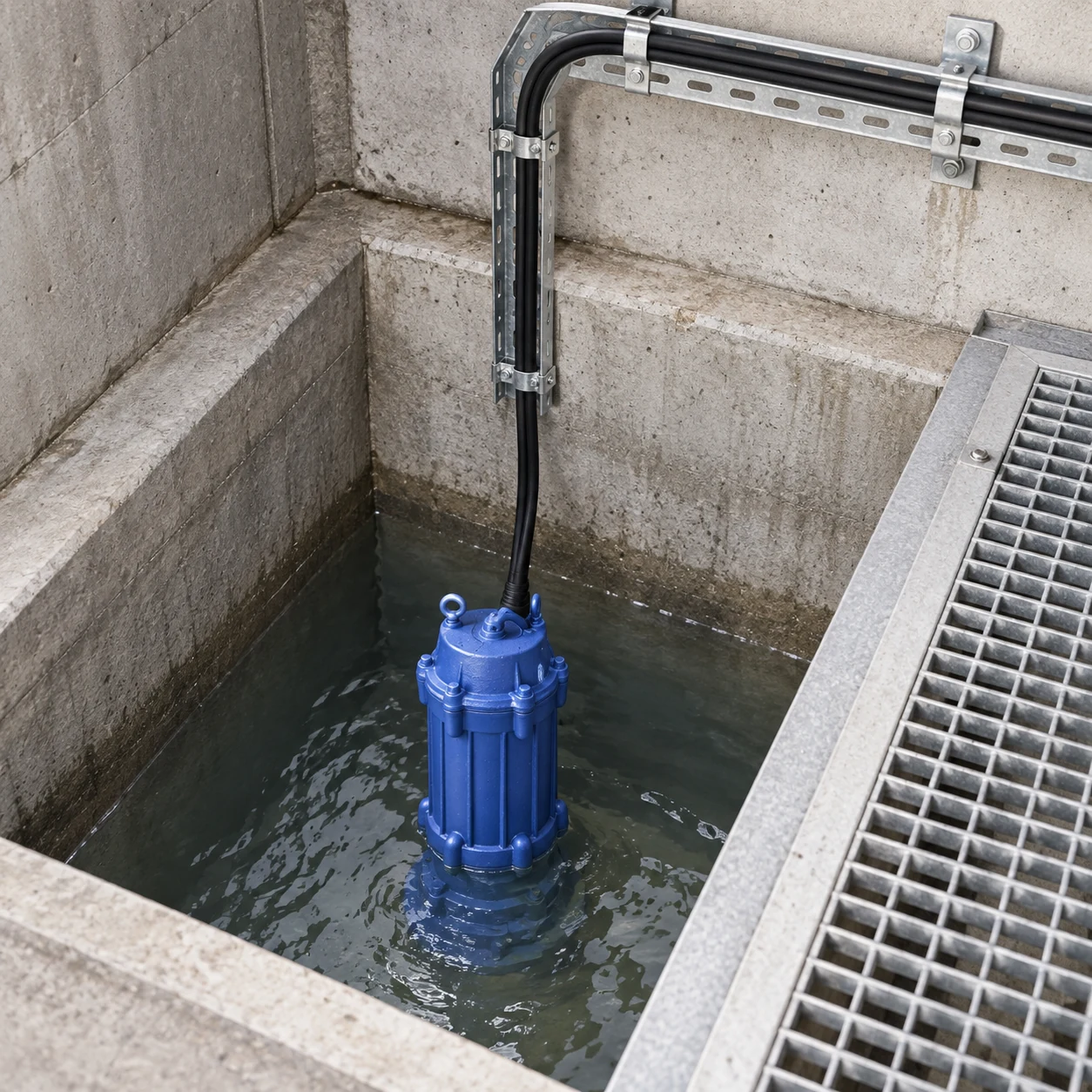
OSHA’s underground construction requirements include keeping power lines insulated or away from water lines and other conductive systems. Do not convert that general rule into a claim that any specific WQ pump has a certified underground rating. Verify the supplied unit, cable and protection as a package. The pump should also have low-water protection so it does not run dry, and a high-water alarm that reaches someone able to respond.
Provide resilience appropriate to consequence
A small working sump may tolerate a brief interruption; a shaft or face with rapid inflow may not. Define the failure case in minutes and water level. If one pump is unavailable, can another pump maintain the required level at the actual head? Are suction intake, discharge header, power feed and controls shared points of failure? A standby unit sitting dry on a shelf is useful only if it can be installed before the available storage is consumed.
Test automatic alternation, power failure, sensor failure and high-level alarms where they are part of the plan. Record a safe evacuation and shutdown response for water inflow beyond the design envelope. These are operational requirements, not features inferred from a product photo.
Confirm discharge and environmental controls
Tunnel dewatering water may contain suspended solids or other constituents that require treatment before discharge. The US EPA’s construction dewatering and turbidity guidance illustrates why discharge monitoring and controls can matter under a permit. The actual permit and receiving-water conditions govern the site. A filter or settlement unit adds head loss and may limit the flow the pump can usefully deliver. Include its dirty-condition loss in the curve review.
At commissioning, measure level, flow, pressure, current, sediment condition and run hours at representative operating points. Test the high-water alarm and standby changeover. Recheck after each material route extension, new shaft or changed treatment device. Keep an inflow log so the selection can be updated before the tunnel reaches a wetter zone.
Sık sorulan sorular
Is a submersible pump always the best tunnel dewatering choice?
No. It can suit a local sump, while groundwater drawdown, long-distance transfer or hazardous atmospheres may require other arrangements.
Can maximum catalogue flow be used for tunnel sizing?
No. Use the exact pump curve at the tunnel’s discharge head, treatment loss and water-level range.
Does a sewage-pump label prove it can handle tunneling slurry?
No. Verify solids size, concentration, abrasiveness, materials and seal conditions for the exact model.
What is the essential backup question?
Ask how fast water reaches a hazardous level after a pump or power failure and whether a tested standby system can respond in that time.
Gelişmiş öğrenme
NPTEL IIT Kharagpur Dewatering lecture explains groundwater-control methods. It is background for method choice; the tunnel’s ground investigation and safety plan govern the final pump arrangement.