
Centrifugal pump viscosity correction estimates how a pump’s documented water performance changes when it handles a more viscous liquid. The review must address the pump curve, efficiency and power as well as the piping-system losses. Density correction alone is insufficient: density changes pressure and power relationships, while viscosity changes resistance to flow and can alter hydraulic performance. Use a recognized method within its stated limits and obtain the manufacturer’s acceptance for the exact liquid, temperature and configuration. A corrected curve does not establish chemical compatibility, seal suitability or approval for hot-oil service.
This article is a procurement and calculation checklist. It does not provide unverified correction factors, turn a clean-water model into an oil pump, or prescribe a permissible viscosity for a BORRAPUMP product. Project suitability remains a separate documented decision.
Begin with a defined liquid and temperature range
Identify the actual liquid rather than describing it only as oil, chemical or process water. Record composition, temperature range, density, viscosity and the possibility of solids, gas or contamination. State whether the viscosity is dynamic or kinematic and give its units. A bare number without a temperature and unit is not a usable input.
Use representative fluid data from an appropriate source or test. Start-up temperature may differ substantially from normal running temperature, and a cold condition can govern power or inlet performance. Do not assume that warming a liquid will always solve the problem: temperature changes may affect seals, vapour pressure, materials and the process itself. Record every condition that must be accepted before ordering equipment.
Keep density and viscosity separate
Density relates mass to volume. Viscosity describes resistance to shear and flow. Two liquids can have similar density and quite different viscosity. Treating them as interchangeable can produce an incorrect power estimate and an unsuitable selection.
If dynamic viscosity and density are used to obtain kinematic viscosity, use compatible units and preserve the conversion. For example, centipoise and centistokes are not the same property even though their numerical values can be close for a liquid with a particular density. Do not insert a specific-gravity value into a viscosity field in software. Have a second reviewer verify the property definitions and temperatures before relying on calculated results.
Das oil transfer selection guide introduces the application information needed for an enquiry. The present article deals specifically with hydraulic correction of a centrifugal performance curve, not the broader choice of pump type or wetted materials.
Obtain a usable baseline water curve
Request the curve for the exact proposed speed, impeller diameter and stage configuration. It should identify flow, head, efficiency and power definitions, together with the test liquid and any relevant qualifications. A maximum-head and maximum-flow pair cannot replace a complete performance curve. Those maxima do not normally occur at the same operating point.
Check whether the supplied curve is already corrected for the project liquid. Applying a correction twice can be as misleading as omitting it. Record the curve revision and calculation method beside the offer. The pump curve reading guide helps identify the configuration and units before any fluid-property adjustment is attempted.
Use a recognized method within its scope
Das Hydraulic Institute overview of viscosity effects explains that viscous service can reduce centrifugal pump head, flow and efficiency relative to water performance, with implications for input power. It identifies ANSI/HI 9.6.7 as a correction framework. Obtain the applicable method and current requirements rather than copying an unlabeled factor from a chart online.
A method has input requirements and limits. Confirm its suitability for the pump type, liquid behaviour and operating range. A calculation intended for a Newtonian liquid cannot automatically characterize a slurry, a yield-stress material or a changing mixture. If the service lies outside the method’s scope, obtain specialist and manufacturer assessment instead of extrapolating until the result looks acceptable.
Correct the system requirement as well
A corrected pump curve describes the machine’s estimated capability. The installation also changes when the liquid’s flow behaviour changes. Recalculate pipe and fitting losses using appropriate properties and methods, including the actual internal diameters and route. Components such as filters, valves and heat exchangers may need separate performance information.
The installed operating point comes from the corrected pump characteristic meeting the applicable system requirement. Comparing a viscous pump curve against an unchanged water-system curve can hide a flow shortfall. Review the cold and warm cases separately, and document valve positions, source conditions and destination requirements for each case. A large nominal flange does not by itself establish low inlet loss.
Review the calculation outputs together
Do not accept an isolated corrected head value. The selection review needs the associated flow, efficiency and shaft power across the relevant range. Define how the results relate to the offered motor and drive, and check the governing condition rather than only normal operation. A low-flow outcome may still impose an unacceptable load or fail the process requirement.
| Prüfungselement | Question to resolve | Notwendiger Datensatz |
|---|---|---|
| Liquid data | Which temperature and property definitions apply? | Fluid data and units |
| Baseline curve | Is it water data or already corrected? | Configuration and revision |
| Correction method | Is this service within its scope? | Method, inputs and limitations |
| System losses | Were route losses recalculated? | Cold and warm duty cases |
| Fahrer | Which condition governs the load? | Accepted shaft-power envelope |
| Inlet conditions | Are suction losses and requirements acceptable? | Separate inlet assessment |
| Materialien und Dichtungen | Is the liquid physically and chemically suitable? | Manufacturer approval |
This table lists decisions rather than universal correction values. A completed row should point to actual project evidence, not a generic statement that the pump is industrial grade.
Check inlet performance independently
Higher liquid resistance can make the suction route more demanding. Record source pressure, lowest liquid level, temperature, pipe route and any strainer or valve losses. Obtain the relevant manufacturer information for the project liquid and operating condition. Do not assume that a corrected head-flow curve also certifies the inlet arrangement.
Das NPSH comparison article provides the system-side framework, while the selected pump needs its own accepted requirements. Check start-up and transient conditions through the applicable procedure. A self-priming designation is not permission to ignore inlet losses, liquid limits or the time and conditions needed to establish prime.
Separate hydraulic correction from product approval
Ein oil-transfer product family is a starting point for an application discussion. It does not confirm a universal viscosity, chemical compatibility or high-temperature capability. Send the real fluid and temperature information and ask for the suitable model, wetted materials, seals and accepted operating conditions.
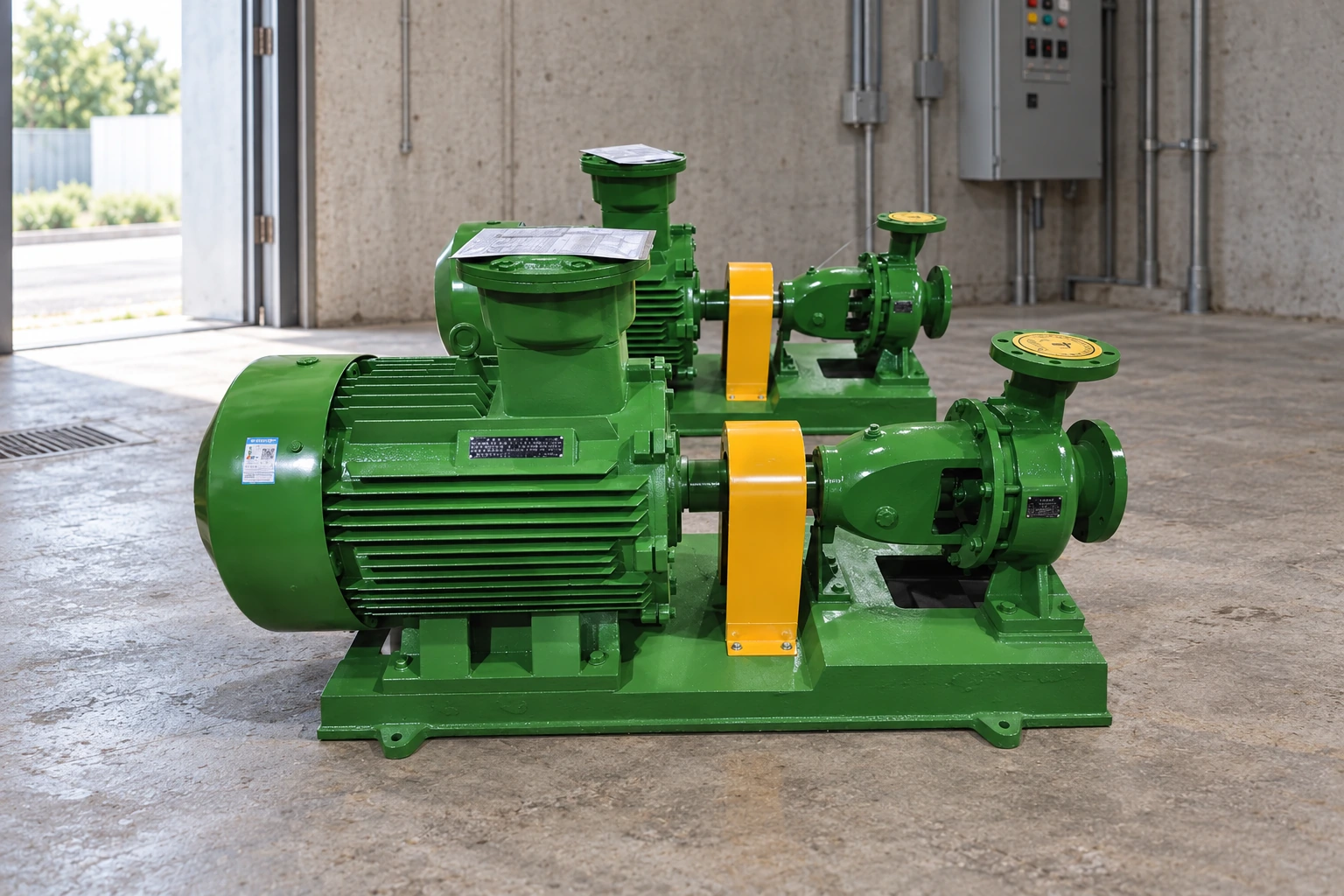
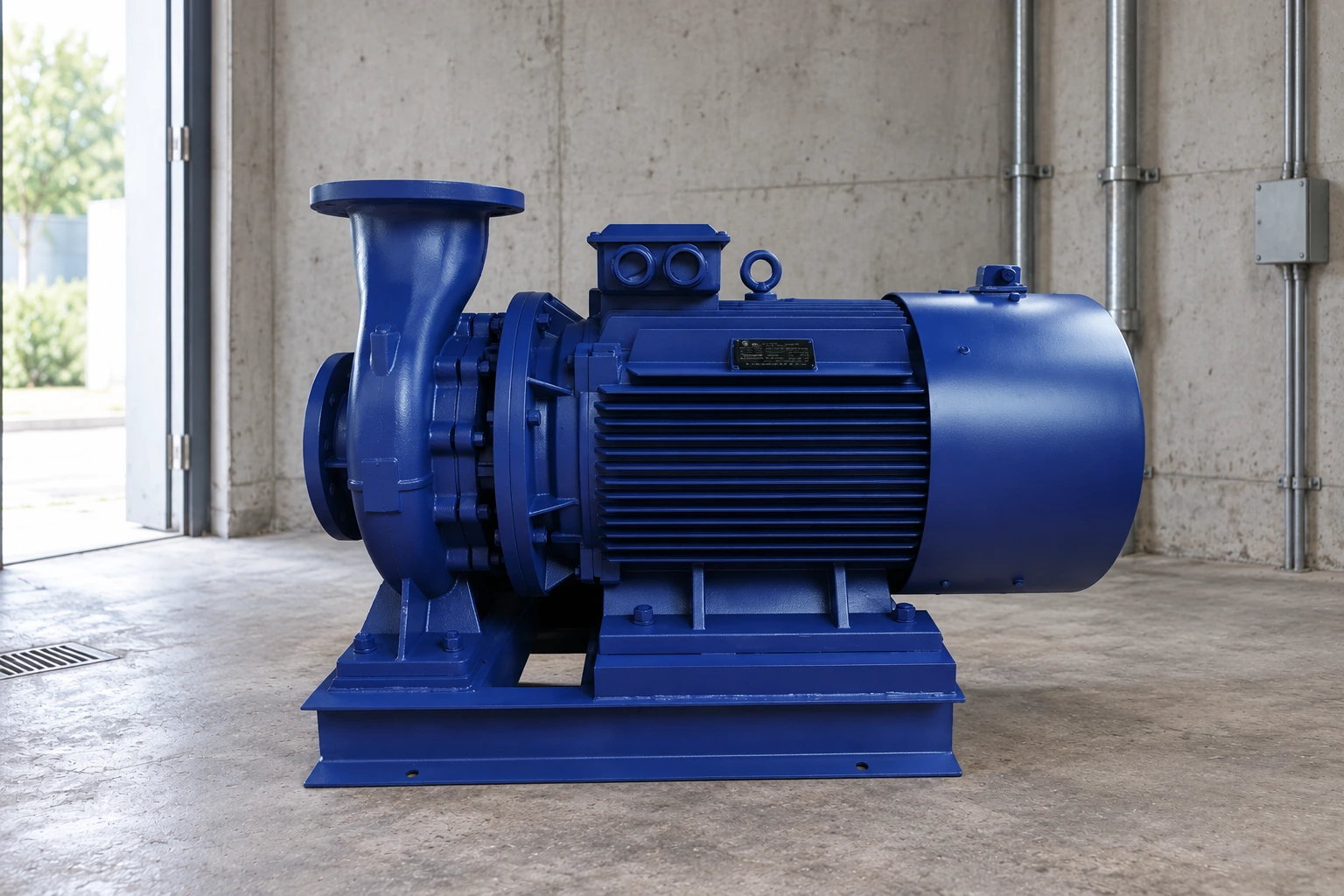
Likewise, an IS clean-water centrifugal pump pictured in a technical explanation is not being represented as approved for the viscous service. Its role is to illustrate a centrifugal product family. Selection, materials review and performance correction must remain separate evidence checks so that a calculation cannot accidentally become an unsupported product claim.
Compare alternatives on the same service basis
If correction leaves an unsuitable operating point or an unattractive energy requirement, compare other accepted configurations or pump types. Use the same fluid, required delivery and temperature cases for every option. Include inlet limitations, speed range, maintenance requirements and control arrangements. A positive-displacement alternative has different protection and performance considerations; it should not be treated as a drop-in replacement based solely on viscosity.
Assess the delivered service and life-cycle implications rather than choosing from the highest water efficiency. A pump with a strong water curve may be a poor match after correction. Conversely, a conservative operating choice may satisfy the requirement without an unnecessarily complex modification. Ask for the reasoning and data behind the offered solution.
Preserve a reproducible acceptance file
Keep the original water curve, fluid-property source, calculation inputs, method version, corrected curve and system cases together. Identify assumptions and the person responsible for confirming each uncertain value. Record the manufacturer acceptance and the operating restrictions in the purchase documents.
Das AFT description of viscosity correction shows how an engineering model treats this as an explicit performance adjustment. Software output still requires correct inputs and interpretation. During commissioning, compare measured duty with the accepted project prediction under documented fluid and temperature conditions. Investigate discrepancies before changing speed or installing a larger motor to force the system to work.
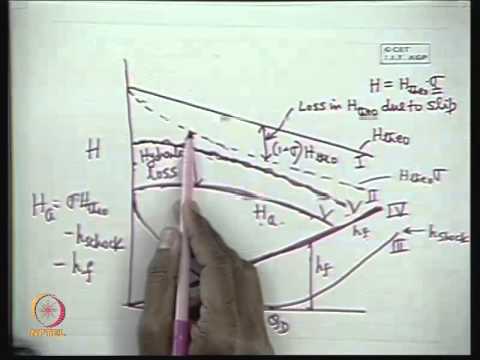
Further learning: NPTEL explains centrifugal pump characteristics. Use this educational background with the model-specific data and method discussed above; the lecture does not certify a BORRAPUMP model.
Häufig gestellte Fragen
Can I correct only for specific gravity?
No. Density and viscosity describe different properties. A density adjustment does not replace the assessment of viscosity effects on the pump and piping losses.
Can one fixed factor correct every point?
Do not assume so. Use the applicable method for the complete operating range and obtain the manufacturer’s accepted curve and limitations.
Does correction establish hot-oil suitability?
No. Temperature, materials, seals, vapour pressure and other service requirements need separate verification. A hydraulic estimate cannot approve the construction.
Can I use a water-system resistance calculation unchanged?
Not without checking the liquid effects on route and equipment losses. The pump capability and the system requirement must refer to the same fluid and condition.
What should accompany a viscosity-related enquiry?
Provide the actual liquid, property data with temperatures and units, required flow and head, inlet conditions, operating cycle and baseline curve if available. Request a documented accepted configuration.