
A dewatering standby pump contingency plan should explain how groundwater or surface-water control will continue when a duty pump, power source, intake or discharge route fails. Specify the required remaining pumping capacity, the changeover arrangement, independent failure risks, monitoring triggers and the people responsible for response. A spare pump stored nearby is not equivalent to a tested backup that can deliver the required flow through an available discharge path. The plan must be designed around the excavation, ground conditions and consequences of water-level recovery, with limits set by the responsible engineering team.
This guide focuses on continuity and failure response. Initial pump sizing, sediment treatment and normal maintenance need separate supporting plans. None of the illustrative comparisons below establishes a universal standby percentage, safe excavation water level or permitted pumping interruption.
Start with the consequence of interruption
Ask what happens if pumping stops during the most vulnerable construction stage. Water may flood the work area, affect access, increase pressure beneath a structure or alter ground stability. A shallow drainage sump and a pressure-relief well system can have very different tolerance for interruption even when their pumps have similar motor power.
Have the geotechnical and temporary-works team define monitoring points, operating limits and response triggers. Identify whether the important measurement is sump level, groundwater elevation, piezometric head or another project-specific indicator. A dry-looking excavation surface does not prove that subsurface pressures remain acceptable.
HSE’s excavation-safety guidance highlights groundwater inflow, additional water loading and the effect of sump pumping on excavation stability. This UK safety guidance supports reviewing water-control consequences. It is not a US code or a prescription for standby quantities; apply the local requirements and the project’s engineered groundwater-control plan.
Define backup duty as flow at the required head
List the pumping demand that must be met after each credible failure. Determine whether a standby pump replaces one duty unit, supports the remaining units or serves a separate collection zone. Compare performance at the actual suction conditions and total dynamic head, including the discharge route that will be available during the failure.
A larger motor or matching pipe diameter does not establish interchangeable capacity. Check the pump curve, speed, available suction conditions, solids limitations and operating range. For surface-mounted equipment, the ability to establish and maintain prime also matters. A spare that cannot start pumping at the site’s water level is not usable standby capacity.
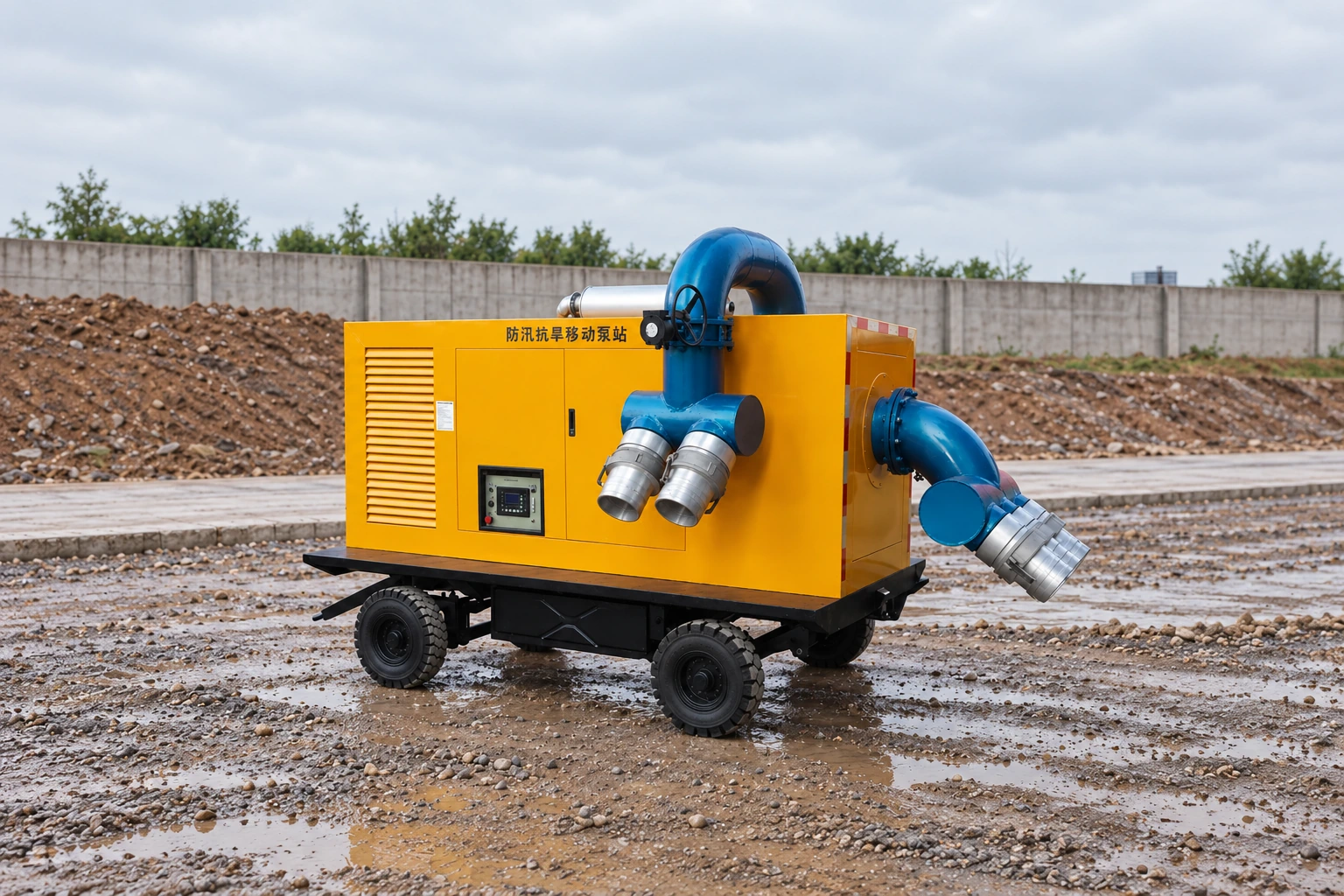
When considering a mobile diesel trailer pump, request the model-specific curve and installation requirements. The pictured Borra product is an equipment illustration, not evidence of a commissioned backup installation. Confirm the supplied engine, priming arrangement, fittings and operating limits for the actual order.
Evaluate common failures, not only pump breakdown
Two pumps can fail together if they share a flooded electrical panel, blocked intake, damaged hose crossing or inaccessible fuel supply. List these common dependencies explicitly. Adding another pump while leaving the same single vulnerable discharge connection may provide less resilience than the equipment count suggests.
Consider power independently from hydraulic capacity. An electrically driven standby unit connected to the same failed supply cannot resolve that outage. A generator needs compatible starting capability, distribution, protection and safe connection arrangements. A diesel-driven unit needs fuel, starting reliability, ventilation and access appropriate to the site conditions.
Benutzen cofferdam dewatering selection for the broader relationship between inflow, head and temporary works. Keep the contingency review specific: identify exactly which failure each backup measure covers and which failures remain unresolved. Avoid calling the whole system redundant because one component has a spare.
Choose a readiness level that matches the response window
A connected standby can be ready to operate through a defined changeover. A stored spare may require transport, positioning, hose assembly, priming and testing before delivering water. Document these differences rather than using the same “standby” label for both arrangements.
Estimate response from detection through confirmed pumping. Include alarm transmission, acknowledgment, travel, access, setup and verification. The engineer must compare that total with the project’s tolerable interruption and monitoring triggers. Do not deliberately stop a critical system to discover how quickly groundwater returns unless an approved engineering test permits it.
Where automatic changeover is specified, define the initiating condition and the evidence of successful takeover. A motor-run signal does not prove flow. The plan should identify appropriate confirmation, such as measured discharge, pressure or a demonstrated water-level response, interpreted for the particular system and its response time.
Build a failure-response matrix
| Failure scenario | Backup provision to demonstrate | Critical dependency to check | Record at the trial |
|---|---|---|---|
| One duty pump unavailable | Remaining pumps meet the approved emergency duty | Shared intake or header restrictions | Which units run and measured hydraulic response |
| Main electrical supply lost | Approved alternative power or independently driven pumping | Transfer arrangement, starting demand and fuel | Detection, changeover and confirmed delivery |
| Discharge hose damaged | An available repair or alternate route | Couplings, safe access and outlet permission | Route readiness and controlled leak check |
| Intake obstructed | Approved cleaning or alternative collection arrangement | Sediment, debris and safe isolation | Monitoring response and restored intake condition |
| Alarm communication unavailable | Defined local monitoring and escalation | Staffing, coverage and access | Who receives, acknowledges and acts |
The matrix is a planning framework. Set project-specific acceptance criteria for each row before testing. If the contingency arrangement cannot meet the required response, reduce exposure or revise the engineered system before relying on it during excavation work.
Protect the complete discharge path
Confirm that the standby can use a permitted outlet without overwhelming treatment equipment or eroding the receiving area. A backup flow that bypasses sediment control may solve one water-level problem while creating a discharge incident. Treatment capacity and monitoring remain part of the contingency arrangement.
Check hose ratings, connection compatibility, restraint, crossings and physical protection. The replacement route may be longer or higher than the normal route, changing the pump duty. Record the installed configuration and repeat the hydraulic review whenever the excavation layout or discharge elevation changes materially.
Das North Central Texas Council of Governments construction-dewatering guidance provides background on managing construction discharge. It is not a permit for another jurisdiction. Confirm local discharge conditions and use the project’s approved sediment-control and monitoring arrangements for normal and backup operation.

Prove readiness without creating an uncontrolled outage
Prepare a witnessed trial with the engineer and site team. Define the safe initial condition, temporary operating arrangement, test limits, abort conditions and restoration steps. Demonstrate backup equipment while maintaining required groundwater control; a destructive failure simulation is neither necessary nor automatically appropriate.
Check that the pump can start, establish flow and sustain the required duty through its assigned route. Verify alarms and the response process as well as the machine. If a pump runs but the receiving tank does not accept flow or the discharge route is unavailable, the contingency trial has not demonstrated continuity.
Record the actual configuration, readings, elapsed response stages and outstanding defects. A workshop test is useful equipment evidence but does not include site suction levels, hose losses or operator access. Close defects and repeat the relevant part of the trial before declaring the arrangement ready.
Keep standby readiness visible during operation
Assign named roles for observation, alarm acknowledgment, equipment changeover and engineering escalation. Include out-of-hours cover and replacement contacts. A plan that depends on an unavailable individual is incomplete even if every pump is in good condition.
Add readiness checks to the dewatering-pump maintenance schedule. Check condition, fuel or power availability, battery status where applicable, valves, hoses and access using the supplied equipment instructions. Set inspection and exercise intervals from project requirements and service risk rather than copying a universal weekly or monthly rule.
Preserve an operating log with water-level observations, unit status, alarms, maintenance and changeovers. Mark any equipment temporarily unavailable. If the standby is borrowed for another task, the original system’s backup arrangement must be reassessed before assuming the same level of protection remains.
Update the plan when the site changes
Review the contingency arrangement after excavation deepening, a new working area, changed inflow, heavy rainfall, a moved discharge outlet or a pump replacement. A longer hose route or lower water level can invalidate an earlier successful trial. Record the drawing and equipment revisions used for the latest acceptance.
Apply the same review before taking a duty unit out for service. Confirm the alternate pumping arrangement is ready and monitored, then use the approved isolation procedure. The discharge-hose layout guide helps identify route considerations; it does not determine the permitted groundwater interruption.
Stopping dewatering at project completion also requires an engineering decision. Structural readiness, backfill, groundwater recovery and adjacent works can affect when pumping may be reduced or removed. Do not treat the disappearance of surface water or the end of a shift as authorization to shut down a groundwater-control system.
Give suppliers a complete standby enquiry
Provide the required duty point and operating range, water characteristics, suction conditions, available power, required readiness level, intended operating duration and discharge arrangement. Include connection details and site access constraints. State whether the package must support automatic takeover, manual changeover or rapid replacement under an engineered plan.
Request curves, installation instructions, maintenance requirements and a list of supplied accessories. Clarify which valves, controls, hoses, fuel provisions and tests remain the contractor’s responsibility. This prevents a quotation for a bare pump from being mistaken for a complete, accepted contingency system.
Further learning: water and ground response
The Practical Engineering video below discusses sediment and the changing behavior of water infrastructure. It provides background for considering intake and discharge conditions; it is not a dewatering design or a demonstration of standby changeover. The written contingency plan and approved engineering limits remain the operating basis.

Häufig gestellte Fragen
Ist eine Ersatzpumpe immer ausreichend?
No. Required backup depends on failure consequences, demand, remaining capacity and common dependencies. The engineering review should demonstrate performance for credible failures rather than rely on equipment count alone.
Kann die Standby-Energie die gleiche elektrische Versorgung nutzen?
Es kann einen Pumpenausfall abdecken, kann jedoch den Verlust dieser gemeinsamen Versorgung nicht abdecken. Bestimmen Sie, welche Ausfälle behandelt werden müssen, und stellen Sie eine genehmigte alternative Strom- oder Antriebsanordnung bereit, wo erforderlich.
Does a motor-run signal prove successful takeover?
No. A running motor may coexist with lost prime, an obstructed intake or an unavailable discharge. Use the defined hydraulic and monitoring evidence to confirm effective pumping.
Can the standby discharge bypass treatment during an emergency?
Do not assume permission. The contingency plan must address receiving capacity, environmental controls and applicable discharge conditions. Establish an approved alternative before the emergency occurs.
When should the contingency plan be retested?
Follow project requirements and review after changes that affect duty, response or reliability. Equipment replacement, route changes, repeated alarms and altered groundwater conditions are reasons to reassess the relevant trial and acceptance record.