Choose a quarry dewatering pump from the water entering the excavation, the changing bench and sump geometry, and the discharge or reuse route. Groundwater through fractured rock, rainfall runoff, stone-washing water and settled fines may create different duties. Calculate normal and storm flow, total head to a treatment or settling area, suction condition, particle size and abrasion, then compare exact pump curves and service limits. A mobile diesel trailer may suit a quarry with changing benches, while a fixed station may suit stable long-term inflow; neither is automatically better. The outlet permit, sediment-control capacity, access for cleaning and backup response can limit useful pumping more than the pump’s catalogue maximum.
Characterize the quarry water sources
Map runoff from haul roads and exposed benches, groundwater seeps in rock joints, wash-plant return water, and water stored in low quarry areas. Separate routine dry-weather seepage from storm peaks and from planned drawdown after shutdown. A fractured limestone quarry may behave differently from a sand-and-gravel pit; do not transfer an inflow value from another site. The US Geological Survey’s quarry groundwater investigation in Michigan illustrates that quarry dewatering can be a major component of regional groundwater use in a particular setting. Its numerical findings are not a design value for this quarry.
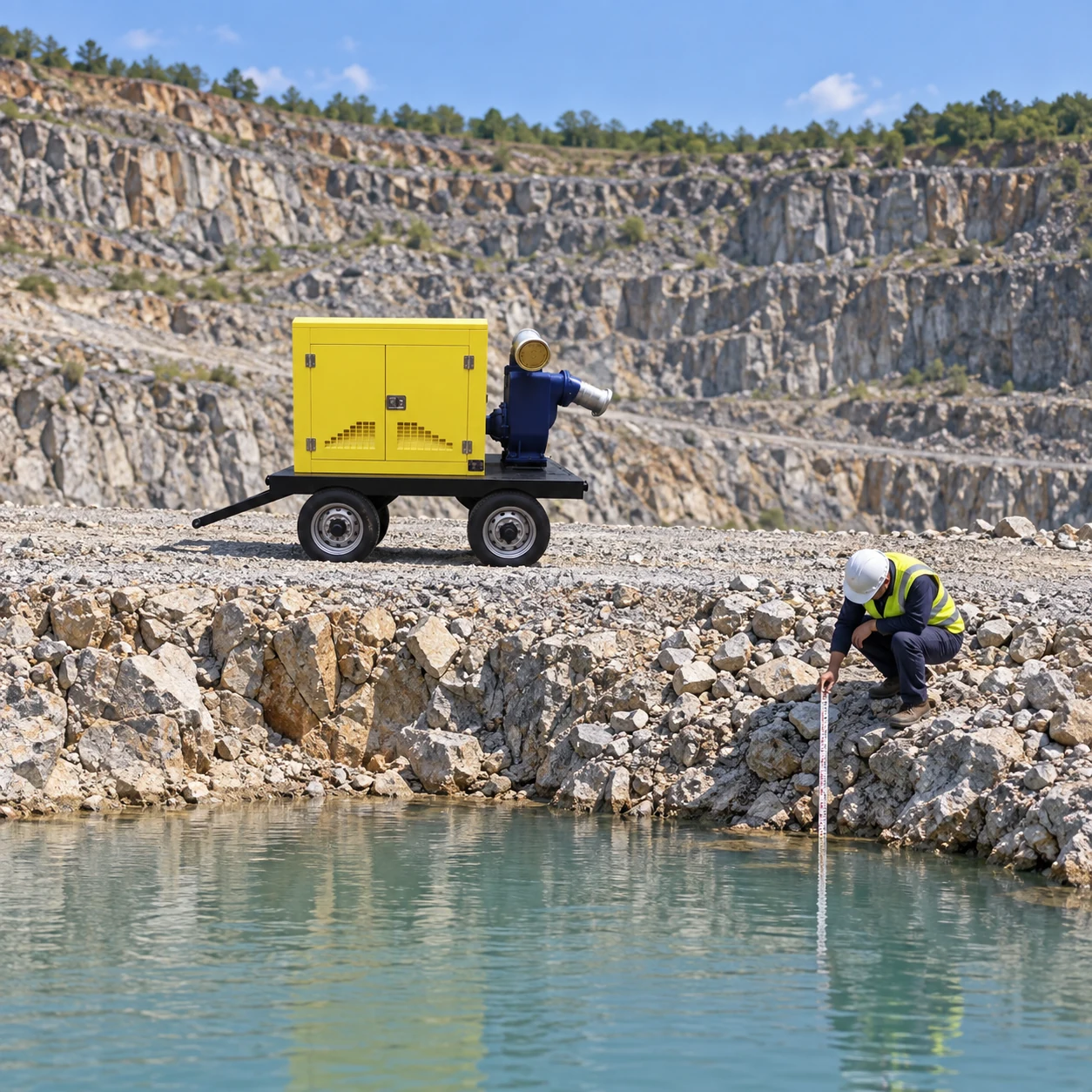
Measure water levels and pump operation over time. A rising sump during a known pump-off interval can help estimate inflow if the sump area versus elevation is mapped, but rain and process-water inputs must be accounted for. Groundwater modeling or pumping tests may be needed for a new depth or a sensitive surrounding aquifer. The excavation flow calculation guide explains how to combine continuing inflows and stored-water drawdown without treating quarry volume as pump flow.
Separate the minimum level needed for operations from the higher alarm and shutdown levels. The usable volume between those elevations gives operators time to respond when a pump stops, but only if the sump’s area-by-elevation curve is known. A narrow quarry pit may gain far less storage per meter of rise than a broad settling area. Check whether overflow would reach electrical equipment, haul roads or an unstable bench. This time-to-impact calculation determines how quickly the standby pump must start or be connected; it should be revisited as excavation changes the low area’s geometry.
Match a real site product to the duty
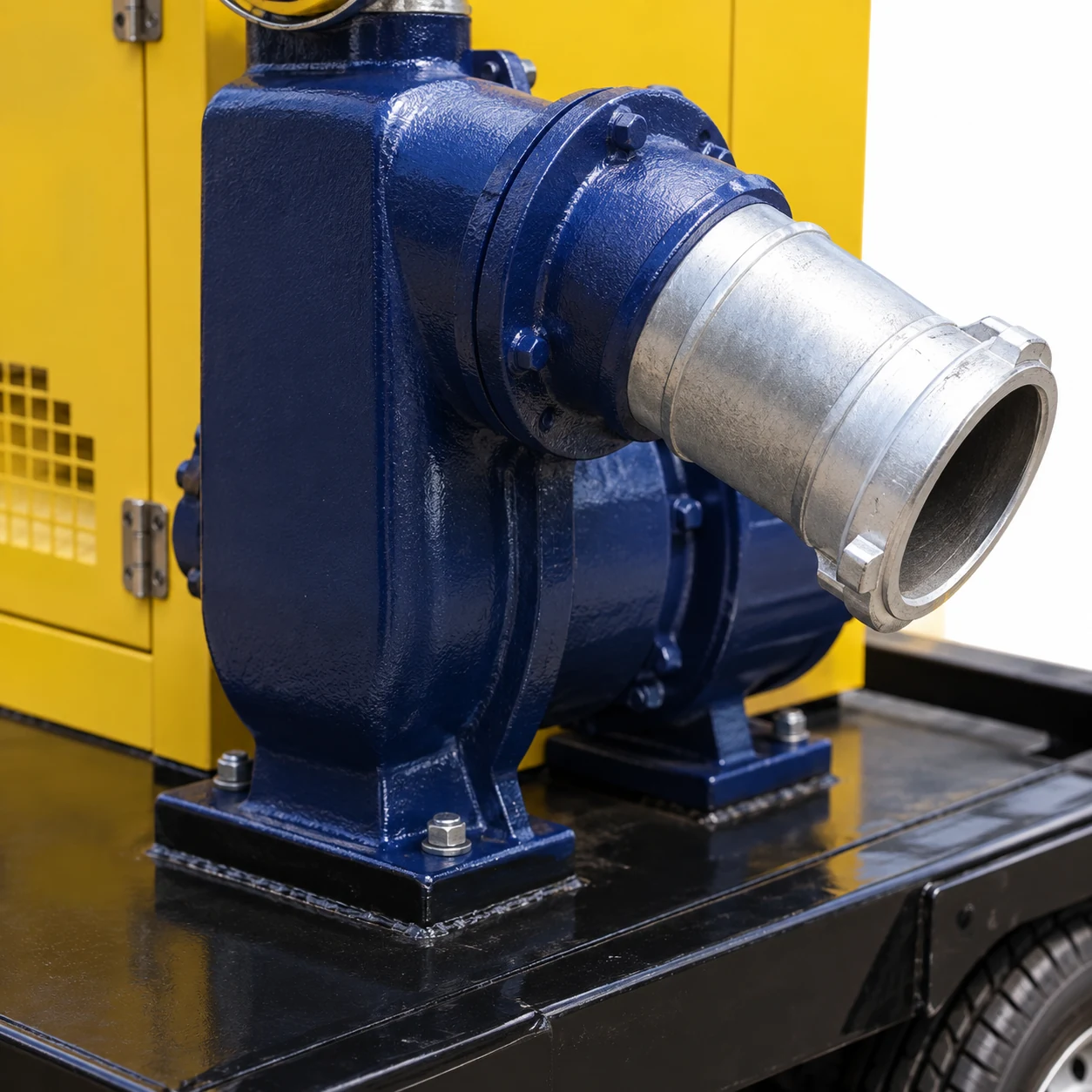
Das BorraPumps ZBCY mobile diesel engine trailer pump is a real product reference. Its indexed image shows a yellow enclosed cabinet beside a dark-blue pump casing on a black four-wheel trailer and drawbar. The picture does not establish a flow curve, head, fuel use, solids size, sound level or quarry certification. Request exact model data before specifying it. The trailer-pump range provides related mobile candidates.
A pump that moves around a site still needs a stable operating surface, an accessible fuel and service route, suitable hose supports and a plan to avoid traffic and blasting hazards. A fixed pump may simplify monitoring if the outlet route and sump stay stable. Compare the whole installation and failure case, not merely wheeled versus stationary appearance.
Calculate head as the quarry deepens
Survey the lowest operating water level, the pump elevation, the settling pond or permitted outlet, and the actual hose route. Total head at design flow includes static elevation difference, suction and discharge loss, elbows, check valves and any treatment unit. As a quarry deepens, static lift can rise while hose length also grows. A pump that met the early bench duty may lose flow later. The dewatering head calculation guide explains the common datum and system curve; use the exact ZBCY pump curve at each stage.
Do not count the source-to-outlet elevation change and then add suction lift a second time. Check surface-pump priming and inlet NPSH separately. If the source is far below the pump, lowering the pump or using a suitable alternative wet end may be more reliable than assuming a larger engine solves the inlet constraint. Include dirty-filter head loss if the quarry water passes through treatment before release.
Account for fines, grit and stones
Quarry runoff can carry fine rock flour, sand, sharp fragments and occasional larger stones. The mixture may settle in a long low-velocity hose or wear the casing and impeller at high local velocity. Sample actual water and sediment over more than one operating condition. Specify particle-size distribution, concentration, hardness and chemistry. A “trash pump” label does not prove it can handle dense abrasive slurry, nor does a large flange prove an internal passage of the same diameter.
The Hydraulic Institute’s slurry-properties resource helps organize solids concentration, density and hardness. The muddy-water self-priming pump guide develops the wear questions for another pump type. For the ZBCY model, confirm casing, impeller, seal, valve and hose limits from its supplier. Place the intake above settled material when possible while preserving enough submergence to avoid an air vortex.
| Quarry condition | Pump-selection consequence | Site evidence |
|---|---|---|
| Dry-weather seepage | Sustained flow and run hours | Water-level and discharge records |
| Storm runoff from benches | Peak flow and storage need | Drainage map and design rain case |
| Deepening quarry | Higher static head, longer hose | Staged survey and route plan |
| Rock fines and grit | Wear, blockage and treatment load | Representative sediment samples |
| Settling pond outlet | Backpressure or flow limit | Pond levels and permit conditions |
| Mobile placement | Bench stability and access | Traffic, blast and service layout |
| Pump failure | Standby and alarm response | Critical water elevation and available time |
The table is a framework for collecting inputs. It does not assign a universal flow or solids rating to the pictured product.
Control sediment and discharge quality
The pump’s delivered flow must fit the settling or treatment system and the discharge approval. Pumping faster can carry fines through an undersized treatment route, erode the outlet or exceed a permitted rate. The US EPA’s Sector J mineral-mining stormwater fact sheet covers industrial stormwater control for mineral mining and processing facilities. Its mineral mining effluent guidelines page explains that mine dewatering and processing can generate regulated wastewater. Current local permits and water-quality results govern this site’s discharge.
If water is reused for stone washing or dust control, define the reuse rate, storage and required quality separately from emergency pit drainage. A single pump may serve several modes only if the flow/head points and liquid compatibility are verified. Keep the settling pond accessible for sediment removal; a full or blocked pond can raise outlet level and backpressure, moving the pump away from its intended operating point.
Choose power and mobility deliberately
A diesel trailer can operate before permanent electrical power reaches a new bench, but it needs fueling, exhaust management, noise control, engine service and safe relocation. A fixed electric station can be efficient for continuous service, but cables, protection and backup power must be installed for the environment. Do not put equipment on an unstable bench merely because its wheels make it mobile. Secure and level the trailer and use stabilizers according to the manual.
Plan intake and discharge hoses against vehicle traffic, sharp rock and vibration. Provide enough length for planned moves but avoid unmeasured coils and bends that consume head. Check that operators can disconnect, tow, position and reconnect the unit without entering an unsafe sump edge. The site must specify whether one pump out of service requires an automatic standby, a spare trailer ready to connect, or a controlled pause in quarry work.
Inspect a quarry duty over time
Measure flow, suction and discharge pressure, sump level, outlet level, motor or engine load, hose configuration and sediment condition at commissioning. Keep a baseline for priming time, vibration and leakage. A reduction in flow can come from a deeper quarry, a longer hose, a clogged intake, higher settling-pond level or pump wear. Diagnose the changed boundary before replacing equipment. The USGS work on quarry groundwater effects supports monitoring beyond the pump station when drawdown may affect surrounding water resources.
As new benches open, update the water balance and head profile. Inspect the unit after abrasive service and keep critical wear parts on a documented schedule. Test high-level alarms and the standby route at the head they must actually serve. Records should show when the selection needs to be revisited, not simply that the engine started.
Send a complete inquiry to suppliers
Provide quarry material and water samples, normal and storm flow, required drawdown time, current and planned bench elevations, suction and discharge layout, treatment or reuse outlet, run hours, fuel or power availability, noise limits, site access and failure response. Request exact pump curves, priming limits, solids and materials data, engine continuous rating, dimensions, maintenance clearances and spare parts. Compare candidates at the same flow/head cases and identify every unverified assumption before purchase.
Häufig gestellte Fragen
Can one mobile pump serve every quarry bench?
Only if it meets the changing flow, head, priming, solids and access duty at each stage. Recalculate when the pit deepens or hoses move.
Is quarry water always a slurry?
No. Some water is relatively clear while other flows carry abrasive fines or stones. Sample the actual mixture before choosing the wet end.
Does a trailer pump remove the need for standby capacity?
No. Mobility and redundancy are different. Define how long water can rise after a failure and test the backup route.
Can quarry discharge go directly to a stream?
Do not assume so. Treatment, monitoring and permits depend on the water quality and jurisdiction; follow the site’s approved plan.
Weiterbildungen
NPTEL IIT Kharagpur Dewatering Design Principle lecture gives a neutral introduction to water-control methods. The quarry’s groundwater investigation, product curves and discharge permit still determine the design.