
Select sewage pump solids passage size from the expected wastewater, the pump’s documented free-passage definition and the required flow and head. Do not choose it from the discharge flange diameter alone. A nominal opening describes a geometrical limit; it does not prove that flexible wipes, long fibers, grease or a bundle of debris will pass without blockage. For a lift station, request the exact pump configuration, identify what enters the wet well and check the station’s upstream restrictions before accepting a quoted solids size.
Start with what the number actually describes
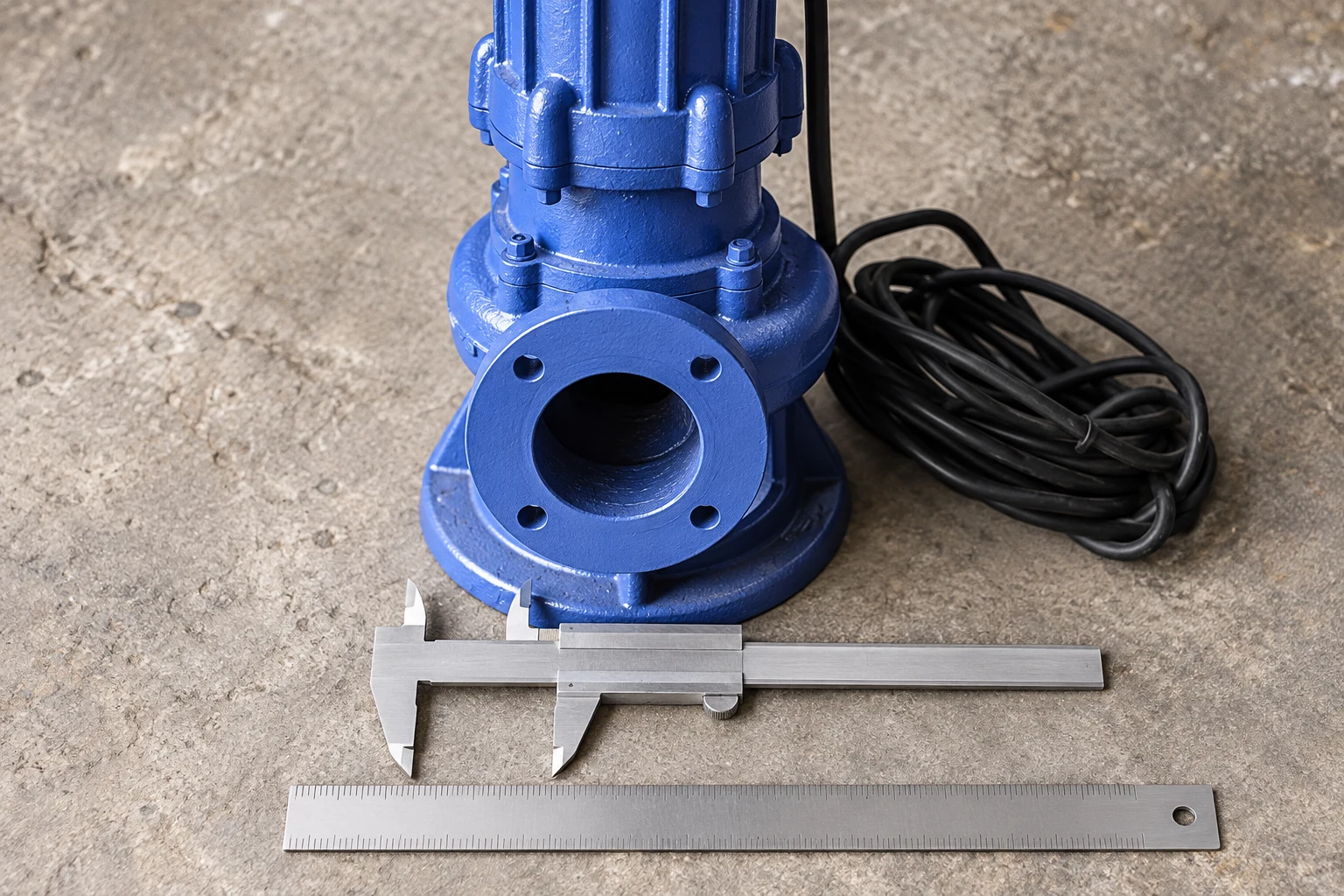
Ask the supplier to define the advertised passage. It may refer to a sphere that can travel through a particular hydraulic path, a limiting opening or a tested particle dimension. Those descriptions are not interchangeable unless their definitions agree. Request a drawing or a clear explanation showing where the limitation occurs. A statement that the pump “handles solids” is too vague for an engineering comparison.
El Borra WQ sewage pump product page identifies the pump family used for the exterior image references. The visible outlet marking and casing photograph do not establish the internal passage. Confirm the offered model’s passage, impeller arrangement and permissible material in the supplier’s written technical information. The examples in this guide are selection questions, not a declaration of a particular Borra passage size.
Separate four different kinds of material
Hard rounded particles primarily raise a clearance question. Angular objects can lodge differently from smooth spheres, even with similar overall dimensions. Fibrous material raises a wrapping and bridging question. Grit introduces abrasion, and grease can collect or combine with other debris. Write these categories separately in the enquiry rather than describing all wastewater as containing “small solids.”
Identify unusual inputs as well as normal sewage. A municipal station, a food-processing drain and a construction site may have very different materials and liquid conditions. Record upstream screening, source-control practices and known incidents. If actual composition is uncertain, explain the uncertainty to the supplier; inventing a precise particle size from a distant site photograph creates misleading confidence.
Check the whole route into and out of the pump
The pump is only one restriction in the system. Check the intake approach, screens, foot or check valves where present, bends, reducers and the force main. A large pump passage cannot make an upstream narrow opening larger. A downstream obstruction can create low flow that operators mistake for an undersized solids passage. Review the assembled installation instead of comparing pump brochures in isolation.
For submersible installations, include the discharge coupling and the transition into the station pipework. Check whether an accessory changes the limiting opening or creates a place for debris to catch. An adaptor that solves a connection problem may introduce a new solids problem. Request dimensional details and service access for the full offered package.
Use an evidence-based selection checklist
| Entrada de selección | Question to answer | Evidencia |
|---|---|---|
| Hard particles | What size, shape and frequency are credible? | Site observations and the supplier’s passage definition |
| Fibers and wipes | Can material bridge or wrap despite fitting through an opening? | Relevant rag-handling evidence and maintenance history |
| Grit | How will abrasive exposure affect wear? | Material specification and inspection requirements |
| Servicio hidráulico | Will the configuration achieve the required flow and head? | Exact pump curve and permitted duty range |
| Station restrictions | Is another component the limiting opening? | Assembled system drawings and inspection |
| Mantenimiento | Can the pump be lifted and cleaned safely? | Access, lifting and isolation arrangements |
General wastewater station planning is covered in the EPA lift-station fact sheet. It supports reviewing the complete station; it does not establish the free passage of a particular product.
Compare impeller arrangements without confusing the criteria
A recessed vortex arrangement and a channel arrangement create different flow paths and different interaction with debris. Passage geometry, efficiency and ragging resistance need separate questions. Two units with the same stated spherical passage can behave differently when exposed to cloth or wipes. Do not infer a blockage guarantee from the impeller name.
Use the vortex and channel impeller comparison to structure an enquiry. Ask which arrangement is offered in the exact model and how its evidence relates to the expected wastewater. If a grinder is proposed, evaluate the whole pressure-sewer application rather than treating grinding as an automatic upgrade to every sewage station.
Preserve the required hydraulic performance
After establishing the solids requirement, plot the pump’s curve against the expected system duty. Confirm normal and peak inflow, static lift, pipe losses and the downstream level or pressure. Check the supplied motor power over the approved operating range. A pump that accepts the relevant particles but delivers too little flow can still allow the wet-well level to rise.
El submersible sewage pump sizing guide explains the larger duty calculation. Solids passage is a compatibility requirement within that calculation, not a substitute for it. If enlarging or changing the pump also changes the duty, ask the designer to review cycling, level settings and pipe behavior before retaining the existing controls unchanged.
Do not solve ragging only by increasing a diameter
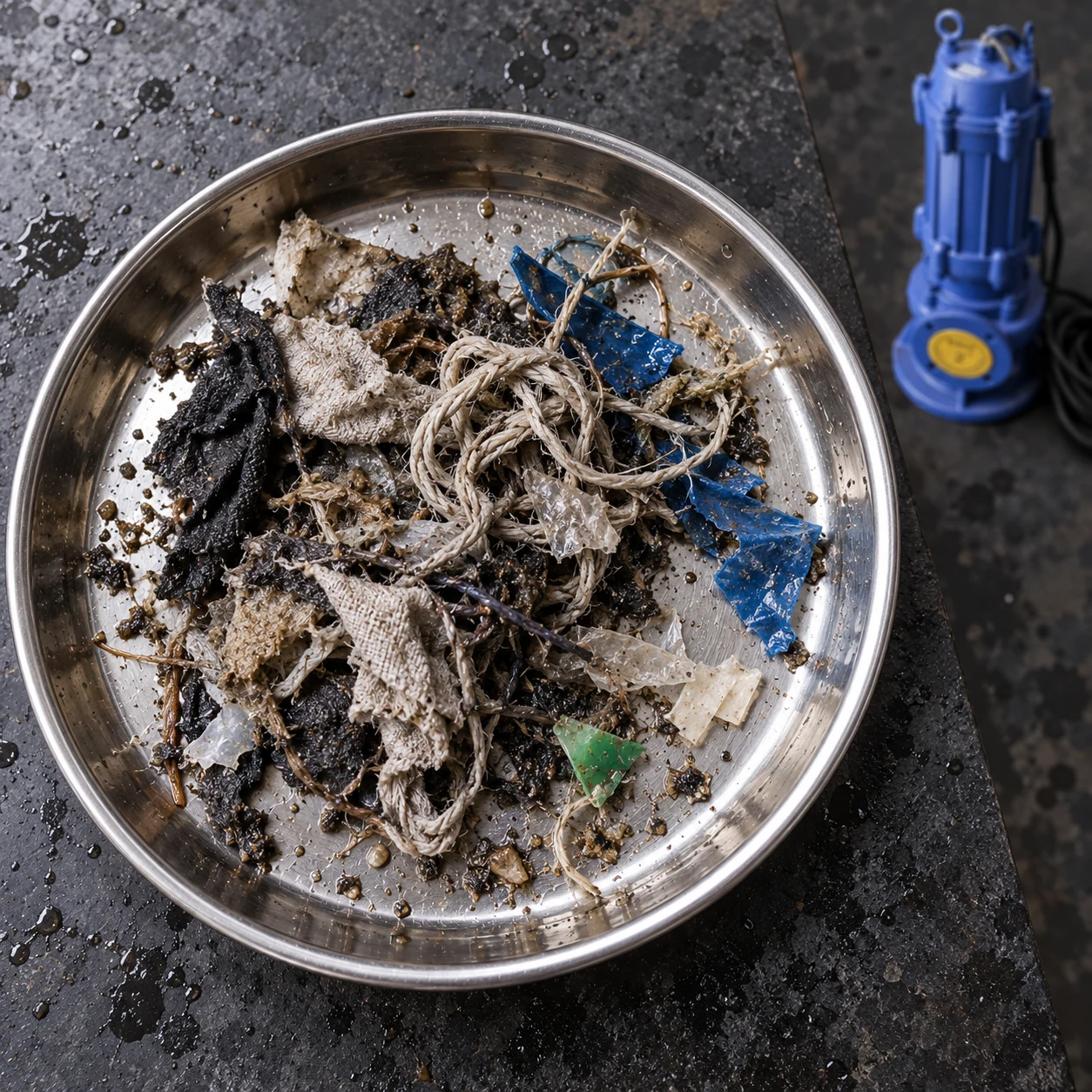
Look at the material recovered during previous blockages. A long wipe can fold and travel through one section before catching at another. Grease and fibers may form a mat that bears little relation to the dimension of one incoming object. These failure modes need a review of source control, intake conditions and the offered hydraulic design.
Keep a blockage log with location, debris type, station level and operating conditions. If the same material repeatedly arrives, discuss upstream action with the responsible operator. The sewage station clogging prevention guide explains how operational changes complement equipment selection. Do not claim that a larger passage makes wipes acceptable sewer inputs.
Account for wear and inspection
Abrasion can change clearances and performance over time. Ask which wear components can be inspected, what measurements the manual requires and how the supplier defines a service limit. Do not use an arbitrary clearance or replacement interval borrowed from an unrelated pump. Record the baseline condition at commissioning so later findings have a meaningful point of comparison.
Inspect safely after isolation and lifting under the approved procedure. Biological contamination, suspended loads, electrical supplies and trapped pressure remain relevant. The OSHA hazardous-energy guidance explains why maintenance must control the energy sources before access. It does not replace the pump-specific disassembly instructions or the site’s wastewater safety procedures.
Define acceptance and the supplier’s scope
Write down the required passage definition, liquid conditions, duty range and installation interfaces in the request for quotation. Ask the supplier to state exclusions explicitly, including unsuitable materials or conditions. Keep the configuration information with the final pump curve. A later model substitution should trigger the same compatibility check instead of relying on the original family’s marketing description.
For a critical station, agree how hydraulic performance and debris-related operation will be reviewed after commissioning. A clean-water test can verify a defined hydraulic duty, but it cannot by itself prove performance with fibrous wastewater. Do not create an unsafe site trial by deliberately feeding foreign objects into an operating station. Use an agreed, controlled test method or documented service evidence appropriate to the procurement.
Prepare a concise enquiry
Send the wastewater source, expected hard particles, fibers and grit, existing screens, required flow and head, temperature and any relevant chemical conditions. Include the wet-well arrangement, outlet size, lifting access, supply and controls. Attach maintenance evidence from existing equipment if it is available. Identify which values are measured and which remain estimates.
A useful response should connect each requirement to the offered model, curve and installation drawing. Ask follow-up questions where the passage definition or permitted materials remain unclear. This reduces the chance of buying a pump that has an impressive number in a brochure but cannot meet the station’s combined solids, hydraulic and service requirements.
Record the source of each selection input
For every significant requirement, identify whether it comes from an operating log, an inspection, an approved design or an assumption. A photograph of a blockage may identify fibrous material without establishing its normal concentration. A historical flow record may omit the largest rain event. Keeping these limitations explicit lets the supplier state what still needs confirmation and prevents an estimated condition from becoming an unsupported product guarantee in the purchase order.
Learning resource
The US EPA’s Math for Wastewater Operators video provides background on wastewater operating calculations. Use it to support the duty assessment; it is not a solids-passage test or endorsement of a pump model.

Preguntas frecuentes
Does discharge diameter equal solids passage?
No. The limiting hydraulic opening may be elsewhere, so obtain the exact configuration’s documented passage.
Can a pump pass anything smaller than that number?
No universal guarantee follows from the number. Shape, flexibility, concentration and interactions with other material matter.
Should the largest available passage always be chosen?
No. Compare material compatibility alongside flow, head, efficiency, installation and maintenance needs.
What should I request if the specification is unclear?
Ask for the definition, relevant drawing, permitted materials and the curve for the exact model offered.