
NPSH available is the suction pressure energy provided by the installation above the liquid’s vapor-pressure head. NPSH required is a pump characteristic reported for stated flow, speed and test criteria. A reliable selection calculates available NPSH for credible worst conditions and compares it with the documented requirement plus the appropriate margin. Equality alone is not proof of cavitation-free operation. This guide explains the distinction for centrifugal water-transfer duties and uses illustrative arithmetic rather than assigning suction ratings to a Borra model.
Keep system information and pump information separate
Available NPSH comes from source pressure, liquid level, temperature, elevation, suction losses and the reference datum. Required NPSH comes from the selected pump’s performance data. The terms are often abbreviated NPSHa and NPSHr. Mixing their sources can conceal a problem: a larger pump does not create more atmospheric pressure at a high-altitude site, and a larger tank does not alter the manufacturer’s tested curve.
Confirm what the supplied curve actually reports. NPSH3 refers to a stated head-drop criterion during testing, not the complete absence of cavitation phenomena. Ask for the requirement and recommended margin for the actual application. The Explication de l'Institut hydraulique concernant le NPSH et les zones de fonctionnement is useful context for treating both suction margin and operating region explicitly.
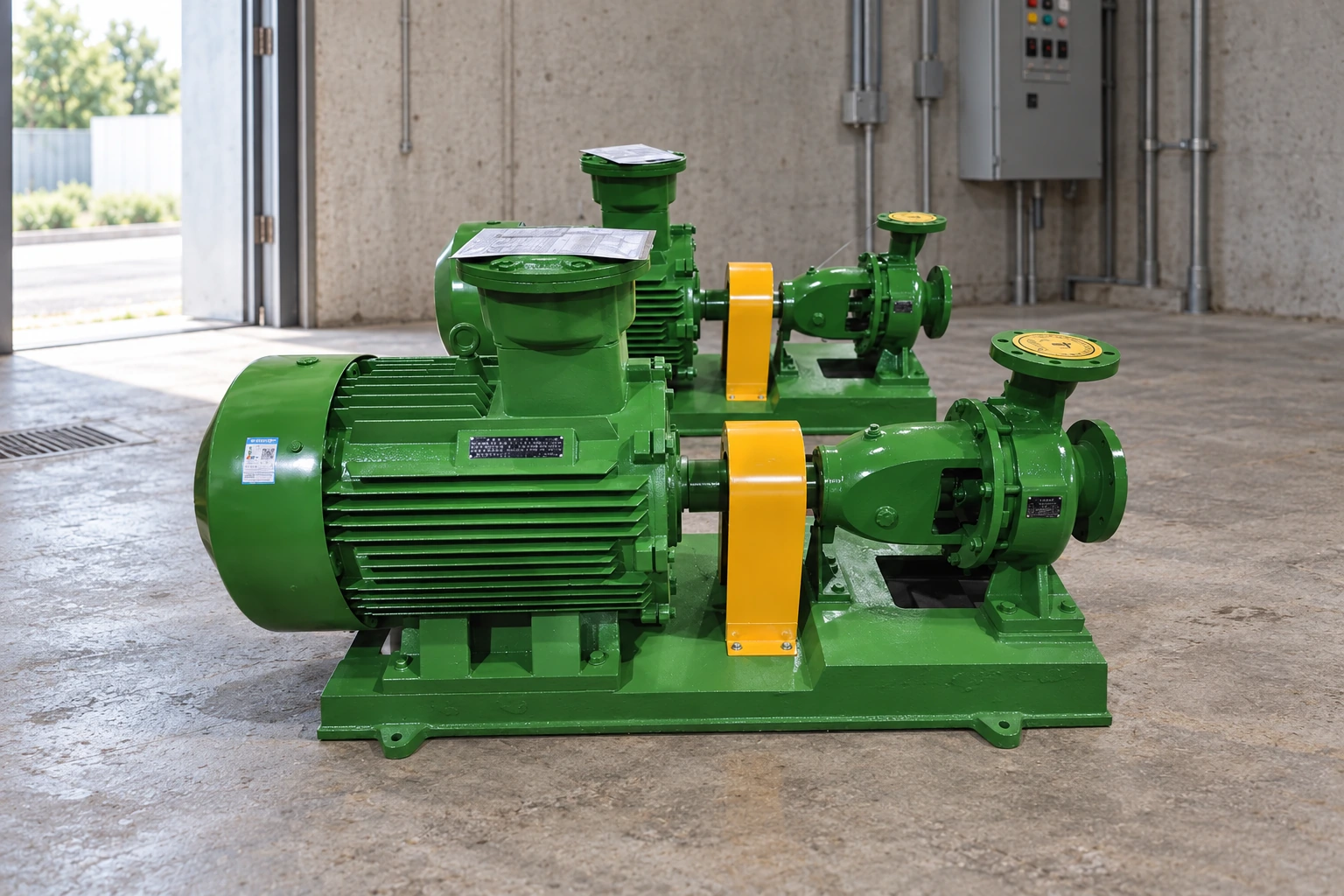
Le Borra est une pompe centrifuge pour eau propre is a relevant water-transfer family, but each proposed model needs its own curve and limits. A public image or a generic suction statement cannot establish NPSHr at every flow or temperature.
Define the datum and pressure convention
Use absolute pressure for the source and vapor-pressure terms. Gauge pressure is measured relative to local atmospheric pressure and cannot be inserted as though it were absolute. State the reference location used by the pump manufacturer and the elevation of the source liquid relative to that datum. Sign errors in the level term can reverse the conclusion.
For a reservoir open to atmosphere and a simplified suction arrangement, a common form is NPSHa = atmospheric-pressure head + liquid-level head − vapor-pressure head − suction losses. Liquid level above the pump datum contributes positively; a suction lift contributes negatively. Apply the energy equation consistently when source pressure, velocity or the reference arrangement requires additional treatment.
All terms must use the same liquid density and head units. Record how atmospheric pressure and vapor pressure were obtained for the actual site and temperature. A calculation using sea-level conditions for a high-altitude installation may overstate the available margin even if every pipe dimension is correct.
Calculate a transparent example
Assume, only for illustration, atmospheric-pressure head of 10 m of the pumped liquid, a source level 2 m above the pump datum, vapor-pressure head of 0.3 m and suction losses of 1.2 m at the operating flow. Available NPSH is 10 + 2 − 0.3 − 1.2 = 10.5 m. These values are chosen to show the method, not to represent the exact atmosphere, temperature or performance of a project.
If the source level instead lies 3 m below the datum, the same illustrative terms give 10 − 3 − 0.3 − 1.2 = 5.5 m. This comparison shows why source elevation matters. The real installation needs its measured or designed levels, liquid properties and loss calculation. Do not retain the 1.2 m loss term if flow or suction routing changes.
Now compare the result with the selected pump’s documented requirement at the calculated installed duty. A requirement taken at another flow can invalidate the comparison. See the guide de position de la pompe et centrifugal curve guide for establishing that operating point.
Check credible worst conditions together
Low source level reduces available head and may change the pump’s installed flow. Higher liquid temperature raises vapor pressure. Higher flow can increase suction losses and alter the pump’s required NPSH. Deposits, a partially closed valve or a fouled strainer can increase resistance. Establish which combinations can actually occur during normal operation, startup or an approved transient condition.
At higher site elevation, lower atmospheric pressure can reduce NPSHa for an open source. Use appropriate site information rather than a universal sea-level number. A pressurized source needs its actual minimum absolute pressure and pressure-control behavior assessed. Loss of source pressure may matter more than the nominal normal value.
Avoid combining unrelated maxima merely to create an excessively conservative number, but do not omit a realistic low-level, hot-liquid case. Document the scenario and its source. The result should be reviewable by another engineer without guessing which values were assumptions and which were measured.
Select margin rather than declaring equality sufficient
Required NPSH may be based on a specified test criterion such as NPSH3. It is not a universal boundary below which cavitation suddenly begins and above which every effect disappears. Appropriate margin depends on pump design, application, operating point and the governing guidance. Request the supplier’s documented recommendation and any relevant standard assessment.
Do not invent a single extra metre or fixed ratio as a rule for every project. If a quotation gives only one minimum number, ask what criterion it represents and whether the proposed operating range remains acceptable. The Ressources du système de pompage du DOE provide general selection context, while the actual margin must be resolved for the offered pump and duty.
A change in speed, impeller, liquid or operating flow should trigger a renewed review. An installation accepted for one selection is not automatically suitable for another model with greater capacity. Keep the margin check with the duty record so substitutions can be compared on the same basis.
Use a suction-condition review table
| Entrée | What to establish | Why the worst case matters |
|---|---|---|
| Source pressure | Minimum absolute pressure | Gauge and absolute values differ |
| Source level | Lowest credible level relative to datum | Reduced level lowers available head |
| Temperature | Highest credible liquid temperature | Vapor pressure changes with temperature |
| Voie d'aspiration | Actual bore, length, fittings and condition | Losses vary with flow and obstruction |
| Pump data | cURL Too many subrequests by single Worker invocation. To configure this limit, refer to https://developers.cloudflare.com/workers/wrangler/configuration/#limits | cURL Too many subrequests by single Worker invocation. To configure this limit, refer to https://developers.cloudflare.com/workers/wrangler/configuration/#limits |
| cURL Too many subrequests by single Worker invocation. To configure this limit, refer to https://developers.cloudflare.com/workers/wrangler/configuration/#limits | cURL Too many subrequests by single Worker invocation. To configure this limit, refer to https://developers.cloudflare.com/workers/wrangler/configuration/#limits | cURL Too many subrequests by single Worker invocation. To configure this limit, refer to https://developers.cloudflare.com/workers/wrangler/configuration/#limits |
cURL Too many subrequests by single Worker invocation. To configure this limit, refer to https://developers.cloudflare.com/workers/wrangler/configuration/#limits.
cURL Too many subrequests by single Worker invocation. To configure this limit, refer to https://developers.cloudflare.com/workers/wrangler/configuration/#limits
cURL Too many subrequests by single Worker invocation. To configure this limit, refer to https://developers.cloudflare.com/workers/wrangler/configuration/#limits.
cURL Too many subrequests by single Worker invocation. To configure this limit, refer to https://developers.cloudflare.com/workers/wrangler/configuration/#limits.
For a self-priming installation, priming capability and NPSH are separate checks. A pump may remove air during startup yet lack adequate suction margin during sustained operation. The self-priming cavitation checks provide related troubleshooting context without turning a priming claim into a cavitation guarantee.
Diagnose symptoms with evidence
Noise, vibration and declining performance can be consistent with suction problems but do not prove cavitation on their own. Check source level, temperature, valve position, suction restrictions and actual flow. Investigate entrained air, mechanical condition and instrumentation as alternative or concurrent causes. Avoid adjusting speed or replacing components until the operating evidence is understood.
Record measurements under a defined condition and compare them with the calculation. Inspect accessible components using the site’s isolation procedure. Any opening of equipment or handling of energized machinery requires qualified personnel and the applicable work controls. The Règlement officiel de contrôle de l'énergie dangereuse gives background for preventing unexpected startup during maintenance.
Preserve assumptions for later changes
Attach the source-pressure basis, level range, temperature, suction route and selected curve to the calculation. If a later maintenance task changes a strainer, valve, pipe bore or operating speed, review those inputs before returning the pump to service. A previously acceptable margin is evidence for the former arrangement, not automatic approval of every modification. Keeping the assumptions visible makes it possible to check the changed condition without repeating the entire site investigation.
Pour la sélection plus large de transferts d'eau, utilisez le guide de la pompe d'aspiration finale outre ce calcul spécifique ou cette révision de la conception.
Foire aux questions
Is NPSH the same as total dynamic head?
Non. La hauteur dynamique totale décrit l'augmentation d'énergie requise par la pompe à travers la charge du système. Le NPSH concerne l'énergie de pression d'aspiration au-dessus de la pression de vapeur et nécessite sa propre référence et son propre calcul.
Le NPSHa est-il égal au NPSHr pour garantir l'absence de cavitation ?
No. Confirm the reported test criterion and the appropriate margin. Equality with a head-drop criterion is not a promise that all cavitation effects are absent.
La capacité de levage par aspiration peut-elle remplacer le calcul ?
No. A general suction or priming claim does not establish available margin at the actual flow, temperature, altitude and pipe condition. Calculate the installation and compare the selected pump's documented data.
What should be checked after a capacity increase?
Recalculate the operating point and suction losses, obtain required NPSH at the new flow and speed, and verify the margin under credible worst conditions. Also check motor loading and permitted operation.
Formation continue
Cette conférence pédagogique de NPTEL explique les caractéristiques des pompes centrifuges utilisées dans la sélection hydraulique décrite ci-dessus. Elle ne vérifie pas la cote Borra ni remplace la courbe de modèle sélectionnée.
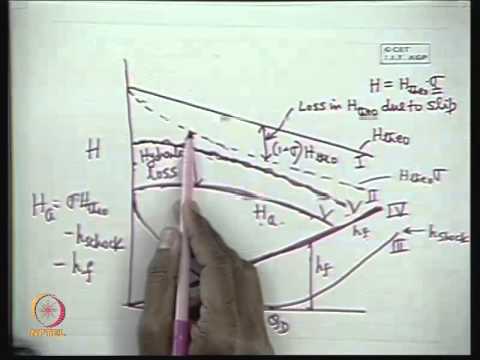
Regardez nptelhrd : Mod-01 Lec-15 Caractéristiques d'une pompe centrifuge