A self-priming pump may use a discharge check valve to prevent reverse flow and, in some installations, a foot valve on the suction pipe to retain liquid between starts. These valves are not interchangeable. Selection must follow the liquid, solids, flow range, pressure, allowable suction loss, installation orientation, maintenance access, and the pump maker’s piping instructions. A leaking valve can allow drainback and make the next start slow; a sticking or undersized valve can restrict flow; a valve that closes abruptly can contribute to a pressure surge. First identify which valve is present and what failure it is intended to prevent, then diagnose its actual condition before replacement.
Identify each valve by location and function
Trace the system on a drawing and on site. A discharge check valve is normally downstream of the pump and upstream of a discharge isolation valve in many arrangements. It limits reverse flow from a pressurized discharge system when the pump stops. A foot valve is a check valve at or near the submerged end of a suction line. It may help hold water in the line so a surface pump can restart without evacuating a full line of air. Some self-priming designs do not need a foot valve, or their manufacturer may discourage it because of added loss or clogging risk.
The Hydraulic Institute’s pump FAQs describe these general roles and warn that an inlet foot valve can affect available suction head and water-hammer behavior. The University of Florida IFAS irrigation pump guide explains why retained water and removal of air matter to priming. Neither source replaces the piping instructions for the exact pump.
Le BorraPumps SP self-priming dirt-drain pump is the product reference here. Its source image shows a dark-blue bare-shaft casing, not an assembled motor-and-valve system. The separate valves shown in this article’s illustrations are installation context, not claims that a particular valve is supplied with that product. The drain-pump range provides related applications.
Diagnose a valve that leaks backward
If the suction line drains while the pump is off, inspect a foot valve for debris on the seat, a damaged disc, incorrect orientation, or an air leak elsewhere. Do not blame the valve only because priming takes longer; a loose priming plug or hose joint can admit air with the valve working normally. If discharge pressure falls after shutdown, a discharge check valve may leak, but demand on the system or another path can produce the same symptom. Isolate sections using an approved procedure and record pressure or liquid-level change over a defined interval.
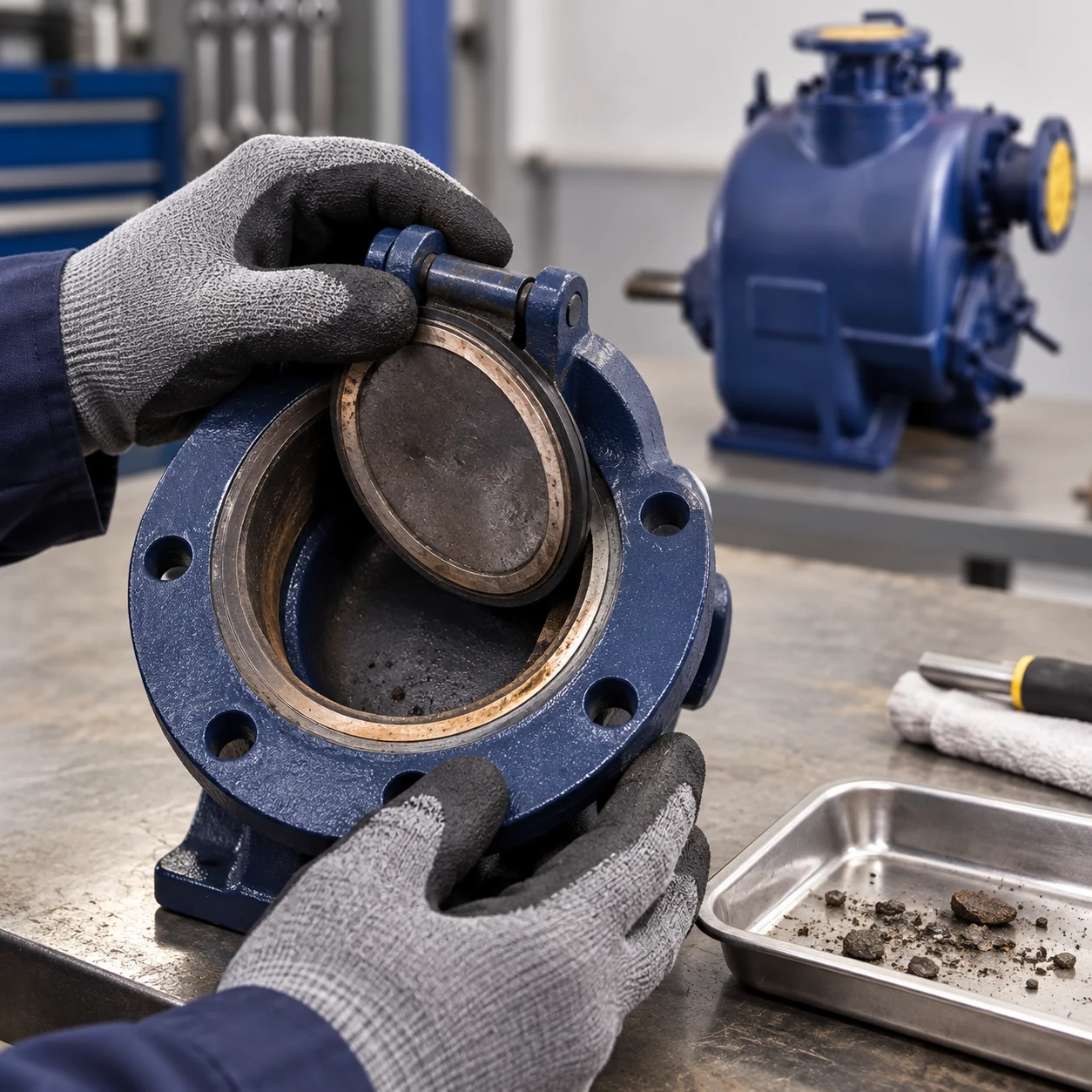
When wastewater or muddy water is pumped, fibrous debris and grit can prevent a valve from sealing. A fine-mesh strainer or tight-clearance valve chosen for clean water may clog. Inspect the inlet environment and solids specification as well as the valve. If the failed valve is a symptom of frequent cycling or reverse flow, correct the operating sequence and system layout before fitting a new part. The self-priming troubleshooting checks provide the broader no-flow diagnostic route.
Diagnose a valve that sticks or restricts flow
A stuck-open check valve may allow reverse flow; a stuck-closed or partially open valve can add head loss and reduce delivery. Check pressure on both sides at known flow where test taps exist. Listen for chattering or repeated impacts, but do not use sound alone to determine internal condition. Isolate and depressurize before disassembly. A disc can bind because of installation orientation, corrosion, debris, a broken spring, or operation below its stable opening flow.
The valve’s nominal pipe size is not enough to select it. Check its minimum opening flow, pressure-drop curve, materials, and solids passage. Oversizing a check valve can leave the disc unstable at normal flow; undersizing adds loss. In a suction-lift line, additional loss can be especially harmful because it reduces available suction margin. The self-priming cavitation guide explains why inadequate inlet margin can produce noise and poor flow that may be mistaken for a valve fault.
| Valve or symptom | Primary purpose or risk | Checks before replacement | Selection evidence |
|---|---|---|---|
| Discharge check valve | Stops reverse flow through pump | Pressure decay, seat, closure noise | Flow range, pressure, transient behavior |
| Suction foot valve | May retain water in suction line | Water-level loss, debris, suction loss | Solids, lift margin, access to clean |
| Valve leaks after shutdown | Can cause drainback or reverse rotation | Isolate other demand paths and air leaks | Seat material and orientation |
| Valve chatters at low flow | Disc may not open stably | Flow versus valve opening range | Correct size and spring or disc design |
| Large pressure drop | Adds required pump head | Measure differential at known flow | Manufacturer loss curve |
| Sharp closure impact | May create a surge | Observe stop sequence and reverse flow | Closure characteristic and transient study |
This table is qualitative. The pump, valve, pipe length, and operating sequence form one system; a valve that behaves well in one layout may not in another.
Consider water hammer and reverse flow
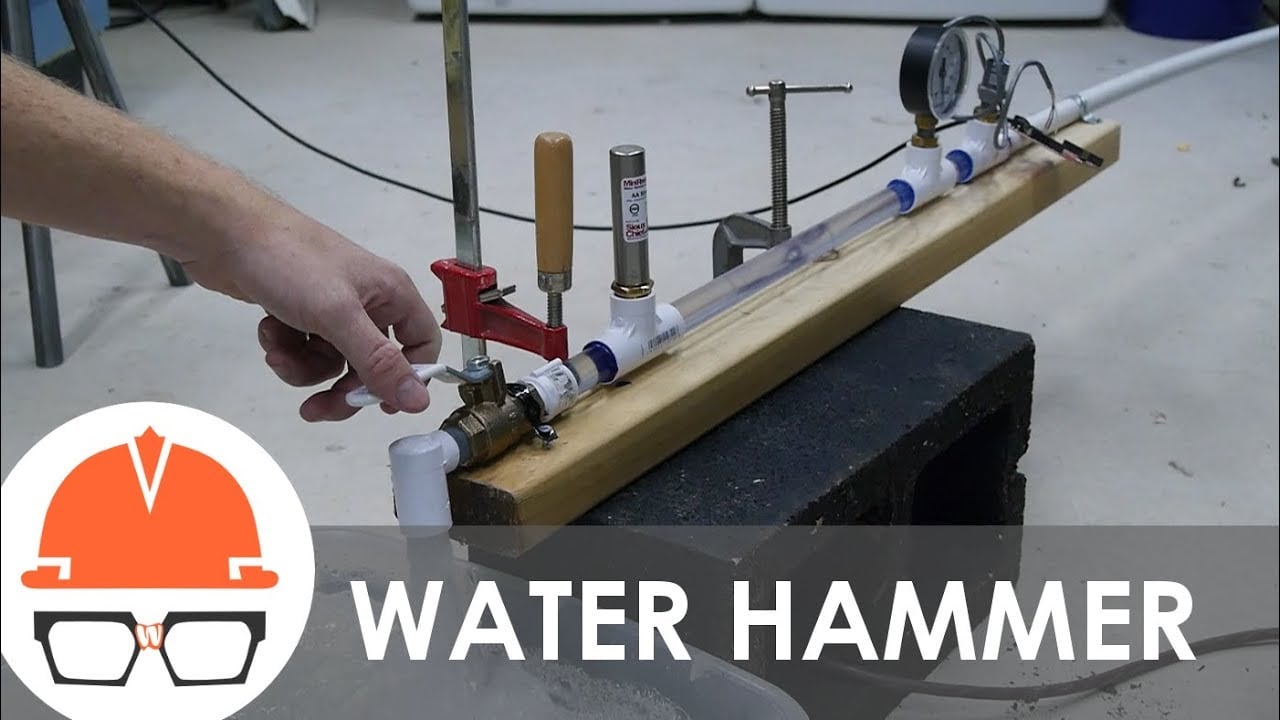
When a pump stops, moving water can reverse before a valve closes. Sudden closure can create a pressure wave, especially in long or high-head discharge lines. A valve labeled “non-slam” is not proof that all transients are controlled. The system may need a controlled stop, different valve characteristic, surge vessel, or transient analysis. The Hydraulic Institute’s field evaluation of check-valve designs shows that valve choice can materially change measured surge pressure in a specific station; do not transfer its numerical results to this installation.
Le booster water-hammer prevention guide covers the broader transient mechanism. For a self-priming pump, observe both suction and discharge behavior during stops and restarts. A foot valve may maintain prime but can also slam or block; a discharge check valve protects against reverse flow but may not prevent suction drainback through another path. Choose a valve only after the intended function is clear.
Match materials and solids to the liquid
For clean water, corrosion resistance and elastomer compatibility may dominate. For muddy water or sewage, the valve must pass the expected solids and be accessible for cleaning. For hot water or chemicals, the body, seat, spring, and elastomer must be rated for the liquid and temperature. Do not assume the pump’s material automatically determines the valve material. Request a complete material list and the valve maker’s compatibility advice.
Consider whether a flap, swing disc, ball, or spring-assisted design is appropriate. Each has different installation orientations, pressure loss, closing behavior, and solids tolerance. Avoid a generic rule that one type is always best for self-priming pumps. The correct choice follows the valve’s tested performance at the actual flow range and fluid condition. Make sure the selected valve can be removed without cutting out a long section of pipe.
Install for inspection and safe service
Show flow direction on the drawing and verify it physically during installation. Provide isolation and drain points so the valve can be checked without releasing pressurized liquid. Support the pipe independently of the pump nozzle and leave room to remove the valve body or internals. If the foot valve is submerged, consider how staff will retrieve and clean it safely. A valve installed deep in a muddy sump without access may become a chronic priming problem.
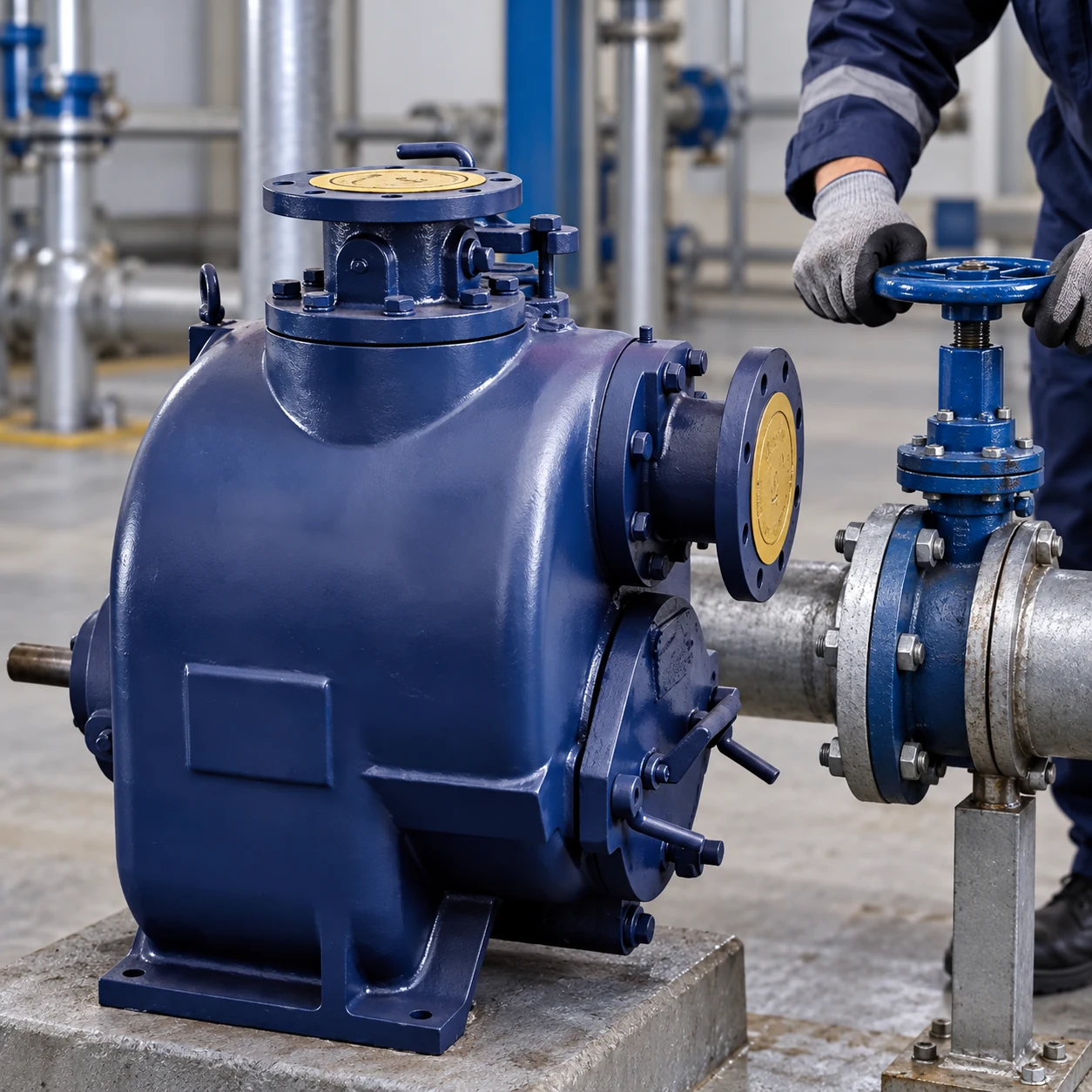
Follow required straight-run or orientation instructions where the maker specifies them. Avoid placing a heavy valve on an unsupported horizontal branch or an elbow that strains the pump flange. Check that a suction valve does not create a high point where air collects. After maintenance, confirm every isolation valve returns to its intended position and record the installed orientation and part number.
Commission at starts and stops
Test a first start with the correct casing fill, a short restart, and a restart after the system has stood long enough for the previous drainback symptom to occur. Observe suction level, pressure and discharge flow. Check discharge pressure decay and listen for valve closure impact while measuring if the risk requires it. A valve that holds pressure for a minute may still leak enough to empty a line overnight.
Record the pump model, valve model, size, material, flow direction, installation position, observed pressure drop, closure behavior, source level, and priming time. If the valve was changed to cure a problem, compare before-and-after measurements under similar conditions. A pump with poor suction piping will not be fixed by a more expensive valve alone.
What to request in a quotation
Provide liquid, solids size and concentration if known, normal and peak flow, suction or discharge location, static and transient pressure range, pipe diameter, operating orientation, temperature, corrosion environment, available suction margin, and required maintenance access. Request a pressure-drop curve, minimum stable flow, closure behavior, material schedule, installation instructions, and spare parts. Confirm whether the pump manufacturer approves a foot valve on the intended suction arrangement.
Foire aux questions
Does every self-priming pump need a foot valve?
No. Some self-priming pumps can restart using retained casing liquid without one. The need depends on the model and suction layout.
Can a discharge check valve keep the suction line full?
Not necessarily. It prevents discharge-side reverse flow; suction drainback may occur through a foot valve, pipe leak, or other path.
Why does a new check valve chatter?
It may be oversized, installed in the wrong orientation, exposed to unstable flow, or affected by debris. Check its operating range and the pump sequence.
Is a non-slam valve enough to prevent water hammer?
Not always. Pipe length, flow velocity, pump stop behavior, and other components govern the transient. Evaluate the system as a whole.
Further learning
Practical Engineering’s What Is Water Hammer? demonstrates why fast changes in water velocity matter to check-valve closure. It does not specify a valve for this pump; use the valve and pump makers’ data.