
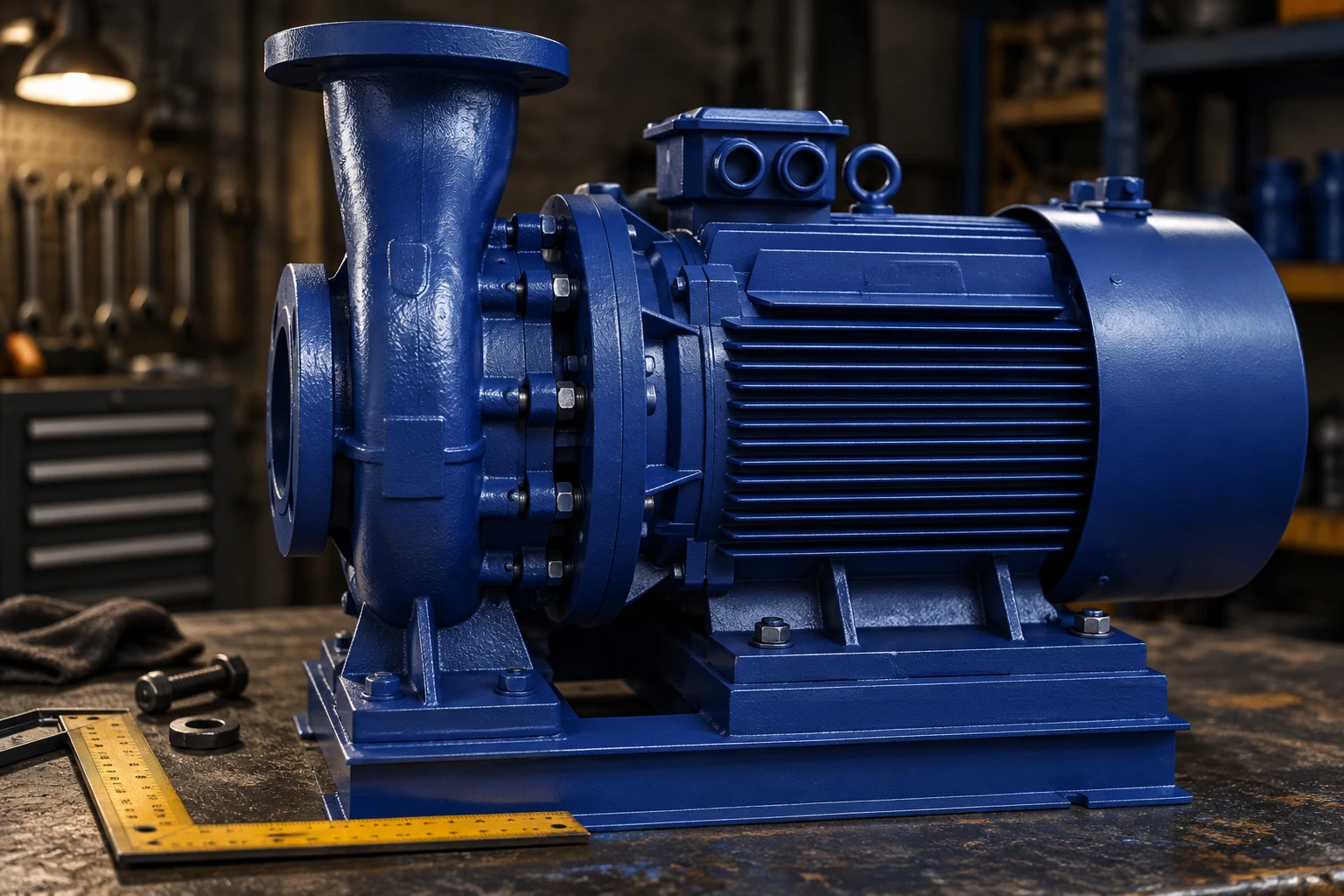
A close-coupled centrifugal pump generally connects the hydraulic unit directly to the motor arrangement, while a frame-mounted pump uses a separate supporting arrangement and coupling between pump and driver. The decision affects installation footprint, alignment responsibilities, service access and replacement options. Neither construction automatically guarantees better efficiency or reliability. Select the hydraulic duty first, then compare the exact mechanical designs and maintenance requirements. This guide concerns water-transfer procurement and does not assign undocumented construction or interchangeable parts to a Borra model.
Confirm what the supplier means by each term
Pump terminology varies between catalogues. Request an assembly drawing that identifies the pump shaft arrangement, motor connection, bearing support and coupling where fitted. Close-coupled does not mean every component is maintenance-free, and frame-mounted does not mean the motor can be changed to any available unit. Dimensions, loads, speed and interfaces still have to match the approved assembly.
Distinguish close-coupled from in-line layout. In-line describes the hydraulic or piping arrangement; coupling terminology describes how the pump and driver are mechanically arranged. A compact in-line product may be close-coupled, but those labels should not be treated as synonyms without the drawing. Similarly, a horizontal orientation alone does not prove a separate bearing frame.
O Borra ISW horizontal inline pump is a relevant product reference for a compact water-transfer discussion. Request its offered model’s sectional and installation drawings. Where a separate-frame alternative is proposed, obtain that exact assembly rather than assuming a generic frame can be added to the product shown on the website.
Start with the same hydraulic duty
Compare options at the same required flow and total dynamic head. Confirm the liquid, speed, impeller and permitted operating region. A mechanical arrangement cannot compensate for an unsuitable head-flow selection. Offers that state the same motor power may provide different hydraulic duties, so the power label is not a fair basis for comparison.
Utilizar how to read a centrifugal pump curve e o pump duty-point guide to establish the installed requirement. Check efficiency and power from the correct curves. Avoid claiming one construction is always more efficient without comparing the actual hydraulic and motor data at the same point.
O DOE pump-system resources support evaluating the whole installation. Pipe resistance, operating hours and controls can matter more to energy use than a broad coupling category. Keep those system inputs constant when comparing life-cycle costs.
Compare footprint and service envelope separately
A short assembled length can help in a constrained room, but the physical footprint is not the full service requirement. Allow the documented clearance for removing seals, motors, couplings or hydraulic components. Check the lifting and set-down route, access to bolts and space for tools. A pump that fits tightly between pipes may be costly to service if major equipment has to be moved first.
Frame-mounted arrangements may provide different component-removal options, depending on the actual design. Confirm what can be removed without disturbing the piping and what must be realigned afterward. Do not assume a back-pull-out feature or spacer coupling exists merely because the pump has a separate baseplate.
Review the plan and section of the installed arrangement, including nearby walls, cable routes, pipe supports and floor drainage. Identify who provides lifting equipment and whether it can reach the actual component. Keep service clearances on the drawing rather than relying on a sales description such as easy maintenance.
Understand the alignment responsibilities
Where a separate coupling is supplied, shaft alignment and coupling installation require the manufacturer’s procedure and appropriate measurements. Foundation condition, baseplate support and piping loads can affect alignment. An assembly aligned before shipping may need verification after installation and again under the required commissioning conditions.
A close-coupled design removes some separate-coupling tasks, but it still needs correct mounting, pipe support and assembly checks. Mechanical loads should not be transferred through the pump because a pipe route is misaligned. Verify permitted loads and support requirements from the selected model’s documentation. Compact construction is not permission to suspend arbitrary pipe weight from its flanges.
Record the checks performed and the acceptance basis. Do not invent universal alignment tolerances or bolt torque values. If the required information is absent, request it from the supplier before installing. Measurements without a documented limit cannot establish acceptance, and a label such as factory aligned does not replace the final installation procedure.
Compare maintenance tasks at component level
Ask how the seal is replaced, what must be disconnected and whether the motor or pump bearing components are separately serviceable. Obtain exploded parts information where available and identify the specific items the owner should keep. A close-coupled unit may need a particular motor shaft or interface, while a frame-mounted assembly may have its own bearing and coupling parts.
Evaluate the local availability of qualified service and correct parts. A familiar motor brand does not establish that an unmodified standard replacement will fit a specialized pump connection. Record the required motor frame, shaft interface, speed and electrical specification from the approved assembly.
Determine the consequence of each likely service event. If replacing a seal means removing the whole unit from a difficult pipe route, installation labor may dominate the parts cost. If a separate frame adds alignment work, include that work in the maintenance plan. Compare actual tasks rather than using one category as a universal reliability ranking.

Use a mechanical comparison checklist
| Pergunta | Close-coupled offer | Frame-mounted offer |
|---|---|---|
| serviço hidráulico | Verify exact curve and motor data | Verify exact curve and driver data |
| Shaft arrangement | Identify motor and pump interface | Identify shaft support and coupling |
| Instalação | Confirm mounting and pipe support | Confirm baseplate, support and alignment |
| Service space | Check motor and seal removal path | Check coupling, bearing and hydraulic removal path |
| Replacement parts | Confirm interface-specific components | Confirm frame, bearings and coupling components |
| Passagem de testemunho | Obtain assembly and service documents | Obtain assembly, alignment and service documents |
This qualitative table avoids assumed performance advantages. The Hydraulic Institute discussion of operating regions provides context for the hydraulic conditions that remain important regardless of mechanical construction.
Keep electrical and environmental requirements visible
Verify supply voltage, phase, frequency, starting method and any variable-speed arrangement with qualified personnel. Motor enclosure and environmental suitability must match the site. Wet locations, heat, dust or aggressive conditions can affect the required selection. Do not infer suitability from a photograph of a pump in an outdoor illustrative setting.
Cable routing and isolation must allow safe maintenance. The official hazardous-energy control regulation explains why equipment should be effectively isolated before service. The work requires the applicable site procedure and the actual motor and pump documentation; this comparison is not an electrical installation guide.
If a variable-speed drive is included, verify the permitted speed range and its effect on hydraulic operation, loading and cooling. A different motor or coupling configuration may require a revised review rather than a simple component substitution. Keep electrical and mechanical changes in one approved selection record.
Compare costs over an identified service period
Include equipment, foundation or mounting work, pipe changes, electrical installation, commissioning, planned maintenance and likely downtime. Use actual quotations and documented operating data. Do not invent annual energy savings or service intervals from the category name. A compact option can reduce one construction cost while increasing a particular maintenance task; another arrangement can have the reverse tradeoff.
State the expected service hours and how critical interruption is to the process. A noncritical transfer pump with easy replacement has different priorities from a continuously required utility station. Discuss spare equipment and temporary continuity measures where needed. The lowest purchase price should be reviewed against those specific requirements rather than a general claim of better life-cycle value.
Verify the delivered assembly and handover
Check the delivered model, motor, coupling if fitted, baseplate and accessories against the approved offer. Record any substitution and obtain review before installation. During commissioning, verify installed duty and mechanical behavior according to the manufacturer’s procedure. Keep the actual configuration and initial measurements as the service baseline.
The final file should contain the curve, assembly drawing, installation procedure, parts references, electrical data and commissioning results. Include alignment records where applicable and the service-removal plan. This makes future replacement decisions traceable and avoids repeating an undocumented assumption about how the unit is constructed.
For the wider water-transfer selection, use the end-suction pump guide alongside this specific calculation or construction review.
Perguntas frequentes
Is close-coupled always more compact to maintain?
Its assembled footprint may be smaller, but maintenance still needs the documented removal clearances. Compare the complete service envelope, lifting route and component access rather than the catalogue dimensions alone.
Does frame-mounted always mean a standard motor fits?
No. Confirm the approved driver dimensions, shaft interface, speed, load and electrical requirements. A separately coupled arrangement still needs compatible components and correct installation.
Can pipe weight be carried by a compact pump?
Only within the model’s documented limits and installation design. Provide proper pipe support and avoid forcing flange alignment. Do not treat compact construction as permission to transfer arbitrary loads through the housing.
Which evidence should decide the comparison?
Use the same hydraulic duty, exact assembly drawings, installation requirements, service procedure, parts availability and complete cost scope. Category labels alone cannot establish efficiency, reliability or replacement compatibility.
Aprimoramento
This NPTEL educational lecture explains centrifugal pump characteristics used in the hydraulic selection above. It does not verify a Borra rating or replace the selected model curve.

Watch nptelhrd: Mod-01 Lec-15 Characteristics of a Centrifugal Pump