Choosing between a two-pump and three-pump booster set is a duty-and-risk decision, not a simple count of motors. A two-pump set can be efficient for a small or predictable demand profile, while a three-pump set can provide better staging and a more useful failure case when the building must continue operating with one pump unavailable. The correct comparison uses the required flow at the design head, the smallest useful operating step, the expected duty/standby philosophy, available floor space, service access, controls, and the owner’s acceptable loss of service. The package must then be checked against a real pump curve and system curve.
Define what “redundancy” must cover
Start by stating the service requirement in plain language. Does the owner need full design flow with one pump out of service? Is reduced pressure acceptable during maintenance? Must the set start at night-time trickle flow without cycling? These answers change the arrangement. Two pumps may be arranged as one duty and one standby, or both may share the peak. Three pumps may be two duty plus one standby, three staged for peak demand, or a lead/lag arrangement with rotation.
Equipment redundancy does not automatically make the whole water system resilient. A common suction header, one failed isolation valve, an empty break tank, a single control power supply, or a blocked discharge can still stop every pump. The BorraPumps booster-regulator water-supply package should therefore be reviewed as part of the complete boundary, including inlet conditions, controls, valves, vessel, and bypass decisions.
Compare the operating steps
Parallel pumps share approximately the same differential head, but their flow contributions depend on the curves and the system. A two-pump set normally has a larger jump between one-pump and two-pump operation. A three-pump set can add capacity in smaller steps, which may improve pressure stability when demand rises gradually. Smaller steps can also reduce unnecessary starts if the control sequence is tuned to actual demand.
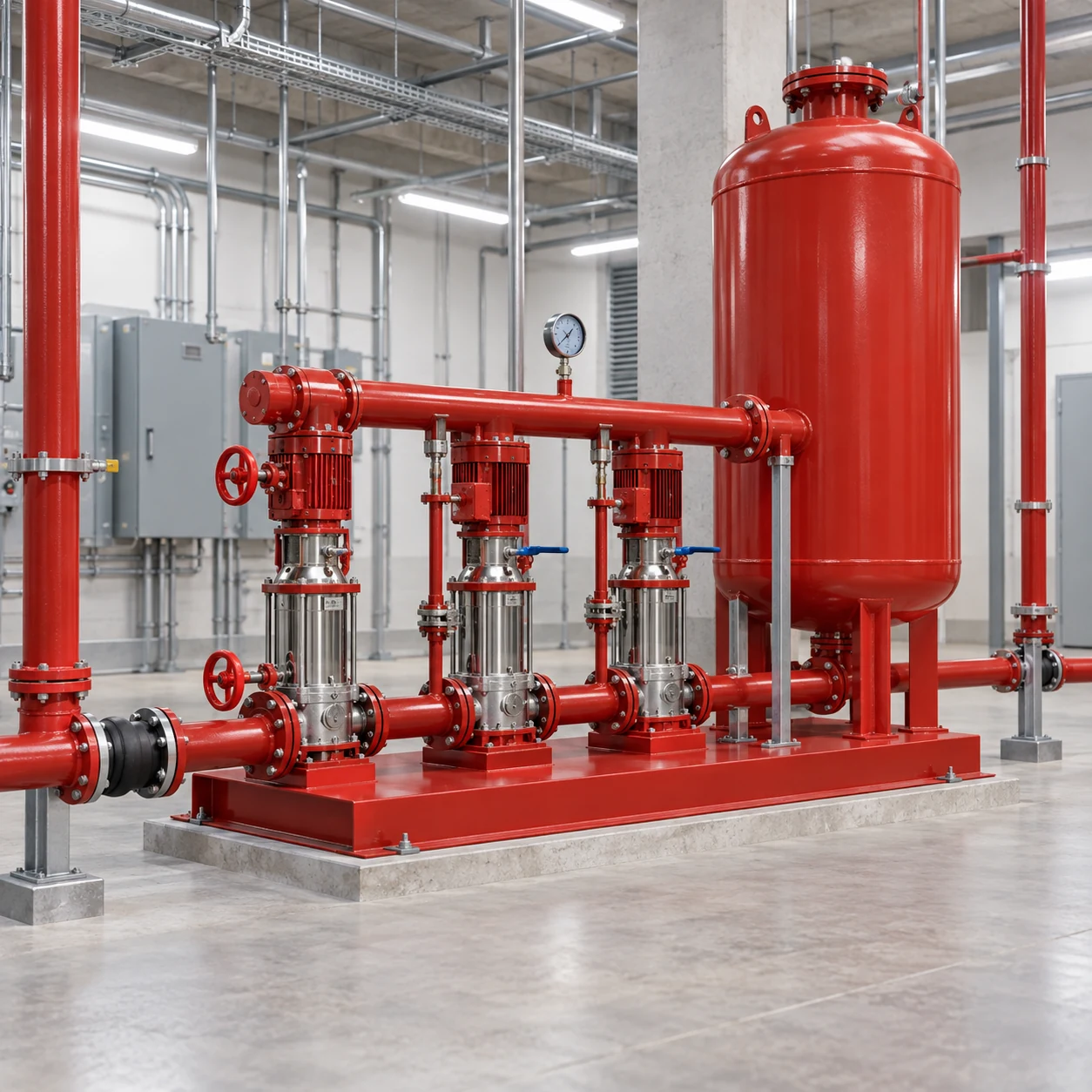
The practical benefit depends on pump selection. Three undersized pumps may still fail to deliver the required peak duty, while two correctly selected pumps may meet a modest load. Conversely, a pair of oversized pumps can produce a large minimum step and frequent starts. Ask the supplier to show one-pump, two-pump, and, where relevant, three-pump operating points at the project flow and head.
| Decision item | Two-pump set | Three-pump set | Check before ordering |
|---|---|---|---|
| Low-demand staging | One pump may be a large step | More gradual staging is possible | Minimum stable flow and starts per hour |
| Full-load capacity | Often two pumps in parallel | One, two, or three pumps can share duty | Combined curve at design head |
| Failure case | One remaining pump may carry part of load | One pump can be unavailable while two remain | Required service with the failed unit |
| Controlos | Simpler lead/lag logic | More staging and rotation logic | Sequence, alarms, and manual mode |
| Footprint | Usually shorter | More equipment and clearance | Access path and maintenance space |
| Custo inicial | Often lower | More motors, valves, and controls | Whole-life cost, not only purchase price |
The table is a design comparison, not a universal rule. Actual flow, head, motor size, vessel arrangement, local electrical requirements, and the selected manufacturer’s limits govern the final package.
Size the duty point before counting pumps
Estimate the probable design flow from the building’s fixtures and operating profile, then calculate the required head at the controlling point. The apartment booster flow guide explains why fixture count alone is not the same as simultaneous demand. The multi-story head calculation guide shows how elevation, residual pressure, component losses, and available inlet pressure belong in one consistent balance.
Do not divide a required flow by two or three and immediately select a pump from a catalogue. First decide whether each pump must carry the full emergency duty, a share of the normal peak, or a defined reduced service. Then check the curve at the actual common head. For a hypothetical 120 gpm peak at 90 ft of head, two equal pumps might be selected around 60 gpm each for normal parallel duty, but that does not prove one pump can maintain acceptable service alone. A three-pump arrangement might use 40 gpm modules, yet the additional staging only helps if the curves remain stable at the lower flows.
Review redundancy at the system boundary
For a meaningful failure test, list every component that can stop water delivery. Include incoming isolation valves, strainers, check valves, pressure sensors, control panel power, communication links, the vessel, and the discharge header. If all pumps share one component, that component is a common-mode vulnerability. A third pump does not repair it.
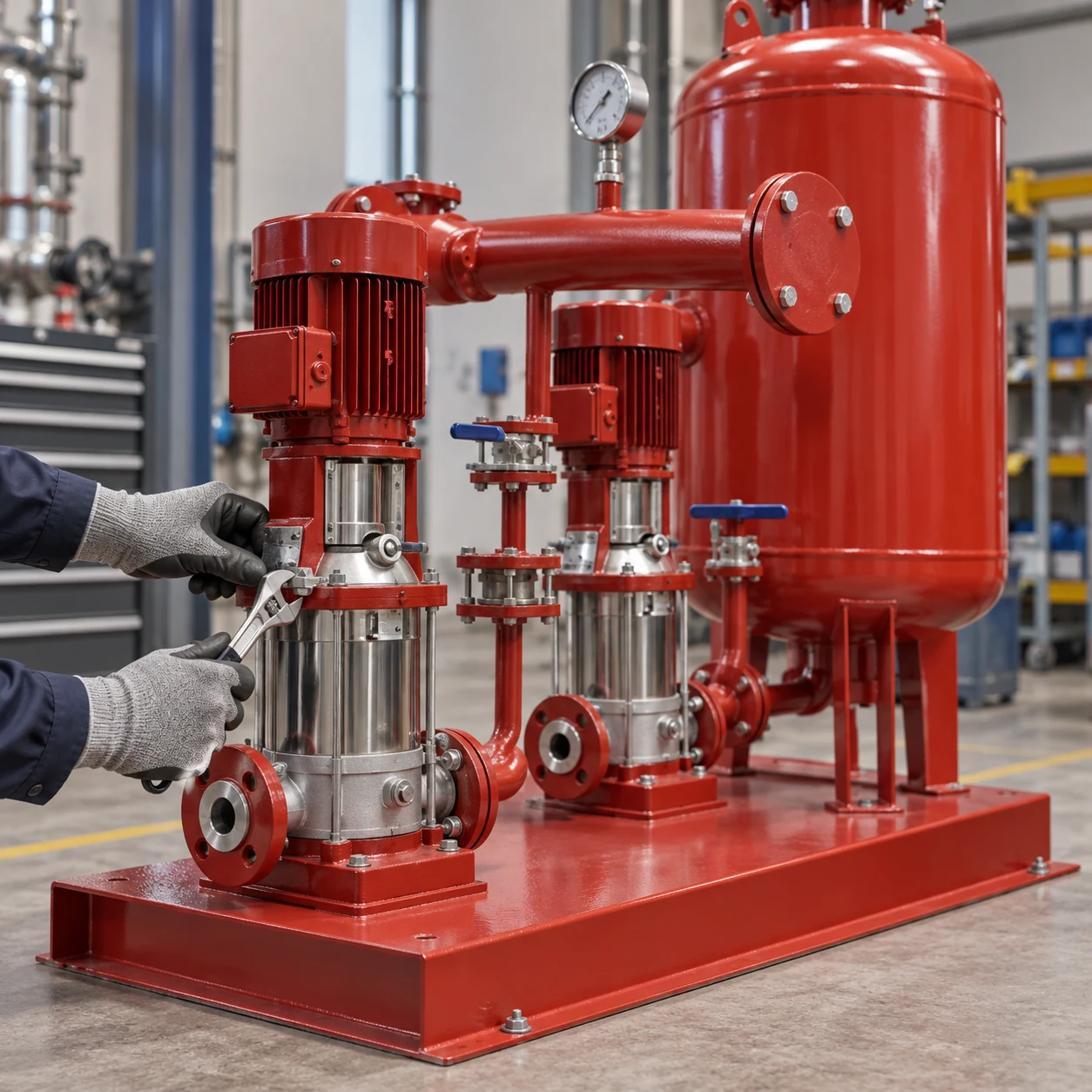
Ask whether the owner expects automatic rotation, manual isolation, or a technician to intervene. Provide enough valve and access clearance to remove a pump without dismantling an entire header. The duty and standby configuration guide explains how lead/lag and standby wording should be tied to a testable failure case rather than a marketing label.
Match controls to the demand pattern
The controller should rotate lead pumps, start the next pump only when the first cannot maintain the control target, and stop pumps in reverse order as demand falls. Set minimum run and rest times only after considering the pump, motor, vessel, and the building’s pressure response. A variable-speed drive can smooth some transitions, but it cannot compensate for a poor sensor location or an incorrectly calculated head.
Use pressure, flow, motor status, and fault signals together where the risk assessment requires it. Define what happens on a failed pressure sensor, a pump trip, a low-inlet condition, and a loss of control power. A manual bypass may be useful for maintenance, but it must not silently defeat low-pressure or high-pressure protection.
Consider space, noise, and service
Three pumps need more room around motors, valves, and lifting points. The extra footprint can be worthwhile if it allows a failed unit to be isolated while the remaining pumps operate. Check the door width, lifting route, drainage, ventilation, electrical panel location, and access to the pressure vessel. Do not place a third pump where it cannot be removed.
Noise and vibration are affected by speed, foundation, pipe support, flexible connectors, and operating point. A larger number of small pumps is not automatically quieter. Confirm the installation’s structural and acoustic constraints and provide a commissioning baseline so a future change can be detected.
Build a supplier inquiry that can be checked
Send the supplier the design flow, required differential head, minimum and maximum inlet pressure, fluid and temperature, voltage and frequency, control target, duty/standby requirement, installation dimensions, and acceptable failure service. Request curves for each staging case, motor data, control sequence, vessel arrangement, valve schedule, and the service-clearance requirements. The BorraPumps water-supply range can help identify candidate package types, but the final choice must follow the project’s hydraulic and electrical information.
Review lifecycle cost and spares
The larger set is not automatically the more economical set. Compare energy at the expected operating profile, not only at the single peak point. A three-pump arrangement may run one smaller pump for much of the day, while a two-pump arrangement may have fewer starters and a simpler control panel. Include replacement motors, seals, check valves, sensors, drives, commissioning labor, and the cost of taking a pump out of service. Ask whether the owner can keep one complete pump or common control component as a spare.
Make the choice traceable
Put the alternatives on the same schedule. List the required normal flow, peak flow, head, one-pump failure duty, staging points, start frequency, power, dimensions, service clearance, and control assumptions. Mark each value as measured, calculated, or an owner requirement. This makes a later change visible. If a tenant load increases, the engineer can see whether the change affects flow, head, staging, vessel drawdown, or the failure case instead of simply adding a motor.
Verify the proposal in the plant room
Before approval, walk the proposed arrangement through the actual room. Check that the suction and discharge headers can be isolated, that a pump can be lifted out, that the panel door can open, and that drains do not discharge onto electrical equipment. Confirm that the pressure vessel, control panel, and valves have enough clearance for inspection. A diagram that fits on paper can fail at the door or at the lifting route.
Ask for a written sequence of operation. It should explain lead rotation, staging, standby start, manual operation, low-inlet protection, high-pressure protection, sensor loss, and power restoration. Require the supplier to identify which tests prove each claim. This turns the word “redundant” into observable behavior and gives the owner a practical acceptance checklist.
Engineering sources
For pump-system efficiency and operating-point context, see the US Department of Energy pump-systems resources and its pumping-system sourcebook. These sources provide general engineering guidance; the selected equipment manual, project calculations, and applicable codes govern the final design.
Perguntas frequentes
Is three pumps always better than two?
No. Three pumps can improve staging and a defined failure case, but they add controls, valves, space, and maintenance. Select the arrangement that satisfies the actual duty and resilience requirement.
Can two pumps provide full redundancy?
Only if the remaining pump can meet the required service when the other is unavailable and common components remain serviceable. State the failure case explicitly.
Should all pumps be the same size?
Often identical pumps simplify rotation and spares, but mixed sizes can suit a highly uneven demand profile. The complete staged curves and control sequence must be checked.
What should be compared in a quotation?
Compare curves at every operating step, motor and control data, valve and vessel arrangement, service access, failure behavior, warranty scope, and documented commissioning requirements, not only the number of pumps.
Further learning
The NPTEL IIT Kharagpur lecture on pump characteristic curves is useful background for understanding why the installed system can behave differently from a catalogue point. It is educational material, not a substitute for the selected pump manual, project calculations, or local code review.