Select an open-pit mine dewatering pump from the mine’s evolving water balance and discharge route. Separate direct rainfall and run-on, groundwater entering pit walls or floor, process water, and stored water after a storm. Then define the required drawdown time, lowest pumpable level, total head to treatment or discharge, solids and abrasion, power or fuel availability, access to each mining bench, and the consequence of a pump failure. A mobile trailer pump may move with mining, but its pictured form does not establish a mine-duty curve, solids rating or permitted use. Verify the exact model, source water and discharge plan at every planned pit stage rather than buying from one maximum-flow number.
Treat pit dewatering as a changing system
The water source and pump location change as the pit deepens. A pump that reaches an outlet at an early bench may face much greater static lift and hose loss at a lower bench. Rainfall runoff can arrive quickly along haul roads; groundwater may persist through dry periods or enter preferentially through fractures. Process water from drilling or dust control can add another operating case. Do not use the same rate for all sources without evidence. The excavation dewatering flow guide shows how to separate rates and stored volume in a time-based balance.
A US Geological Survey open-pit mine groundwater study documents that mine dewatering can alter groundwater levels and flow patterns beyond a single pit. Its site-specific numbers are not transferable to a new mine, but it illustrates why a hydrogeologic assessment matters. Define whether the project only removes collected pit water or also needs groundwater lowering outside the active work area. The latter can require a designed well or pressure-relief system in addition to sump pumps.
Select a product from a verified duty
The BorraPumps SCPY high-suction-lift trash-water trailer pump is the real site product reference. Its image shows a blue centrifugal casing, engine, yellow coupling guard, wheel, protective frame and stabilizing jacks. It is a candidate type for review, not a declaration that it meets a particular open-pit mine duty or hazardous-area requirement. Obtain the exact pump and engine curves, priming limits, allowable solids and materials. The trailer-pump range contains related mobile options.
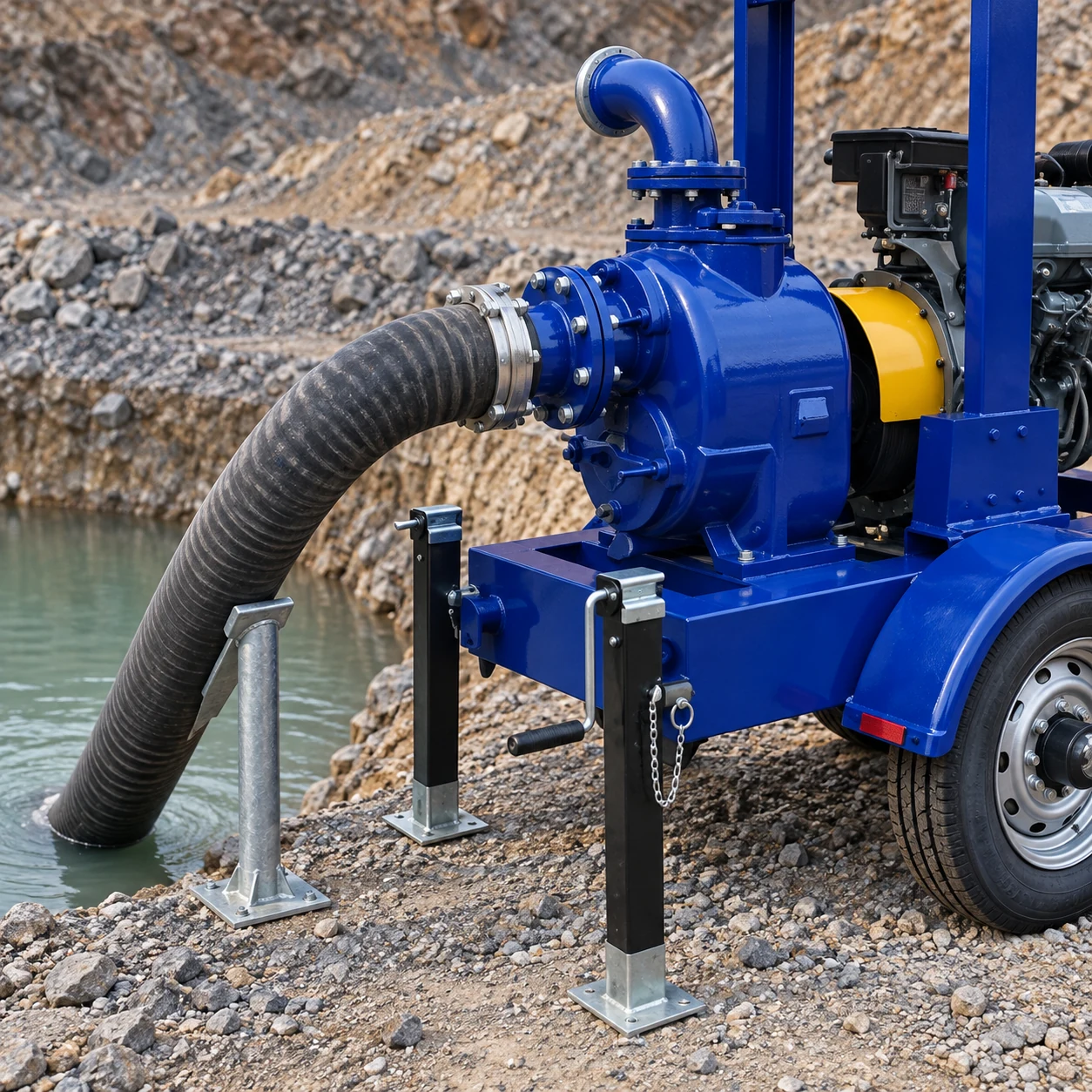
Match design flow to both routine seepage and credible storm recovery. Determine how much water can be stored safely in sumps or designated low areas before it affects haul roads, equipment, slope stability or work. Define the maximum time allowed to restore the level. A smaller pump with adequate storage and a tested backup may outperform one oversized unit that short-cycles in dry periods, but the selection must follow the mine’s consequence assessment.
Calculate head for each mining stage
At each planned bench, survey the lowest source water level and the final outlet or treatment tank. Add pipe and hose friction, elbows, check valves, screens and treatment losses at design flow. A longer, steeper route as the pit deepens can sharply reduce the output of a fixed-speed pump. The construction dewatering head guide explains a consistent elevation datum and avoids counting suction lift twice. Request pump curves for both the early-stage and deepest-stage routes.
If two pumps feed a common discharge line, plot their combined curve against the actual system curve. Do not multiply one pump’s catalogue flow by two. Check whether the hose and treatment unit can accept the combined rate and whether one pump can keep water below the critical level during service. The driver must be capable of the selected duty at site altitude and temperature; a nominal engine rating is not enough.
| Pit design input | Why it changes the pump choice | Evidence to collect |
|---|---|---|
| Routine groundwater seepage | Sets sustained run duty | Investigation and measured dry-weather inflow |
| Storm and run-on | Creates short peak and recovery duty | Local rainfall and drainage map |
| Pit stage and bench elevation | Changes static head and access | Staged survey and route drawings |
| Hose length and treatment | Adds flow-dependent head | Component curves and layout |
| Solids and chemistry | Controls wear, blockage and materials | Representative water and sediment samples |
| Power or fuel | Limits placement and unattended operation | Electrical survey or fuel plan |
| Failure consequence | Determines standby and alarm response | Critical water level and response time |
This is a site-data checklist. No numerical flow, head or solids capacity is inferred for the BorraPumps model.
Handle abrasive and variable solids
Pit water can contain fines, sharp rock particles, clay, oil or process residues. A trash-water description may not cover dense abrasive slurry. Confirm particle size distribution, concentration, hardness, pH and temperature. Check the pump’s internal passages, impeller, casing, seal, hoses and valves as one path. A strainer that prevents large stones may still pass fine abrasive grit; a fine screen can clog and starve a surface pump. Ask the supplier how the quoted curve changes with the actual mixture.
The Hydraulic Institute’s slurry-properties tutorial explains how solids concentration and specific gravity affect classification of slurry services. Use it to organize samples, not to assume that a particular SCPY unit is a slurry pump. Set inspection intervals from measured wear and the operating duty. Keep replacement hoses and wear parts accessible without stopping the mine’s only drainage route.
Place the pump safely on a stable bench
A trailer or skid should be set on stable ground with its jacks and restraints used according to the equipment manual. Keep it away from unstable edges, vehicle paths, blasting activity and areas that could flood before staff can move it. Plan the lifting or towing route as the pit geometry changes. Secure suction and discharge hoses against abrasion, traffic damage and sudden movement. Put the intake where it remains submerged but is accessible for cleaning and not buried in the heaviest sediment.
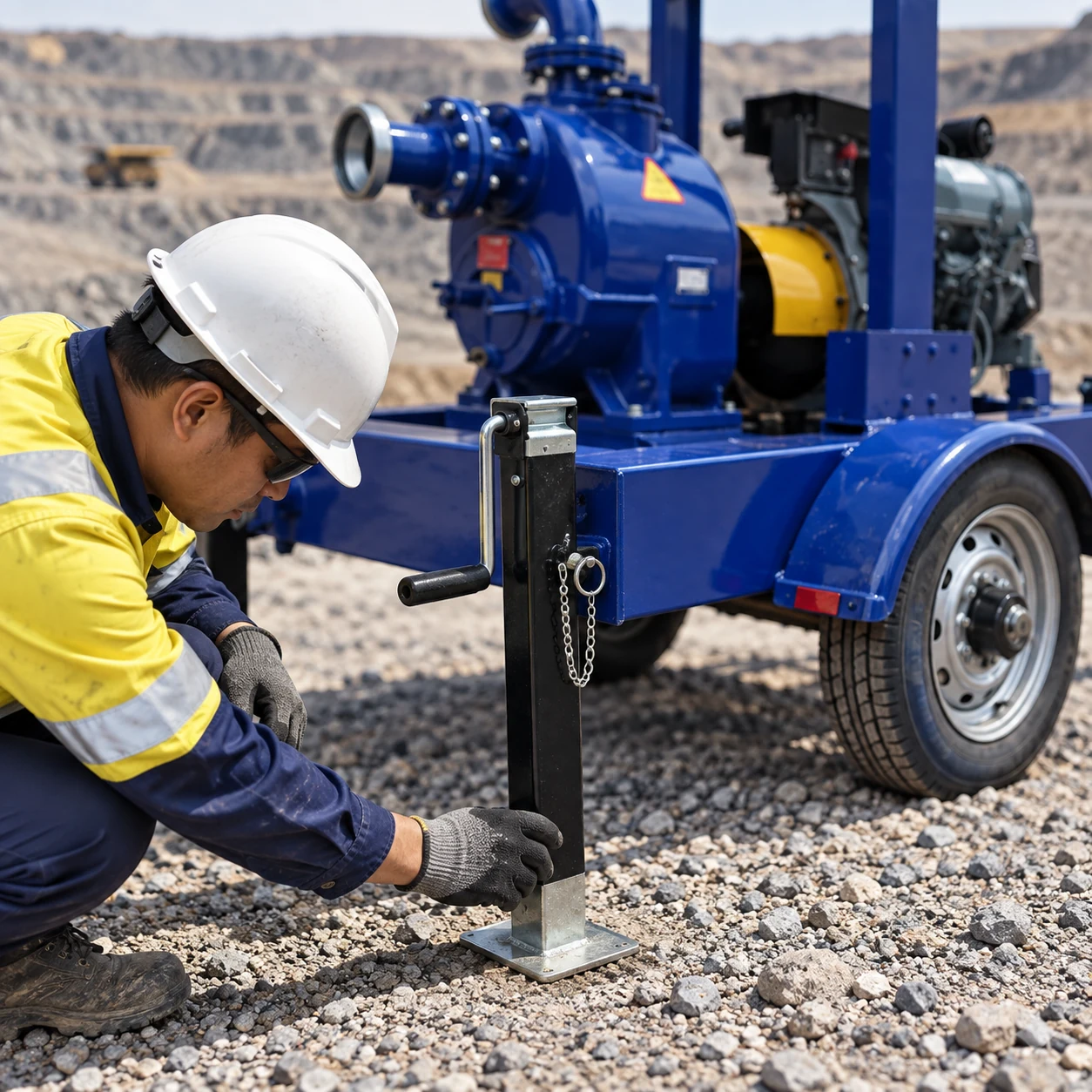
The Mine Safety and Health Administration’s mine-water inundation prevention bulletin emphasizes knowing adjacent workings and water levels. It is a hazard-awareness resource, not a pump sizing rule. Pumping surface water does not by itself prove a bench is stable; the mine’s qualified ground-control personnel must decide where equipment and workers can safely operate.
Compare mobile diesel with fixed electric service
Mobile engine-driven packages can follow changing pit work before permanent power is extended, but fuel delivery, exhaust, noise, service access and monitoring must be planned. A fixed electric station may suit sustained flow at a stable location, yet cables, protection, backup power and relocation costs can be substantial. The diesel versus electric dewatering comparison applies the same hydraulic duty to both drives. For a mine, also review site electrical standards and the interaction with haulage, blasting and high walls.
Do not call a mobile diesel pump “redundant” if both units depend on one suction intake or blocked discharge line. Standby arrangements should be tested at the head and flow they must carry alone. A high-water alarm must reach a person able to respond before water reaches the critical level. If the mine operates through multiple shifts, specify inspection and fueling intervals that fit that schedule.
Protect the discharge boundary
Mine water may need sedimentation, treatment or monitoring before release or reuse. Discharge route and permitted rate can constrain useful pump flow. The US EPA’s metal-mining stormwater fact sheet describes diversion and pollution-control considerations for exposed mine areas. Different minerals, receiving waters and jurisdictions have different permit conditions; use the project’s current approval rather than assuming one universal rule. Include the treatment unit’s clean and dirty head loss in the pump calculation.
Survey where the outlet goes during high external water levels. A rising receiving pond can add backpressure and reduce the actual flow. Keep discharge away from unstable slopes and erosion-sensitive areas. If the water is reused for dust control or process use, define that demand and storage separately from emergency pit drainage. The same pump may not serve both duties well.
Commission, trend and reselect when the pit changes
At each major stage, measure pit water level, flow, suction and discharge pressure, engine speed or motor input, hose arrangement and sediment load. Compare these with the design curve. Record run hours, starts, fuel or energy, vibration and seal leakage. A falling flow may be caused by a deeper pit, longer hose, clogged screen or pump wear; do not replace the wet end before locating the cause. Test high-level alarms, power or fuel loss and the standby unit under real water load.
As the pit deepens, update the water balance and total head. A pump that no longer meets the duty may need a booster station, staged pumping or a different outlet route. Recheck the groundwater model when observed seepage or drawdown differs materially from predictions. Selection is a living engineering decision, not a one-time purchase.
Sık sorulan sorular
Can one trailer pump serve an open-pit mine for its full life?
Possibly, but only if the changing flow, head, solids, access and failure duty remain within its verified limits at every stage.
Is a trash-water pump automatically suitable for abrasive mine slurry?
No. Confirm solids concentration, hardness, particle size, materials, seal and performance correction for the exact model.
Which water level controls pump head?
Check the lowest credible source level and the relevant outlet level for each pit stage, including treatment backpressure and hose losses.
Why is standby pumping important?
If water reaches a hazardous level before repair, a tested backup and alarm response may be essential. Size it for the duty it must carry alone.
Gelişmiş öğrenme
NPTEL IIT Kharagpur Dewatering lecture, Part 2 gives an educational overview of groundwater-control choices. It does not replace the mine’s hydrogeologic, slope-stability or equipment design.