A booster pump that cycles on and off repeatedly is responding to a control condition that is changing too quickly, a pressure vessel that is not providing useful storage, a sensor or switch that is misreading the system, or a hydraulic problem that prevents the set from reaching a stable operating point. Short cycling wastes energy, heats the motor, increases starts and stops, and can make building pressure uncomfortable. The right remedy begins with a timed record of pressure, flow, pump state, and valve conditions. Raising the pressure setpoint without diagnosis can hide the cause and create overpressure.
Confirm what “cycling” means
Record how many starts occur in an hour, how long the pump runs, the pressure at start and stop, which pump is lead, and whether any fixture is open. Distinguish normal staging from a fault. A set may start a second pump as demand rises and stop it as demand falls; that is not necessarily a defect. Cycling occurs when the same pump starts and stops repeatedly while demand appears steady, or when the pressure signal crosses the control band without a real change in use.
The BorraPumps booster-regulator equipment should be assessed with its actual control requirements, vessel arrangement, inlet conditions, and pump curve. Do not infer the package’s pressure settings, sensor type, or allowable start frequency from an image.
Check the pressure vessel and pre-charge
A pressure vessel can buffer small demands, but only when its usable volume and pre-charge suit the system. A vessel that is waterlogged, isolated, incorrectly charged, or too small may offer almost no drawdown. A failed bladder or diaphragm can change the effective air volume. Follow the vessel and pump manufacturer’s isolation, depressurization, and charging instructions; do not open a fitting on a live pressurized system.
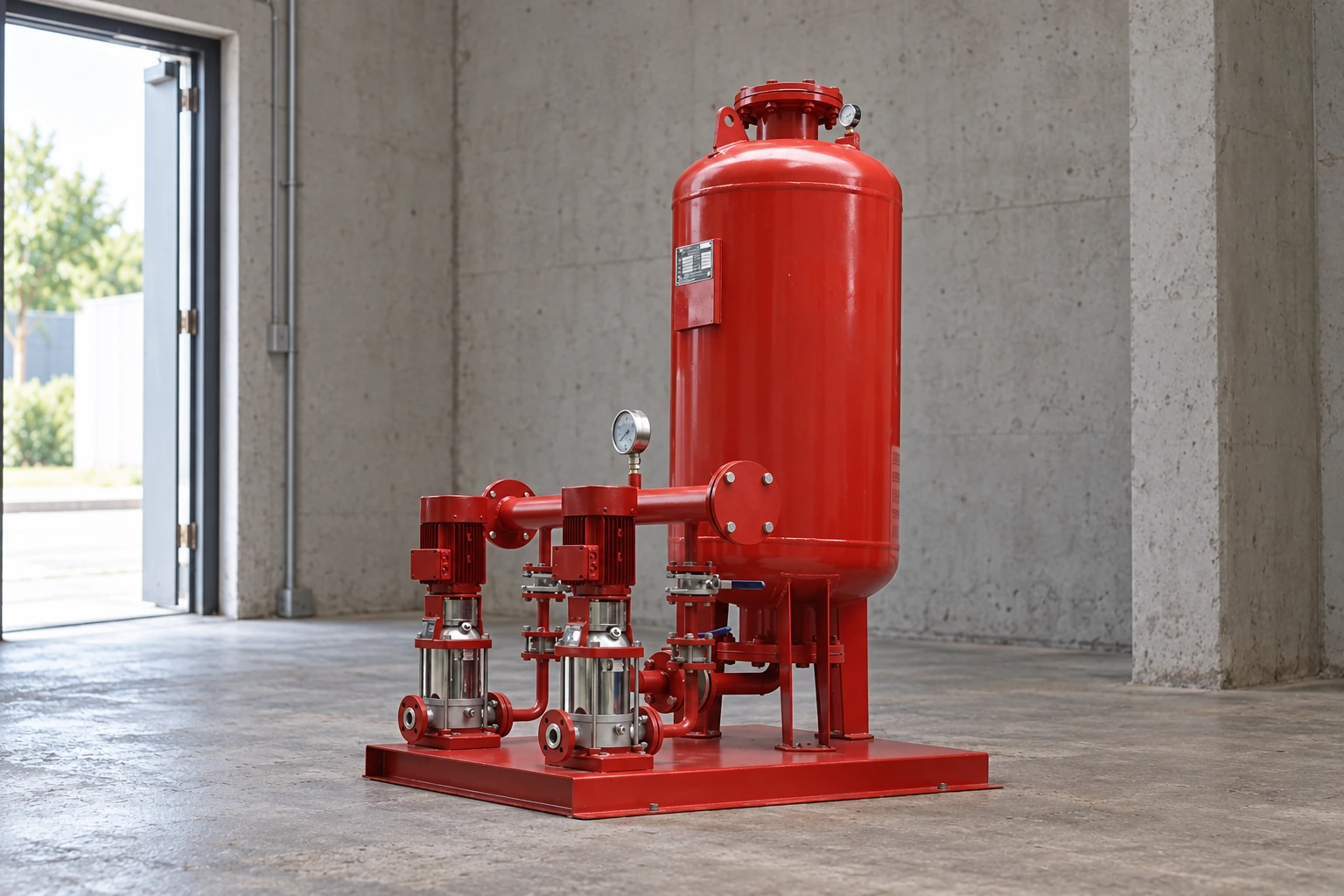
Measure and document the vessel condition safely with the water side depressurized as required. Verify that isolation valves are open after service and that the vessel is connected at the intended hydraulic point. The correct pre-charge is project- and equipment-dependent; never copy a number from another building without checking the design and manufacturer instructions.
Verify the sensor, switch, and control band
Compare the controller reading with an independent gauge at the same hydraulic point and elevation. Check for a blocked impulse connection, trapped air, a loose electrical terminal, a damaged transducer, an incorrect range, or a pressure switch differential that is too narrow for the system. A sensor installed near pump pulsation, a check valve, or a turbulent elbow may see a rapidly changing pressure that the users do not experience.
The pressure sensor placement guide explains why the measured point must match the control objective. Define the start and stop or variable-speed band deliberately. A narrow band can improve pressure precision but can also cause frequent starts when the hydraulics or sensor response are slow.
| Triệu chứng | First checks | Possible corrective direction |
|---|---|---|
| Starts with no fixture demand | Leaks, vessel drawdown, sensor drift | Repair leakage, restore vessel function, verify signal |
| Runs briefly then stops | Stop setpoint, blocked suction, oversized pump | Check head and flow, sensor point, and minimum run logic |
| Pressure reading jumps | Impulse line, pulsation, loose wiring | Stabilize the tap, wiring, and signal filtering |
| Second pump starts too soon | Staging threshold or lead curve | Review sequence and actual operating point |
| Cycles after maintenance | Closed isolation valve or changed pre-charge | Restore intended valve position and recommission |
| Pressure falls while running | Inlet restriction, air, leak, wrong rotation | Check inlet, priming, valves, rotation, and system demand |
This table is a troubleshooting starting point, not a substitute for the equipment manual or a safe isolation procedure.
Look for real water demand and leakage
Small leaks in toilets, faucets, irrigation branches, relief valves, or a building’s hidden distribution can keep the pressure below the stop point. A backflow device, pressure-reducing valve, or check valve may pass water in a way that is not obvious at the pump. Isolate branches in a controlled sequence and record whether the cycling changes. Do not close critical medical, fire, or life-safety services without the responsible owner and procedure.
If cycling follows a new tenant, fixture, or control change, revisit the probable flow calculation. A demand profile can be different from the original design, especially at night. The apartment flow calculation guide helps separate fixture inventory from a defensible design duty.
Kiểm tra điểm hoạt động thủy lực
An oversized pump can reach the stop pressure very quickly, then stop before the system has absorbed the small demand. A pump operating near shutoff can also heat the liquid and become unstable. Compare the measured pressure and flow with the pump curve and system curve. Check suction pressure, discharge pressure, operating pumps, and valve positions at the same time.
If a variable-speed drive is present, verify minimum speed, sleep mode, ramp time, sensor response, and the transition to a second pump. A drive may reduce cycling when correctly tuned, but it cannot fix a blocked strainer, air ingress, a wrong rotation, or a failed check valve. The VFD selection guide covers the inputs that must be checked before changing drive parameters.
Correct common mechanical causes
Inspect the suction line for a closed valve, clogged strainer, air leak, insufficient inlet pressure, or a pipe arrangement that creates excessive loss. Confirm pump priming and rotation. Inspect check valves for sticking or reverse flow, and verify that discharge isolation valves are in the intended position. Look for a leaking relief valve, a damaged pressure vessel, or a pressure tap that has become blocked.
Correct one cause at a time and then repeat the same start/stop observation. Do not increase pump size as a first response. If a component has been replaced, repeat the lead/lag, low-demand, peak-demand, and power-restoration tests.
Set a defensible control sequence
Use suitable minimum run and rest behavior, staging hysteresis, sensor filtering, and restart delays where allowed by the pump and control manufacturer. The sequence should prevent a second pump from starting because of a momentary signal spike and should stop pumps in an orderly way as demand falls. Define what happens on a failed sensor, low inlet, high pressure, pump trip, and loss of communication.
The duty/standby guide explains why lead rotation and failure behavior belong in the commissioning record. A standby pump that starts every few minutes because of a faulty lead signal is not providing useful resilience.
Document the repair and monitor the result
After correction, record the vessel condition, sensor comparison, setpoints, pump sequence, valve positions, inlet and discharge pressure, flow if available, and start count over a representative period. Monitor at low demand and during the building’s peak pattern. Leave a clear note for future technicians so a closed valve or changed pre-charge is not mistaken for a new pump fault.
Check maintenance changes and hidden restrictions
Cycling often returns after a filter cleaning, vessel service, sensor replacement, or valve inspection because one isolation valve was left closed or a control limit was reset. Compare the current valve lineup, vessel connection, sensor wiring, and controller parameters with the commissioning record. Check that a new backflow device, pressure-reducing valve, or water-treatment branch has not introduced an unexpected loss. These changes can be small at static pressure and significant when the pump is loaded.
Use a repeatable observation sheet
For each test, write the start time, fixture condition, suction pressure, discharge pressure, vessel pressure, active pump, speed, current, alarm state, and stop time. Repeat the same test after one correction. A simple time series helps separate a real leak from a noisy sensor and prevents several adjustments from hiding the original cause.
Consider water temperature and equipment limits
Water temperature, motor heating, and the number of starts affect how serious short cycling becomes. A pump that runs for only a few seconds may not move enough water to cool or lubricate itself as intended. A motor that starts repeatedly can accumulate heat even when the average load appears small. Check the pump and motor manual for minimum run time, minimum rest time, and allowable starts rather than inventing a setting.
If the building demand is genuinely intermittent, consider whether a smaller trim pump, a correctly sized vessel, or a staged arrangement better matches the duty. The choice should be tested against pressure comfort, hygiene, minimum flow, and maintenance. Keep the final reasoning in the commissioning record.
Engineering sources
The Nguồn lực của Bộ Năng lượng Hoa Kỳ về hệ thống bơm và Purdue University pump operating-point notes provide general pump-system context. They do not replace the vessel, pump, control, or safety instructions for a specific installation.
Các câu hỏi thường gặp
How often is too often for a booster pump to start?
Không có một con số an toàn cố định áp dụng cho mọi loại máy bơm và động cơ. Hãy tuân thủ số lần khởi động cho phép của nhà sản xuất, thiết kế động cơ và hệ thống điều khiển, cũng như trình tự vận hành của dự án. Tình trạng máy bơm liên tục khởi động trong thời gian ngắn cần được kiểm tra và tìm hiểu nguyên nhân.
Can a larger pressure tank stop cycling?
Bình tích áp lớn hơn có thể làm tăng lượng nước sử dụng được giữa các lần bơm hoạt động, nhưng chỉ khi được kết nối, nạp áp suất đúng cách và tương thích với phương thức điều khiển. Bình lớn hơn không thể khắc phục tình trạng đường ống hút bị tắc, van một chiều bị rò rỉ hoặc cảm biến bị lỗi.
Should I widen the pressure switch differential?
Only after checking the fixture pressure limits, vessel, pump curve, and control objective. A wider band may reduce starts but can create unacceptable pressure variation.
Why does cycling return after maintenance?
Common reasons include a closed isolation valve, changed vessel pre-charge, disturbed sensor wiring, a blocked pressure tap, or a new valve position. Compare the post-maintenance record with the commissioning baseline.
Học tập nâng cao
The NPTEL IIT Kharagpur lecture on pump characteristic curves is useful background for understanding why the installed system can behave differently from a catalogue point. It is educational material, not a substitute for the selected pump manual, project calculations, or local code review.