
Deep well pump sizing for irrigation requires three linked checks: the irrigation demand, the well’s sustainable yield and the total head at the selected flow. Use pumping water level rather than total bore depth to establish lift, and include pipe losses and pressure needed by the irrigation equipment. Then verify the pump curve, bore clearance, electrical arrangement and protection. This guide helps buyers prepare a defensible selection; its numerical examples are illustrative and do not state performance ratings for a Borra borehole pump.
Calculate demand from the irrigation plan
Identify which zones will operate simultaneously and the required flow and pressure for each. Use the irrigation designer’s emitter or sprinkler data and include relevant filter and control losses. Add only the demands that occur together. Summing every zone in a farm that operates sequentially can substantially overstate the pump flow requirement.
Determine the irrigation volume needed within the available operating window. A daily volume and a simultaneous zone flow are different inputs. The system must deliver the needed volume without exceeding the well’s sustainable supply or the approved operation of the irrigation equipment. Record seasonal variation, scheduling constraints and any separate water uses sharing the well.
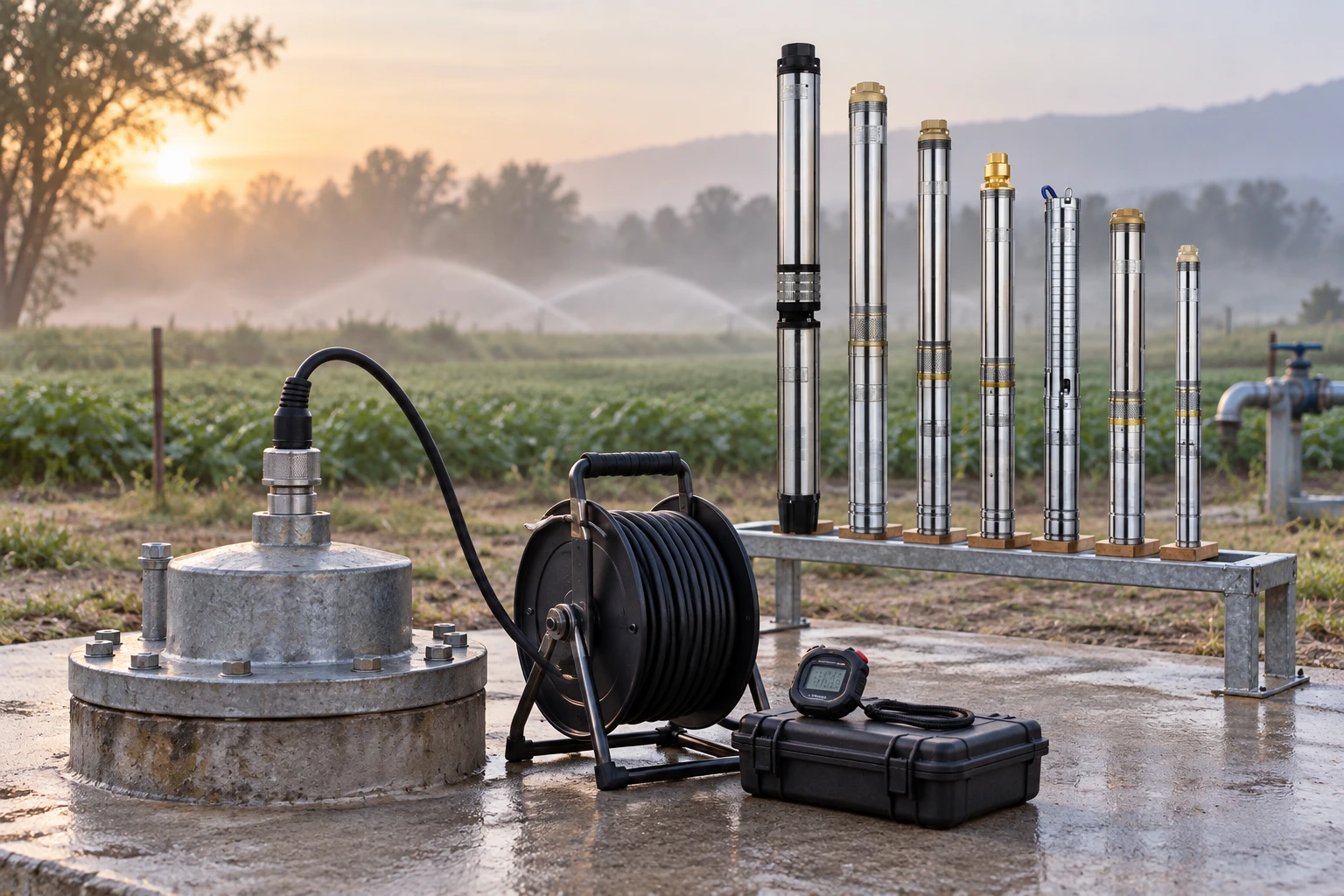
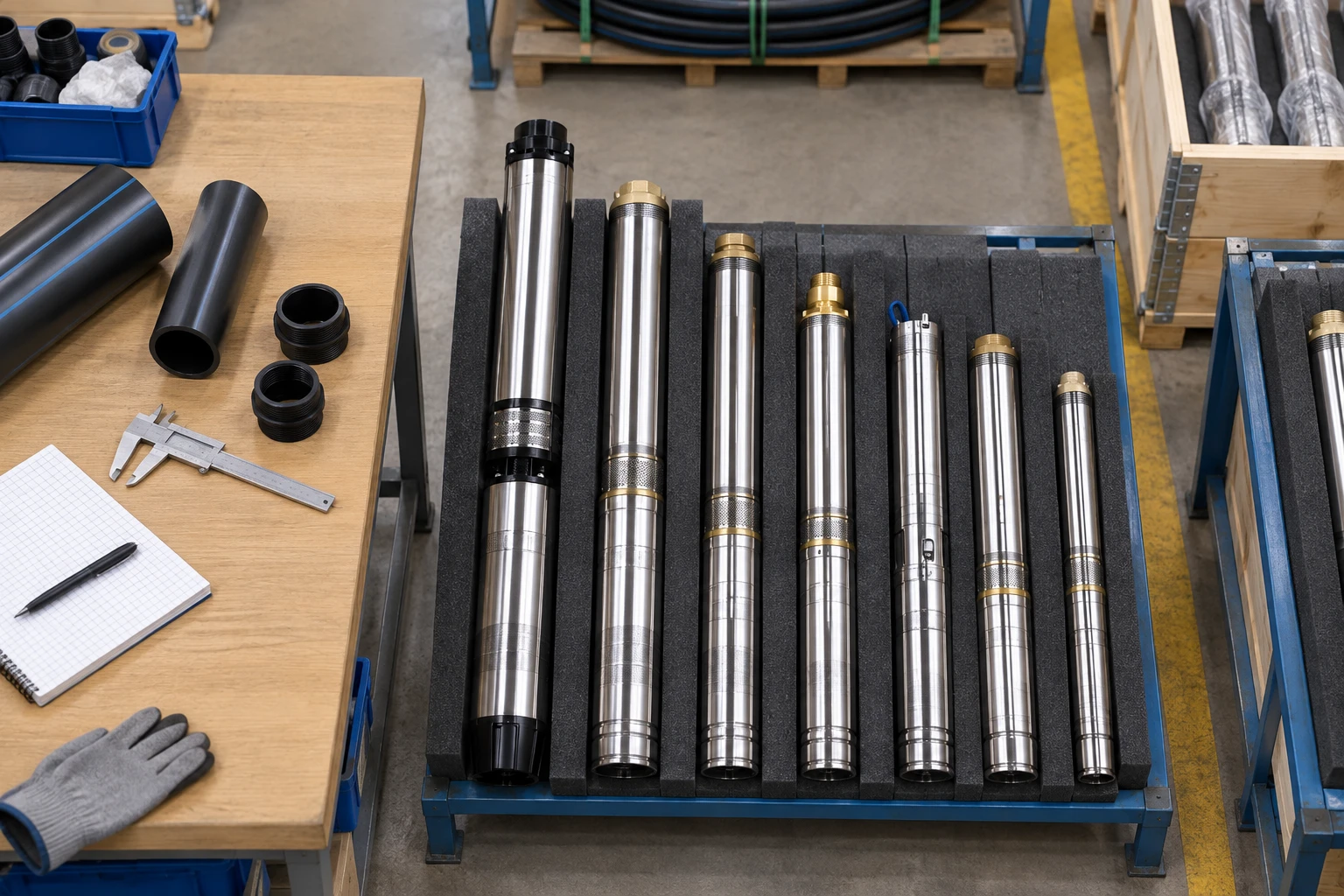
ال Borra QJ deep-well pump for irrigation is a relevant product family. Obtain the exact model’s performance curve and installation limits after demand is defined. A catalogue family containing different diameters and lengths does not establish which member suits a particular well.
Establish sustainable yield from a well test
A well’s yield is not the same as the largest flow a pump can draw briefly. Review the drilling and development records and an appropriate pumping test, including discharge rate, water-level response and recovery. The selection should be based on the well’s demonstrated behavior and the applicable local requirements, not the apparent amount of water present before pumping begins.
ال Penn State guidance on drilling a well highlights the value of water-level measurements during a pump test. Use that principle to request a time-based record rather than one static level and an unsupported yield estimate. The responsible well professional should interpret the test and identify limitations, including seasonal conditions where relevant.
If demand exceeds sustainable yield, options may include revised irrigation scheduling, storage, another approved source or a redesigned system. A larger motor cannot create more groundwater supply. The Penn State low-yielding well guidance provides context for using storage where appropriate; the actual arrangement needs site-specific design.
Use dynamic water level for lift
Static water level is observed when the well is not being pumped under the defined condition. Dynamic or pumping water level is observed while discharging at a stated rate and time. The pump must lift water from the relevant pumping level, not simply from the static level. Drawdown and recovery affect both head and the available submergence over the intake.
Total bore depth is a construction dimension, not automatically the static lift. A pump installed deep in a well may still operate with water standing much higher than its intake. Identify the pumping level relative to the delivery point and use a consistent elevation datum. Include terrain rise after the wellhead and any receiving pressure.
For a replacement, compare the current well test and irrigation demand with the original selection. The well or route may have changed since installation. Retaining the previous horsepower without review can reproduce a mismatch. The deep-well pump selection guide gives broader context for the information to request.
Calculate head through the complete route
Total head includes elevation from the relevant pumping water level to the delivery point, pipe friction, fittings, filters and the pressure needed by the irrigation system. Convert outlet pressure to head using the correct liquid density and units. Include the actual pipe bore and operating flow; nominal pipe size and a short visible section are not enough to establish losses.
As an illustrative example, assume 40 m of lift from pumping level to the irrigation manifold, 12 m of pipe and fitting loss, and 25 m of required irrigation pressure head. The resulting target is 77 m at the stated flow. These are assumed inputs, not a recommendation or a QJ rating. Recalculate them for the measured well and designed distribution system.
Check more than the peak-head case. A higher water level or a different zone can reduce resistance and move the pump to greater flow, which may affect yield, motor loading and control behavior. Use the pump duty-point guide to evaluate those intersections rather than accepting a single head calculation as the complete selection.
Match the selected curve to the well and zones
Confirm the pump model, speed, frequency and hydraulic configuration. Locate the required flow-head cases on the actual curve and review efficiency, motor loading and permitted operation. A multistage borehole pump can develop head through successive stages, but the number of stages alone does not establish delivered flow or suitability.
Ask how flow will be limited or controlled if the installed duty exceeds the sustainable well supply. Any variable-speed arrangement must be documented for the pump, motor and electrical installation. Minimum flow, motor cooling and other operating limits should come from the supplier’s instructions. Do not invent a universal cooling-flow value or dry-running allowance.
اقرأ how to read a centrifugal pump curve for the performance review. Confirm the proposed selection against the lowest credible pumping level and the relevant irrigation zones, and record assumptions the supplier must verify.
Check bore clearance and installation geometry
Confirm the actual bore or casing dimensions, straightness and any restrictions that could prevent lowering or retrieval. The selected pump, motor, cable and fittings must fit the documented installation. Nominal bore diameter alone may not establish usable clearance in an existing well. Obtain the well construction record and consult the installer where dimensions are uncertain.
Set installation depth through the approved design, considering pumping level, required submergence, well construction and sediment conditions. Do not position the intake at an arbitrary distance from the bottom using a generic online rule. The design must also provide the motor’s documented cooling arrangement and an appropriate retrieval path.
Use the designated lifting and support method. Electrical cable is not a lifting line. Record drop-pipe, cable support, wellhead sealing and access arrangements in the handover package. Installation and service should be performed by qualified personnel using the applicable well and electrical procedures.
Use an irrigation selection checklist
| مدخل | Evidence to collect | Selection question |
|---|---|---|
| Irrigation demand | Zone flows, pressures and schedule | Which zones run together? |
| Well yield | Pumping test and recovery record | Can supply sustain the required duty? |
| Water level | Static and pumping levels at stated flow | What lift and submergence apply? |
| Route losses | Pipe bore, length, filters and fittings | What head is required at each zone flow? |
| Pump data | Model-specific curve and limits | Are all operating cases acceptable? |
| التثبيت | Bore record, depth and support details | Can the unit be installed and retrieved safely? |
| Electrical | Supply, cable route and protection design | Is the motor arrangement compatible? |
This qualitative table is not a pump performance schedule. The DOE pump-system resources support matching equipment to the full system and avoiding selection by motor power alone.
Coordinate electrical protection and controls
Provide the actual supply, cable length, starting method and any drive requirements to the qualified electrical designer. Cable sizing needs load, voltage drop, installation method and applicable rules. Do not choose a cable only from horsepower or copy one from a neighboring well with a different route and supply.
Discuss dry-well or low-level protection, overload protection and the intended response after a trip. A restart delay or recovery sequence should reflect documented well behavior and equipment requirements. Protection cannot substitute for selecting a sustainable flow. Keep manual overrides controlled so a temporary test does not become the unattended operating mode.
Identify pressure and flow controls for changing zones and whether storage separates well pumping from irrigation demand. Each arrangement has a different duty profile. Confirm what happens when valves close, a filter obstructs or power returns. The final sequence should be understood by the owner as well as the installer.
Commission with measured flow and water level
Measure discharge flow, pumping water level and irrigation pressure under defined zone conditions. Record speed, valve position and filter state. Compare these observations with the selection and well test. An acceptable pressure at one sprinkler does not establish sustainable pumping or acceptable motor operation throughout the installation.
Keep the initial record for later seasonal or maintenance comparison. Lower yield, increased drawdown or higher route losses can change the duty. Investigate the well, filters and distribution system before installing a larger pump. A measured baseline helps distinguish declining well performance from equipment wear or a changed irrigation plan.
الأسئلة الشائعة
Is total well depth the head I should specify?
No. Use the relevant pumping water level, delivery elevation, route losses and required outlet pressure. Total bore depth matters to construction and installation but is not automatically the hydraulic lift.
Can a larger pump solve a low-yield well?
No. It cannot create more sustainable supply. Review yield, storage and irrigation scheduling with the responsible well and irrigation professionals before increasing capacity.
Should every irrigation zone be added together?
Add the zones that actually operate simultaneously under the approved schedule. Also verify the total volume can be delivered within the available time and sustainable well supply.
Which measurements are most useful after installation?
Record flow, pumping water level, irrigation pressure and operating configuration for representative zones. Keep the selected curve, well test, electrical data and protection sequence with those results.
التعلم المستمر
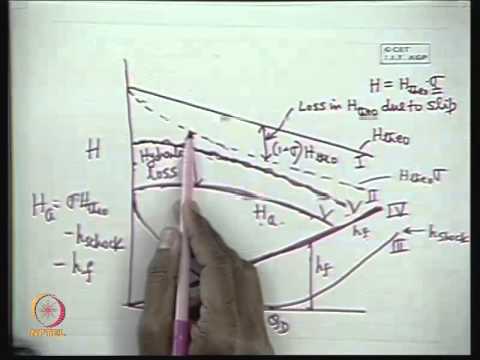
This NPTEL educational lecture explains centrifugal pump characteristics used in the hydraulic selection above. It does not verify a Borra rating or replace the selected model curve.
Watch nptelhrd: Mod-01 Lec-15 Characteristics of a Centrifugal Pump