
A self-priming pump is a centrifugal pump that can clear air out of its own suction line and start pumping without being manually filled before every use. It does this by keeping a charge of liquid inside a reservoir in the casing, recirculating that liquid to separate and expel trapped air, and then drawing the process fluid up the suction pipe. The one condition buyers forget: the casing has to hold liquid for the first start, so a self-priming pump still needs an initial fill and must not be run dry.
That single ability – re-priming from a partly empty suction line – is what separates it from an ordinary centrifugal pump, and it is why self-primers are common wherever the pump sits above the liquid or has to restart on its own.
Part 1. What a self-priming pump is
In plain terms, “self-priming” describes a centrifugal pump built with a liquid-retaining casing so it can evacuate air from the suction line on its own after an initial liquid charge. A standard centrifugal pump cannot do this: it moves liquid well but cannot move air, so it has to be filled by hand every time the suction line loses its prime.
The word “self-priming” is often misread as “no filling ever” or “unlimited lift.” Neither is true. The pump primes itself on restart because it kept liquid from the last run, and its lift is capped by atmospheric pressure like any suction pump. Treat the term as “re-primes automatically within limits,” not “defies physics.”
This article is the definition entry in BORRAPUMP’s self-priming pump guide; the startup, selection, and troubleshooting details live in the linked guides in that hub.
Part 2. How self-priming actually works
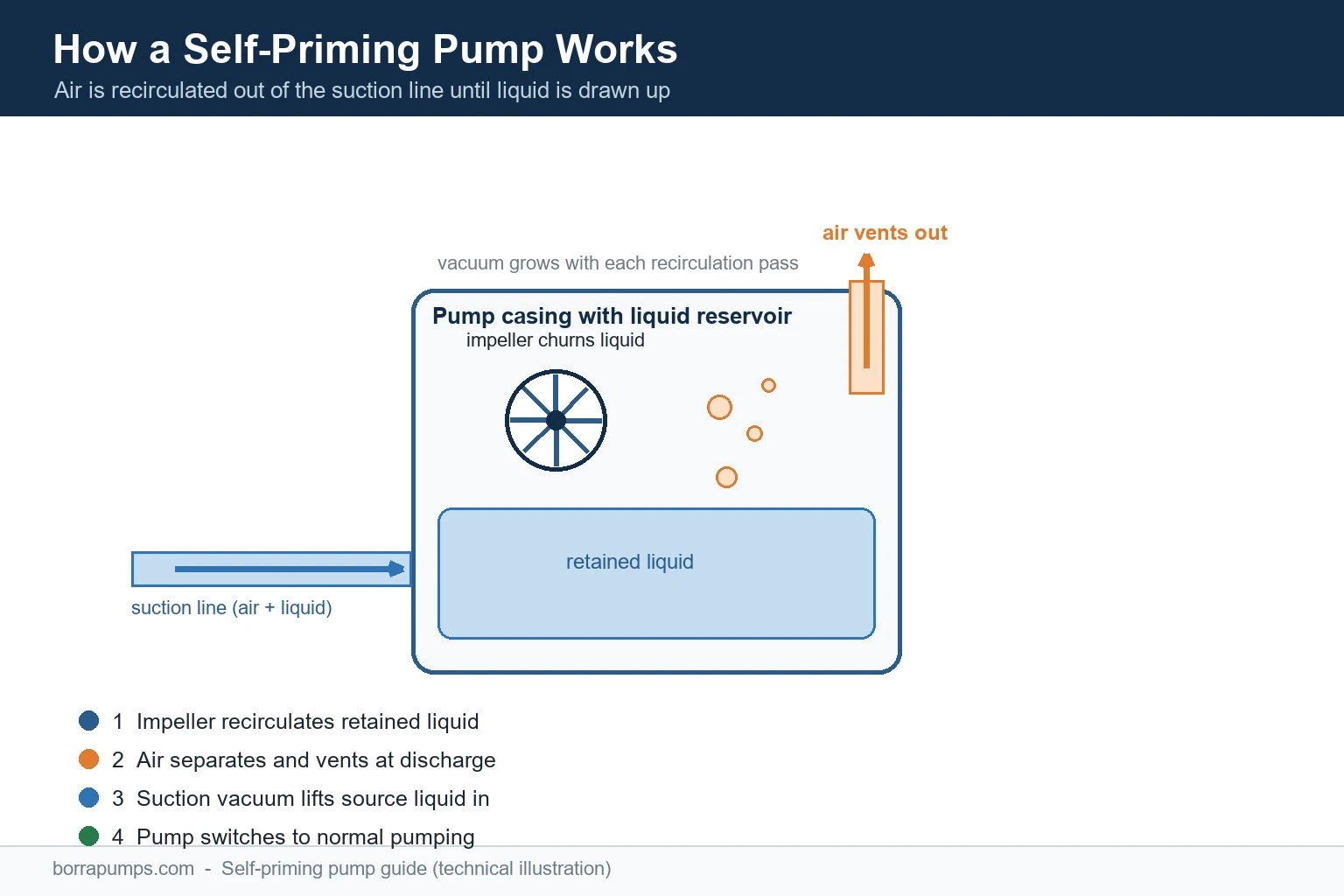
The mechanism is a recirculation cycle inside the casing. When the pump starts, the impeller churns the retained liquid and pulls air out of the suction line into that liquid. The mixture is thrown outward, the lighter air rises and vents through the discharge, and the de-aerated liquid falls back into the reservoir to be used again.
Each pass removes a little more air, so the vacuum in the suction line grows until liquid from the source is lifted into the pump. Once solid liquid reaches the impeller and air stops leaving the discharge, the pump switches to normal centrifugal pumping. Depending on lift and pipe length, that cycle usually takes anywhere from about half a minute to a few minutes.
Two facts follow directly from the mechanism:
- The casing must contain enough liquid to start the cycle. An empty casing cannot recirculate anything, which is why the first start needs a manual fill and why dry running risks the mechanical seal.
- Anything that breaks the vacuum – an air leak, a loose plug, a collapsing hose – stalls the cycle. For the full start-up sequence, see the guide on how to prime a self-priming pump.
Part 3. Self-priming pump vs standard centrifugal pump
Both pumps share the same centrifugal core, and both need liquid at the impeller to pump. What separates them is how they behave when the suction line has air in it.
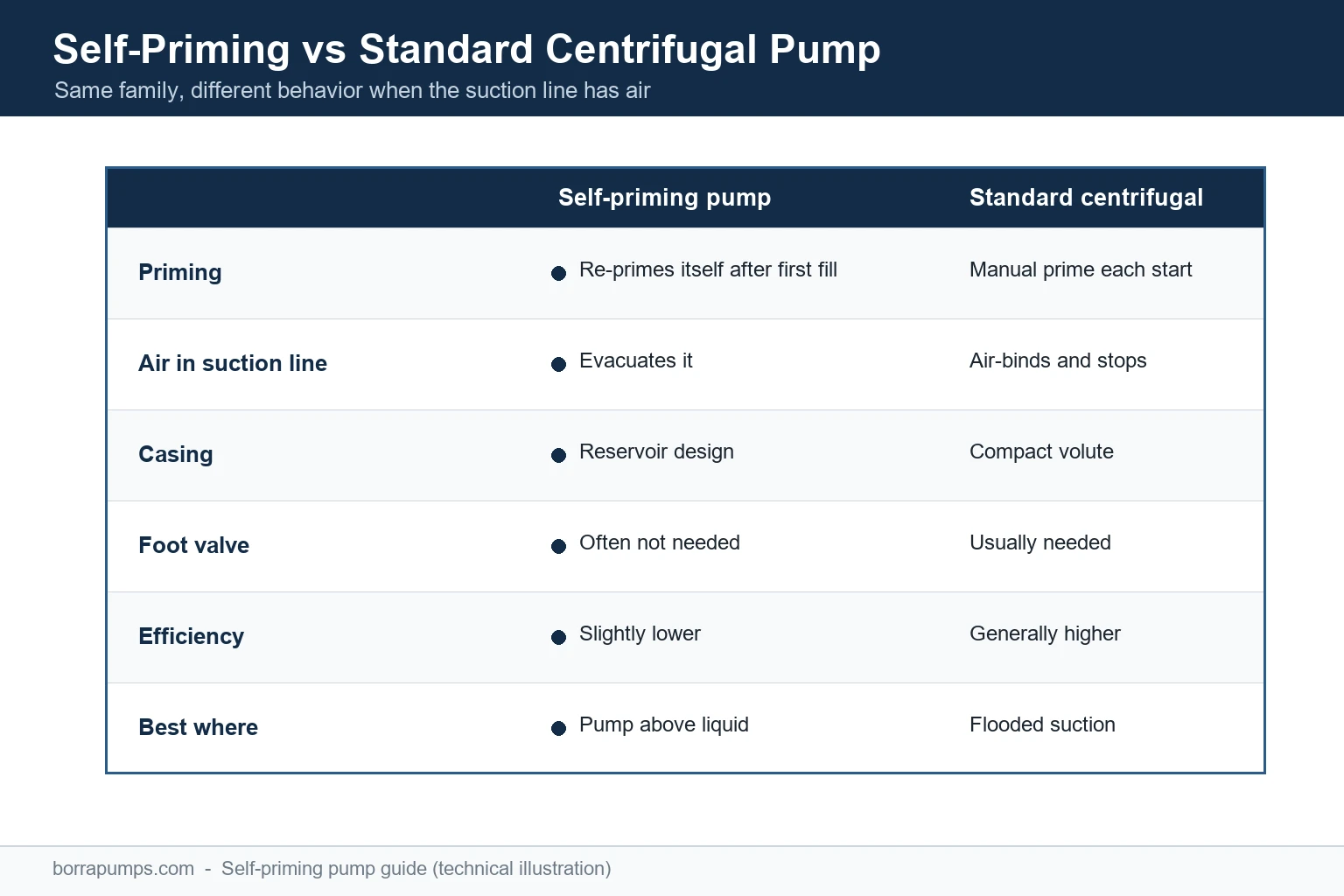
| Aspect | Self-priming pump | Standard centrifugal pump |
|---|---|---|
| Priming | Re-primes itself from retained liquid after the first fill | Must be manually primed before every start |
| Handles air in suction line | Yes, evacuates it through recirculation | No, air-binds and stops pumping |
| Casing design | Larger casing with a liquid reservoir | Compact volute, no reservoir |
| Foot valve dependence | Often runs without one | Usually needs foot valve or manual fill to hold prime |
| Efficiency | Slightly lower for the reservoir design | Generally higher at the same duty |
| Best where | Pump sits above liquid, frequent restarts, portable duty | Flooded suction, fixed installation |
In practice, the trade-off is efficiency for convenience: a self-primer gives up a little hydraulic efficiency to the extra casing volume and buys back automatic re-priming and tolerance of an air-prone suction line. Where the pump can be flooded and left running, a standard centrifugal is often the better hydraulic choice. For the buying rationale behind choosing a self-primer, see why choose a self-priming pump.
Part 4. How high and how far it can really lift
Marketing and physics collide over suction lift. A pump does not “push” liquid up the suction pipe; atmospheric pressure does, and that sets a hard ceiling.
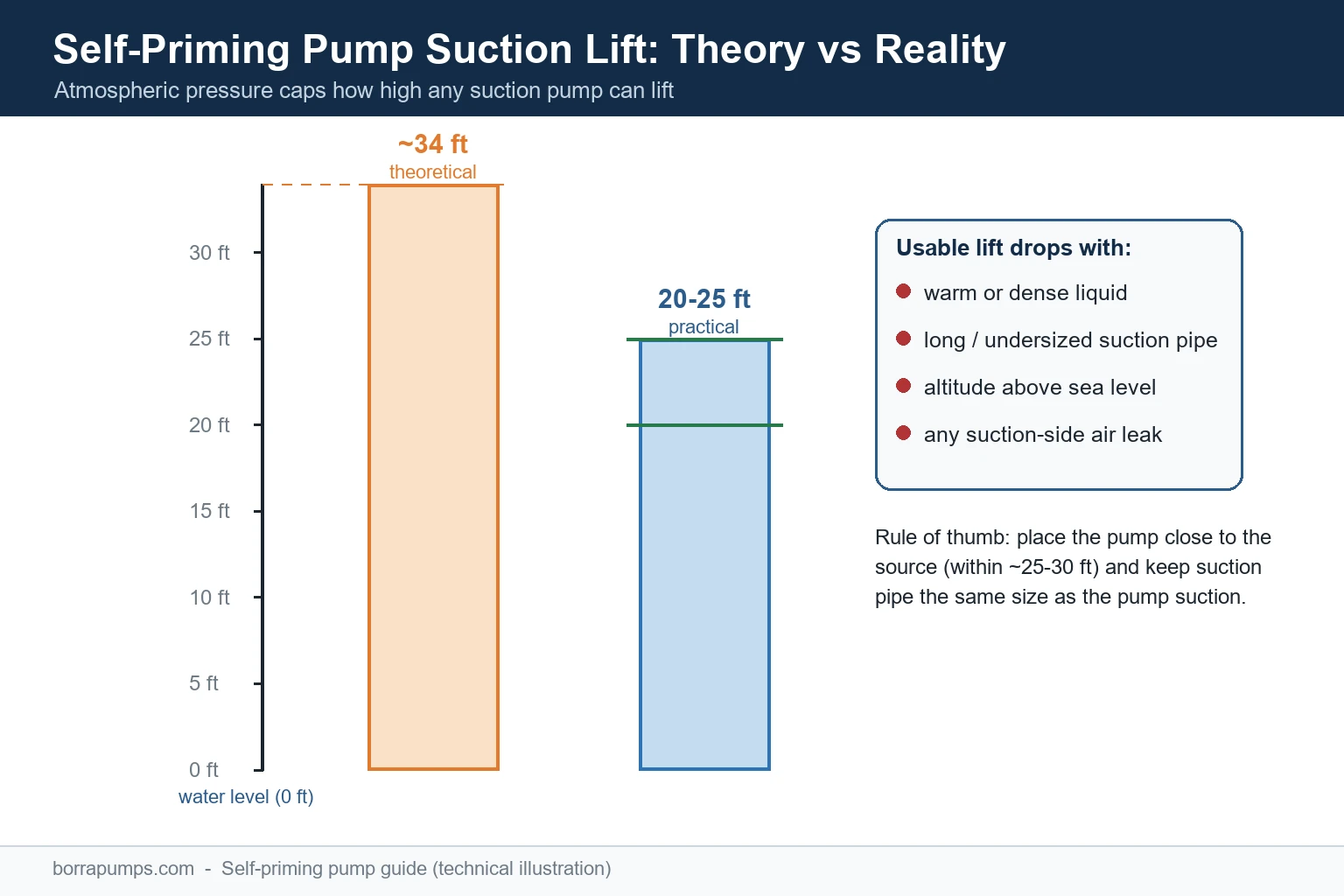
| Suction lift | Value | Note |
|---|---|---|
| Theoretical maximum at sea level | ~34 ft (10.3 m) | Limit of atmospheric pressure; unreachable in practice |
| Practical field lift for a good self-primer | ~20-25 ft (6-8 m) | What reliable installs actually achieve |
| De-rating factors | Temperature, specific gravity, friction, elevation, leaks | Each one lowers usable lift |
Industry practitioners are blunt about this: catalogue maximum lift is not a field number. The usable figure drops with warm or dense liquid, long or undersized suction pipe, altitude, and any leakage. A useful rule from field guidance is to place the pump close to the source – within roughly 25 to 30 feet – and, unlike most pumps, to keep the suction pipe the same size as the pump suction rather than one size larger.
If a job genuinely needs lift beyond the practical range, the answer is usually to move the pump closer to the liquid or lower it, not to expect the pump to overcome atmospheric pressure.
Part 5. Priming time, foot valves and holding prime
Priming time is not a fixed spec. A small pump with a short line and low lift may prime in 30 to 90 seconds; a bigger pump, a longer line, or a higher lift stretches that toward several minutes. If priming time keeps growing over the life of an install, that is a signal – usually a suction-side air leak, a worn clearance, a partial blockage, or a dropping source level.
Foot valves come up often. On many industrial self-primers a foot valve is deliberately left off because it adds friction and eventually leaks or sticks; the pump’s retained liquid holds prime instead. Some designs still use one to reduce the chance of losing suction, so it is a system decision rather than a universal rule.
When a self-primer “won’t hold prime” between runs, the cause is almost always a drain-back path or a lost liquid charge: a failed check valve, a leaking casing drain or plug, or a design that cannot retain the required volume. Chasing that with longer dry runs only risks the seal – the self-priming pump troubleshooting guide works through the causes in order.
Part 6. Where self-priming pumps are used
Self-priming pumps earn their place wherever the pump cannot be flooded or has to restart unattended. Typical duties include:
- Sewage and wastewater lift stations, where the pump sits above the wet well.
- Construction and site dewatering, where a portable pump pulls from a pit or trench.
- Irrigation and agricultural water transfer from ponds, canals, or tanks below the pump.
- Municipal and industrial water transfer where suction conditions vary.
- Intermittent or standby duty where a fast automatic restart matters more than peak efficiency.
The common thread is a suction-lift condition plus a need for hands-off restarts. In a flooded-suction, run-continuously installation, that advantage is worth less and a standard centrifugal may be the better pick.
Part 7. How to select one and send the right RFQ
Understanding the pump is the first half; selecting one is the second. A supplier cannot size a self-primer from “I need a water pump” – the suction conditions are exactly what decide whether a self-primer is right and how it will perform.
| Buyer should provide | Why it matters | Common mistake |
|---|---|---|
| Liquid and temperature | Sets materials, seal, and vapor pressure | Writing only “water” |
| Flow and total head | Defines the duty point | Pairing max flow with max head |
| Static suction lift | Decides feasibility and priming | Measuring from the wrong reference |
| Suction pipe length and diameter | Drives priming time and losses | Omitting bends and strainer |
| Solids and viscosity | Changes hydraulic and wear risk | Assuming all dirty water is equal |
| Power, drive, duty cycle | Sets motor/engine and controls | Giving power without run hours |
| Site, quantity, destination | Supports packing and documents | Mixing selection data with claims |
For a clean-water or irrigation duty that suits a horizontal self-priming route, review BORRAPUMP’s ZX self-priming water pump, whose product page states the casing needs priming fluid before operation and asks for the matching project inputs. For sewage, solids, oil, or fire duties, start from the verified BORRAPUMP product range rather than forcing one model to fit.
This guide fits understanding self-priming pumps and preparing to select one; it does not replace the model manual, a hydraulic calculation, or site safety procedure. Send your liquid, flow, head, and real suction-lift data through the BORRAPUMP contact page and ask the supplier to confirm whether a self-primer is the right choice for the duty.
FAQ
What is a self-priming pump in simple terms?
It is a centrifugal pump that removes air from its suction line and re-primes itself after an initial liquid fill, so it does not need manual priming before every start. It still must be filled for the very first start and must not run dry.
How does a self-priming pump work?
The impeller recirculates liquid retained in the casing, mixing it with air drawn from the suction line. The air rises and vents through the discharge while the liquid falls back to the reservoir. Repeating this raises the suction-line vacuum until source liquid is lifted in and normal pumping begins.
What is the difference between a self-priming pump and a centrifugal pump?
A self-priming pump is a type of centrifugal pump with a liquid-retaining casing that lets it clear air and re-prime on its own. A standard centrifugal pump cannot handle air and must be manually primed each time the suction line loses its charge.
How high can a self-priming pump lift water?
The theoretical limit at sea level is about 34 feet (10.3 m), set by atmospheric pressure, but that is unreachable in practice. A good self-primer reliably lifts around 20 to 25 feet (6-8 m), less if the liquid is warm or dense, the pipe is long, or the site is at altitude.
How long does a self-priming pump take to prime?
Typically from about 30 seconds to a few minutes, depending on suction lift, pipe length and diameter, casing volume, and speed. There is no universal figure; use the model manual and watch for priming time that increases over the install’s life.
Does a self-priming pump need a foot valve?
Not always. Many industrial self-primers run without one because the retained casing liquid holds prime, and foot valves add friction and can fail. Some designs still use one. Confirm the arrangement against the specific model and system.