
A mobile pump station for municipal flood response should be selected and deployed as part of a complete drainage operation: the expected inflow, available storage, pump duty, safe access, discharge route, staffing and backup arrangements. A trailer’s advertised maximum capacity does not establish how much water will leave the flooded area through the actual hose route. Municipal teams need a measured operating case, a site that remains accessible during the event and a clear activation plan. Assess the pump together with the receiving drainage system so that removing water from one location does not create a problem elsewhere.
Identify the area and the drainage failure
Define which streets, low areas or drainage assets the mobile station is intended to support. Establish whether the problem is blocked gravity drainage, elevated receiving-water levels, a capacity limitation or an outage at a permanent station. These conditions imply different operating cases. Record the water levels at which access, public movement and nearby equipment become restricted.
Use the municipal drainage records and event observations to describe the contributing catchment. Separate clean stormwater from water that may contain sewage, hydrocarbons, sediment or debris. A pump suited to one water condition may not be appropriate for the other. Decide who is responsible for identifying contamination and approving the discharge location before the event, when there is time to resolve permissions.
Translate the response objective into a pumping duty
State whether the objective is to keep pace with incoming water, lower a stored volume within a target period or protect a particular threshold. If inflow continues while stored water is removed, account for both. Keep uncertainties visible: a measured water volume differs from an estimate made from a preliminary map, and a forecast event differs from observed inflow.
Review the dewatering flow calculation guide when preparing the operating requirement. Set out the assumptions and units so another team can check the calculation. Avoid turning a short observation during mild rain into a guarantee for a severe storm. The drainage engineer should define the event and operating cases appropriate to the local plan.
Calculate head through the intended discharge route
The pump must overcome the elevation difference and the losses in the real discharge arrangement. Hose length, internal diameter, fittings, bends, valves and the receiving-water level affect the duty. A hose route that seems convenient in dry weather may become longer when road closures or flooded access points force a different deployment position.
Request a duty curve for the offered configuration. Check the predicted operating point and the permitted range rather than comparing only maximum flow figures. The DOE pumping-system sourcebook provides the wider basis for assessing pump and system together. Include changes in the receiving-water level, because a discharge point that is easy to reach can still provide an unfavorable hydraulic condition.
Choose the mobile package for the actual water
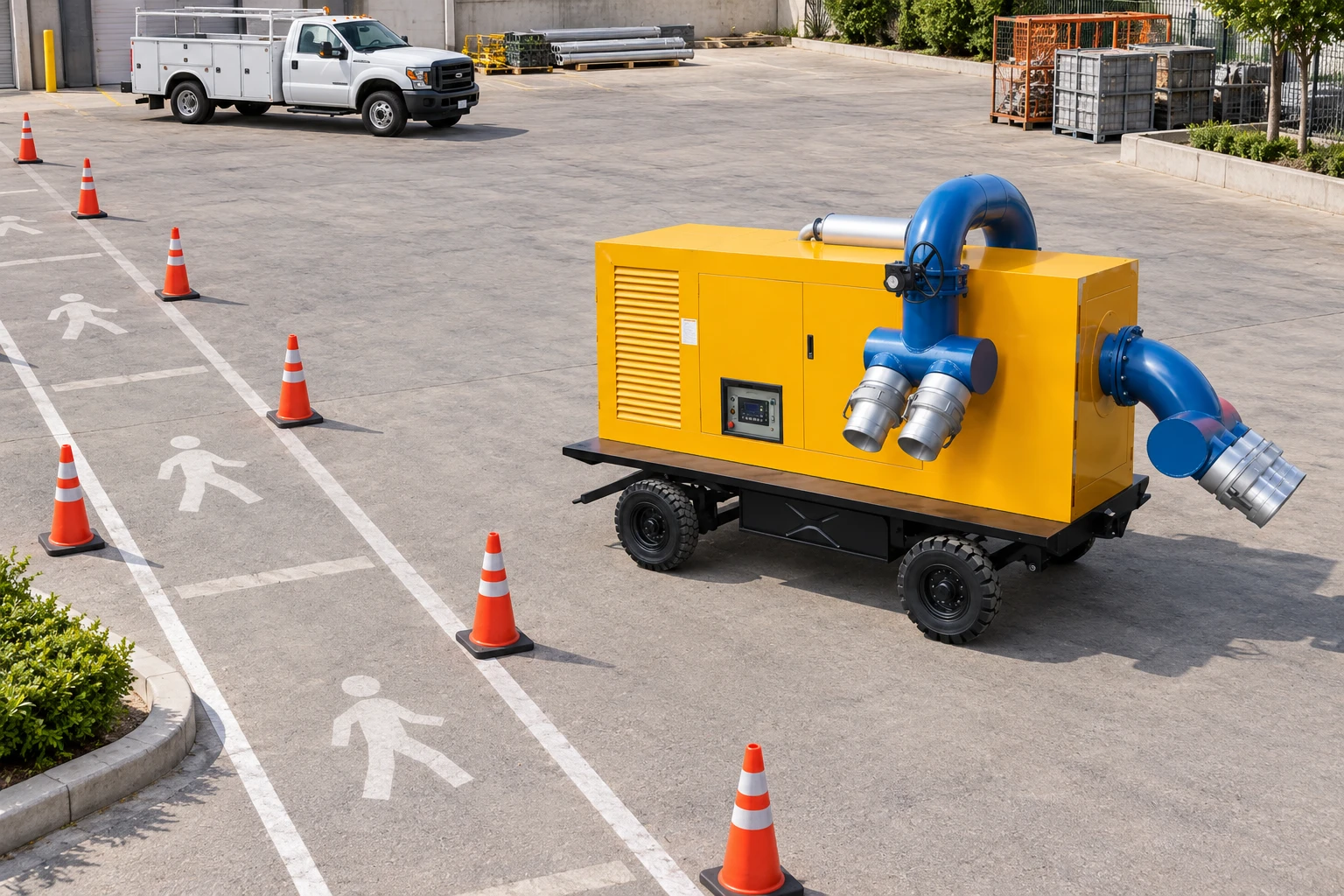
A BorraPumps CHWY mobile diesel drain pump is a relevant product family to discuss when preparing a mobile drainage request. Confirm the exact offered duty, suction arrangement, solids handling, engine package, connection sizes and operating limits. Do not treat a family description as evidence for the installed capacity of a particular unit.
Compare the liquid characteristics and debris load with the supplier’s stated limits. If sewage or fibrous material is present, ask specific questions about clogging and cleaning rather than relying on a single particle-passage figure. Keep a separate plan for intake protection and debris removal; a mobile pump cannot replace the maintenance of the upstream drainage system.
Prepare a deployment matrix before the weather event
| Deployment decision | Evidence to prepare | Responsible action |
|---|---|---|
| Activation trigger | Observed or forecast condition and protected threshold | Duty manager confirms mobilization |
| Equipment position | Access route, ground support and flood exposure | Site team verifies position before placement |
| Intake location | Water level, debris and safe inspection access | Operator checks the intake during service |
| Discharge destination | Capacity, permission, contamination controls and public exposure | Drainage team approves the route |
| Backup arrangement | Failure response, spare equipment and staffing | Coordinator confirms actual availability |
| Release and recovery | Stop condition, cleanup and inspection requirements | Supervisor signs the recovery record |
The table identifies decisions that must be made locally. It does not prescribe universal flood thresholds, discharge permissions or equipment capacities.
Verify access and ground support
Check the route used by the towing vehicle and the space needed to position and recover the station. The equipment location should remain usable under the planned flood conditions. Review soft ground, buried services, edges, slopes and obstructions. A site that supports a parked trailer in dry weather may not remain suitable after prolonged saturation.
Use the soft-ground trailer pump setup guide for the related support review. Obtain the actual weight and support arrangement from the supplier. Keep the operator’s access clear of moving vehicles and hose crossings. If the site becomes unsafe, the plan must say how pumping will be stopped or transferred without sending personnel into an uncontrolled hazard.
Protect the intake while preserving useful flow
Arrange the intake to remain within the documented operating requirements as the water level changes. Consider sediment accumulation, floating debris and the risk of the intake becoming uncovered. If a screen or strainer is used, account for its restriction and provide a safe way to inspect and clear it. A heavily clogged screen can undermine a pump selected on an otherwise adequate duty calculation.
Record water level and useful pumping performance during the event. A running engine is not proof that water is being moved effectively. Operators should know what observation requires a stop, a debris check or an adjustment within the approved procedure. Keep inspection methods appropriate to the contamination and flood conditions; unsafe manual clearing is not an acceptable response to a falling flow rate.

Make the discharge route safe and authorized
Trace the discharge route from the pump to the receiving location. Check hose pressure ratings, coupling arrangements, restraints and protection at vehicle or pedestrian crossings. The design needs to consider where water travels after it leaves the hose. Erosion, obstruction and flooding of neighboring property should be reviewed as part of the operation.
Separate the hydraulic decision from the environmental permission. A route that can carry the flow may still be unsuitable for contaminated water. The municipal emergency plan should identify who can approve a changed route during the event. Record any monitoring, treatment or reporting requirement that applies. Avoid assuming that emergency response removes every local obligation.
Plan staffing, fuel and communication
Assign an operator, a relief arrangement and a contact responsible for decisions outside the operator’s authority. Specify the reporting interval and what must be reported: water levels, observed discharge, unusual noise, leakage, alarms, fuel status and access changes. Use information that can be measured or reliably observed with the equipment available.
Estimate fuel needs from the documented operating duty and the offered engine data, then confirm delivery and safe refueling arrangements. A nominal tank volume does not establish dependable unattended operation. Include changes in duty, delays and the conditions under which refueling is permitted. Keep exhaust, hot surfaces and ignition sources in the site review rather than treating them as an afterthought.
Test readiness under controlled conditions
Before an emergency, check the station, hoses, connections, controls and communications using an approved exercise. Confirm that staff can identify the equipment, reach the intended site and establish the approved route. Where a pumping test is permitted, record the actual duty and operating conditions. A successful road mobilization alone does not prove the hydraulic arrangement.
Das EPA flood resilience guide for water and wastewater utilities discusses emergency planning and equipment readiness. Use it as a planning resource, not a capacity rule for another municipality. Your acceptance criteria should address the local drainage system, available infrastructure and the actual response objective.
Define backup and recovery honestly
Decide which failures the backup arrangement is intended to cover: pump failure, engine failure, inaccessible intake, blocked discharge or loss of staff availability. A spare pump stored elsewhere may not provide immediate protection if no transport or compatible hoses are available. Confirm the time and resources needed to bring the backup into service.
After the event, clean and inspect the equipment according to the liquid handled and the supplier’s procedure. Record damage, wear, clogging and operating difficulties. Link the findings to the dewatering fleet maintenance schedule. Preserve the event measurements so future procurement can use actual duty evidence rather than repeating an untested assumption.
Learning resource
NPTEL’s centrifugal pump characteristics lecture explains the flow-and-head relationship used when evaluating a mobile station’s duty. It supplements the hydraulic review and does not replace the municipal response plan.

Häufig gestellte Fragen
Can maximum pump flow be used as municipal flood-response capacity?
No. Determine the operating flow at the actual system head, with the offered configuration and expected water conditions.
Is a spare pump enough to provide backup?
Only if it can be transported, connected and operated within the required response time. Confirm hoses, staffing, access and compatible equipment.
Can discharge be sent to any nearby drain?
No. Check receiving capacity, contamination, local permission and the risk of transferring flooding or erosion to another location.
What should the event record contain?
Keep deployment times, water levels, operating observations, alarms, fuel and maintenance events, route changes and the final recovery inspection.