
Trailer pump hose size should be chosen from required flow, installed head, suction conditions and the hose’s documented ratings. Matching the hose diameter to the pump connection is only a starting point. The suction hose must remain suitable under vacuum, while the discharge hose must withstand the operating pressure and relevant transients. Both sides need adequate internal diameter, compatible connections and a practical route. A large pump with a restrictive hose may deliver far less than the buyer expects. This guide explains how to specify a complete mobile dewatering hose arrangement without confusing connection size with guaranteed performance.
Separate suction and discharge requirements
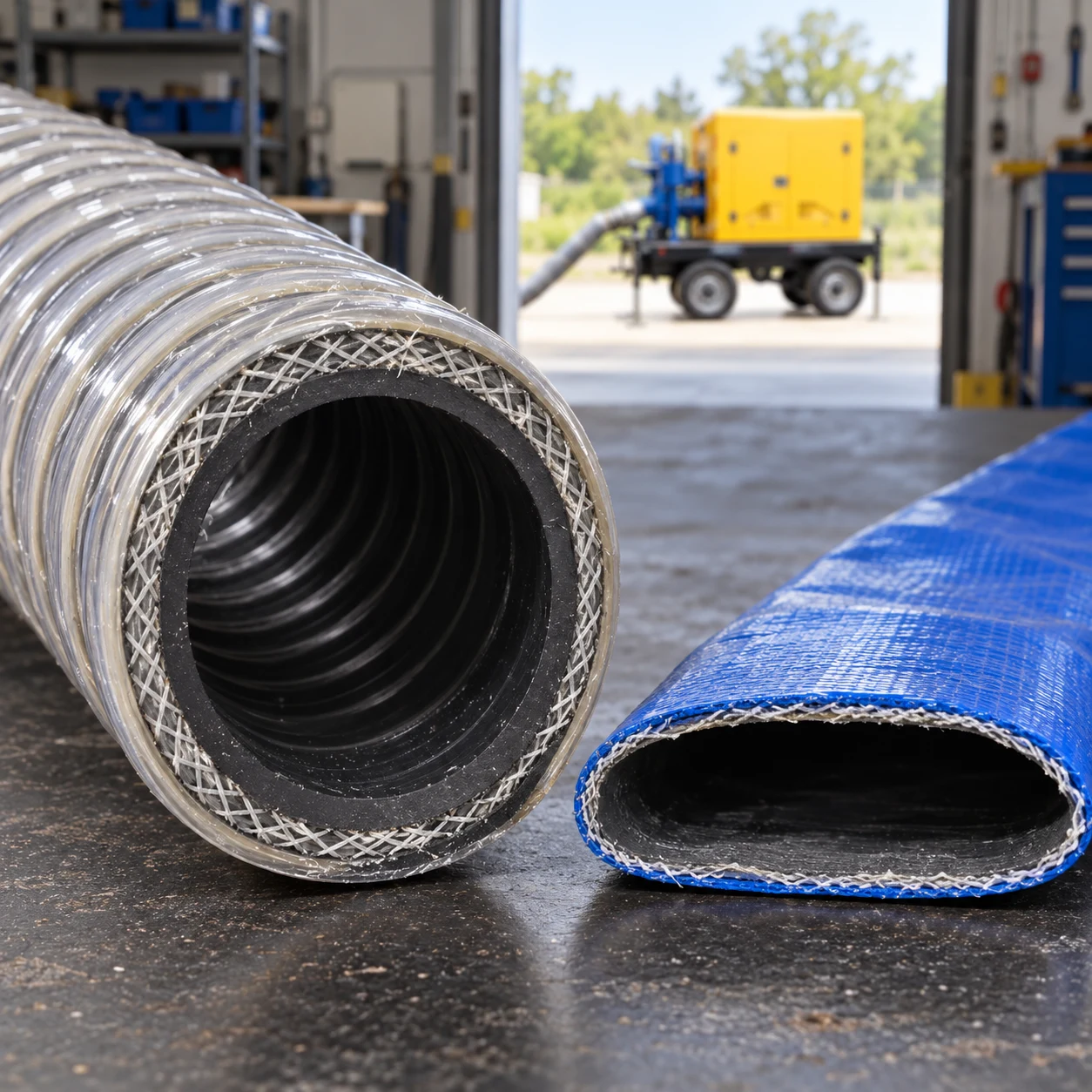
The suction side brings water into a surface-mounted pump. A hose that collapses under the installed suction conditions can stop delivery even when its printed diameter appears correct. Ask for the hose’s stated vacuum suitability, reinforcement, temperature range and relevant liquid compatibility. A flexible discharge hose should not be substituted for a suction-rated hose simply because the coupling fits.
The discharge side carries water away from the pump under positive pressure. Its rating needs to suit the selected system, liquid and temperature, including any pressure changes that require consideration. Inspect the entire assembly: hose, couplings, seals and adapters. The lowest-rated component can constrain the arrangement. Obtain the manufacturer’s documents rather than relying on appearance or a generic description such as heavy duty. A quoted hose size without a defined rating leaves a major part of the selection unanswered.
Build the duty from the site route
Draw the intended route before ordering hose lengths. Record the pump position, expected high and low water levels, discharge destination and elevation changes. Include the lengths on both sides, fittings, valves, reducers and any treatment equipment. Note traffic crossings, sharp edges, access needs and the space required for bends. A route that works on a drawing may need extra length once the equipment is safely positioned.
Use our dewatering flow calculation guide to establish the required water removal rate and our head calculation guide to organize the installed resistance. The US Department of Energy pumping-system sourcebook explains why the system and pump should be reviewed together. Maximum pump flow is not the expected delivery through every possible hose route.
Use a hose selection checklist
The table identifies practical checks for a water-like drainage duty. For abrasive, viscous, chemically aggressive or temperature-sensitive liquids, request additional suitability information. It is not a universal sizing chart and contains no assumed rating for a Borra product.
| Élément de sélection | Suction-side check | Discharge-side check | Éléments de preuve à demander |
|---|---|---|---|
| Internal diameter | Review losses and available suction conditions | Review losses at required delivered flow | Actual bore, not nominal name alone |
| Hose construction | Confirm vacuum suitability and reinforcement | Confirm pressure and temperature suitability | Manufacturer rating and applicable conditions |
| Couplings and adapters | Maintain airtight joints without a restrictive throat | Keep compatible, securely restrained connections | Assembly drawings and component ratings |
| Length and bends | Keep the practical route short with suitable bends | Account for the complete installed route | Site sketch, bend limits and loss information |
| Liquid and solids | Match intake protection to the actual debris | Review abrasion, settling and mixture compatibility | Liquid description and supplier suitability statement |
| Inspection and access | Allow safe leak and intake checks | Allow controlled isolation and hose inspection | Installation and maintenance instructions |
Calculate velocity as a screening step
For a round, full-bore hose carrying liquid, average velocity equals flow divided by internal area. In SI units, velocity in metres per second equals four times flow in cubic metres per second divided by pi times internal diameter in metres squared. Use actual internal diameter and consistent units. A coupling throat that is smaller than the hose should also be reviewed.
For an illustrative calculation, a water flow of 0.04 cubic metres per second through a 0.10 metre internal diameter gives approximately 5.09 metres per second. Through a 0.15 metre internal diameter, the same flow gives approximately 2.26 metres per second. These are arithmetic examples, not approved velocities or product recommendations. They demonstrate why diameter strongly changes the screening result. Select an acceptable arrangement from the real liquid, hose, system and pump data rather than treating either example as a target.
Estimate friction without inventing a hose coefficient
A common engineering expression for straight-line friction is the Darcy-Weisbach equation: friction head equals the friction factor multiplied by length divided by diameter, multiplied by velocity squared divided by twice gravitational acceleration. The friction factor must come from a suitable calculation or reliable data for the real conditions. Hose construction and internal surface can matter; a smooth rigid-pipe assumption should not automatically be assigned to every flexible hose.
Use hose-maker loss data when appropriate and include fitting and coupling effects. Check whether values are given per unit length, at a stated flow or for a particular fluid. A large-diameter hose may reduce losses but add cost, weight and handling demands. The Hydraulic Institute pump fundamentals provide context for relating the pump’s operating point to system resistance. Finish the sizing with a reviewed curve rather than a friction number in isolation.
Give the suction side its own review
Suction selection is more than a pressure-rating check. Review water-level changes, intake submergence, airtightness, available suction conditions and the manufacturer’s priming requirements. Excessive length, a restricted fitting or a partially blocked strainer can make an already marginal arrangement worse. Increasing discharge diameter does not repair a defective suction connection.
Place the pump and intake so the arrangement remains viable near the lowest planned water level. Support the hose without loading the pump connection or creating high points that complicate air removal. Avoid sharp bends and do not rely on a hose that visibly flattens during operation. For more detail on the suction side, see our self-priming suction pipe sizing guide. The complete trailer-hose selection also needs discharge ratings and handling checks addressed here.
Check adapters, valves and the actual assembly bore
A hose assembly can contain several restrictions that are easy to miss in a quotation. Check reducers, quick couplings, elbows, valves and strainer connections. Ask whether the stated nominal size describes the hose bore, flange designation or coupling system. Specify compatible sealing surfaces and retain the documented pressure or vacuum suitability of the complete assembly.
Where a check valve is part of the design, review its suitability and losses rather than adding it as a generic cure for every priming problem. Our check-valve selection discussion explains the related questions. Support and restrain connections according to the supplied instructions. Do not use a reducer arrangement that creates avoidable hose loading or leaves a heavy fitting hanging from the pump port.
Route discharge hose for delivery and safe access
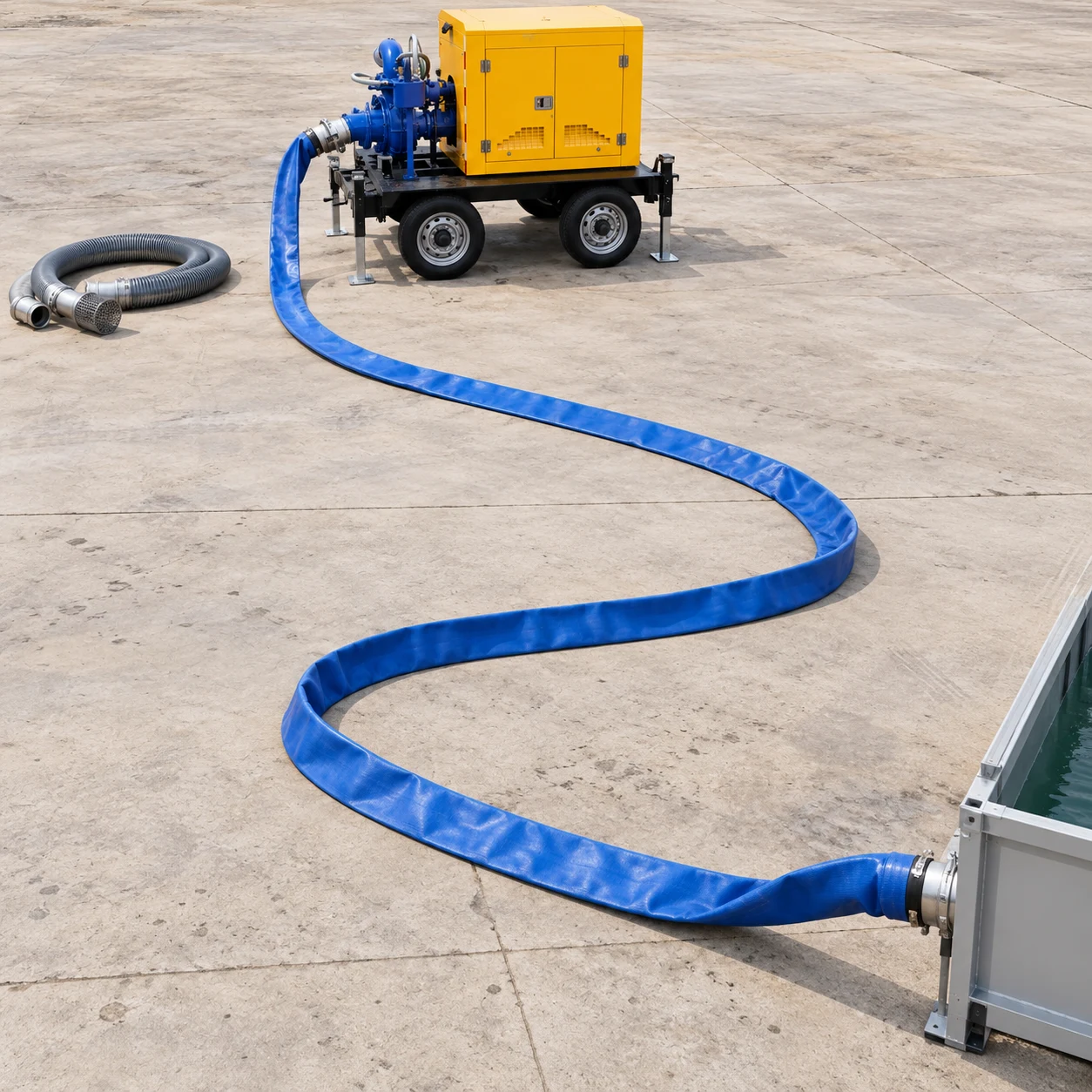
Unroll flexible discharge hose so it can assume its intended operating shape without tight kinks, twisting or local crushing. Keep bend radii within the maker’s instructions. Protect necessary crossings with an appropriate site arrangement rather than expecting a vehicle to drive over an unprotected live hose. Consider abrasion from rock edges and movement during operation.
Account for the discharge destination as it actually operates. A treatment tank, a raised outlet or a changing receiving-water level can affect the duty. Confirm that the route and destination are approved for the water being moved. Avoid uncontrolled movement at an open hose end. Changing valve positions or stopping flow can change pressure conditions, so operating procedures and hose ratings should be reviewed together. A straight, unrestricted demonstration hose does not prove performance on a longer field route.
Confirm the installation with a controlled trial
After installation, check the delivered result at the required duty using an agreed measurement method. Record water level, installed lengths, valve positions and pump operating conditions. Compare the result with the selection basis. Inspect for suction air leaks, local hose deformation, kinks, unstable connections and abnormal operation. Do not reach into an intake or disconnect a pressurized assembly during testing.
If delivery is short, investigate the entire arrangement before increasing speed or ordering a larger pump. Recheck the flow estimate, head, restrictions, priming and actual hose bore. A useful trial record also helps the next shift identify a changed route or developing obstruction. Stop and isolate equipment before maintenance, using the pump and hose assembly instructions. Keep the final route sketch with the job documentation so later changes are visible.
Send Borra a complete hose and pump inquiry
Le Borra ZBCY mobile diesel trailer pump et le trailer pump range provide starting points for mobile drainage selection. The product page alone does not define every compatible hose assembly. Send flow and head requirements, high and low water levels, actual route lengths, liquid and solids information, installation access and destination country.
Ask for the proposed pump duty, connection details, hose bore, vacuum or pressure basis, coupling ratings, bend limits and any required operating procedure. Request clarification where a package quotation says hoses included without defining their selection. Confirm whether spare seals, adapters or additional intake protection are required. This makes the equipment package reviewable and helps avoid a correctly selected pump being limited by an unsuitable hose route.
Foire aux questions
Should hose diameter always equal the pump port?
No. Port size is a starting point. Review actual hose bore, required flow, losses, suction conditions and ratings, including any adapters.
Can layflat discharge hose be used for suction?
Do not assume so. The suction assembly needs documented vacuum suitability. A discharge pressure rating does not by itself establish that suitability.
Will a larger hose always solve low flow?
No. It may reduce some losses, but low delivery can also result from suction leaks, priming problems, a blocked intake, an unsuitable duty or other restrictions.
Are the velocities in this guide recommended limits?
No. They are illustrative calculations only. Suitable operating conditions must be confirmed for the real fluid, pump, hose and installation.
Formation continue
This independent educational lecture provides background for the fluid and pump principles discussed above. It does not verify a Borra product rating or replace the project selection.
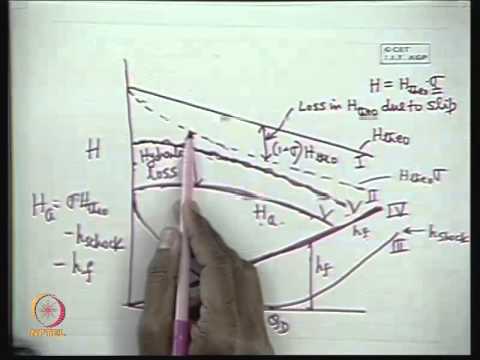
Watch nptelhrd: Mod-01 Lec-15 Characteristics of a Centrifugal Pump