
Dewatering pump discharge sediment control begins with identifying the water, confirming an authorized discharge route and matching treatment capacity to the actual pumping rate. A pump removes water from an excavation; it does not establish that the water is suitable for release. Suspended soil may need settling, filtration or an engineered treatment sequence before discharge. Choose controls for the soil and water conditions, protect the receiving area from erosion and assign someone to monitor the operation. Permit conditions vary by jurisdiction, receiving water and project, so verify the requirements that actually apply.
Define the water and the receiving point
Record where the water originates and what it may have contacted. Groundwater, rainfall collected in an excavation, concrete-contact water and water with a suspected chemical release are not interchangeable. Sediment removal alone does not establish that dissolved pollutants, abnormal pH or other contamination have been addressed.
Map the full route from intake to treatment, final outlet and receiving feature. Identify storm drains, nearby watercourses, unstable slopes and neighboring land. Confirm discharge authorization before mobilizing the pump. Access to an apparently convenient drain is not evidence of permission, and clear-looking water is not evidence that every applicable condition is satisfied.
O North Central Texas Council of Governments construction controls manual provides regional guidance on dewatering controls. Confirm the current permit and project conditions for the site rather than applying a regional manual as a universal discharge approval.
Reduce sediment pickup at the intake
Consider how the intake position affects the treatment burden. An inlet resting in loose sediment can draw a more concentrated mixture as the water level falls. Arrange the intake and its support so they remain suitable for the approved pumping method, expected drawdown and the equipment’s operating requirements.
Protect the pump from debris without assuming that a strainer removes fine suspended soil. The strainer’s role and the downstream treatment role are different. A pump able to pass solids may still deliver sediment-laden water that needs treatment. Conversely, installing a finer inlet screen without reviewing blockage and suction losses can create a pump problem.
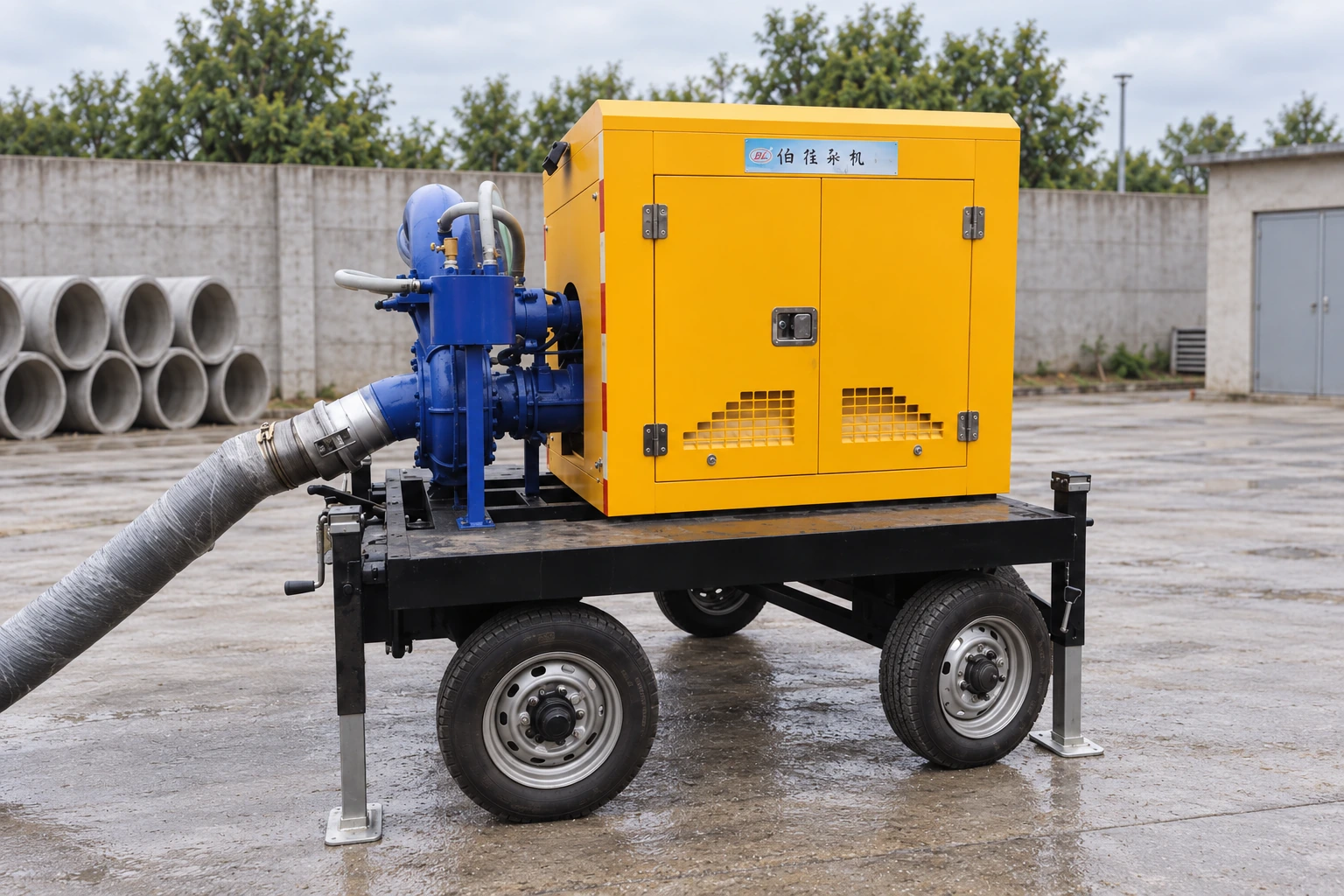
Borra’s SCPY trash water trailer pump is a relevant product option to discuss for temporary water removal. Confirm the actual duty, solids characteristics and supplied equipment. Product availability does not establish environmental treatment performance or permission to discharge a particular water source.
Match a treatment train to the observed material
The following table is a planning aid. It does not assign removal efficiencies or guarantee compliance. Use water characterization, treatment supplier data and the approved site plan to establish the actual arrangement.
| Observed challenge | Treatment question | Practical check before operation |
|---|---|---|
| Coarse sediment settles readily | Is there adequate controlled settling capacity? | Check flow path, available storage and access for accumulated sediment removal |
| Fine material remains suspended | Is settling alone adequate for the required outcome? | Obtain a treatment assessment rather than assuming a larger tank will solve it |
| Filtration is proposed | Is the filter suitable for particle size and loading? | Verify inlet conditions, rated flow, support and safe replacement method |
| Flow varies as excavation conditions change | Can the treatment accept the actual peak rate? | Measure or establish pump delivery at the installed duty |
| Water has oil, unusual odor or suspected contamination | Is sediment treatment the right process at all? | Hold or redirect under the approved plan and obtain specialist review |
| Outlet begins scouring soil | Is energy dissipation adequate? | Inspect the receiving surface and stop deterioration before it creates more sediment |
O Minnesota Stormwater Manual’s dewatering treatment guidance describes settling, filtration and treatment considerations. Its local permit references should be read within their stated jurisdiction. Chemical treatment requires a competent assessment and applicable authorization; this guide does not provide a dosing recipe.
Treat the pump and the controls as one operating system
A pump’s maximum advertised flow is not the guaranteed flow through the installed hoses and treatment equipment. Establish the actual duty with the elevation difference, hose losses, fittings and treatment inlet requirements. Check how the operating point changes as the excavation draws down or a filter loads with sediment.
If pump delivery exceeds treatment capacity, bypass and overflow can defeat the purpose of the controls. Plan how operators will reduce or interrupt flow using a method permitted by the equipment instructions. Do not assume that every pump may be throttled in the same way, or that repeatedly stopping a diesel or electric set is an acceptable long-term control strategy.
cURL Too many subrequests by single Worker invocation. To configure this limit, refer to https://developers.cloudflare.com/workers/wrangler/configuration/#limits Guia de cálculo do fluxo da bomba de dessensibilização. cURL Too many subrequests by single Worker invocation. To configure this limit, refer to https://developers.cloudflare.com/workers/wrangler/configuration/#limits.
cURL Too many subrequests by single Worker invocation. To configure this limit, refer to https://developers.cloudflare.com/workers/wrangler/configuration/#limits
cURL Too many subrequests by single Worker invocation. To configure this limit, refer to https://developers.cloudflare.com/workers/wrangler/configuration/#limits.
cURL Too many subrequests by single Worker invocation. To configure this limit, refer to https://developers.cloudflare.com/workers/wrangler/configuration/#limits.
cURL Too many subrequests by single Worker invocation. To configure this limit, refer to https://developers.cloudflare.com/workers/wrangler/configuration/#limits.
cURL Too many subrequests by single Worker invocation. To configure this limit, refer to https://developers.cloudflare.com/workers/wrangler/configuration/#limits
cURL Too many subrequests by single Worker invocation. To configure this limit, refer to https://developers.cloudflare.com/workers/wrangler/configuration/#limits.
cURL Too many subrequests by single Worker invocation. To configure this limit, refer to https://developers.cloudflare.com/workers/wrangler/configuration/#limits.
Use o dewatering discharge hose layout guide for physical route checks. The present treatment plan adds a separate requirement: water must remain on its intended controlled path through each stage, and the final release must meet the project’s applicable conditions.
Monitor changes during pumping
Create a repeatable observation record at the intake, treatment inlet, treatment outlet and final receiving point. Include time, weather, pumping condition, visible changes, treatment condition and any required measurements. Photographs help document changes but do not replace sampling or instrument readings when these are required.
Turbidity can help track suspended-material changes, but it is not interchangeable with every sediment measurement. The Minnesota guidance cited above discusses treatment monitoring and the limits of treatment performance evidence. Use the required method, location, frequency and response for the applicable project rather than importing a benchmark from another site.
Compare observations before and after operational changes. Moving the intake lower, increasing pump speed or starting a second pump can increase the treatment burden. A previously acceptable outlet condition should not be assumed to continue after the hydraulic conditions change. Record who authorized the change and what was checked afterward.
Maintain controls before their capacity is lost
Plan sediment removal and filter replacement while the system is still accessible. A settling tank gradually loses useful capacity as solids accumulate. Filtration behavior also changes with loading. Establish the inspection and maintenance triggers from the equipment instructions and site plan, not a fixed interval copied from an unrelated project.
Make the maintenance method part of the layout review. Personnel need safe access without standing beneath suspended loads, opening pressurized connections or stepping into an unstable excavation. Provide an approved destination for removed sediment and used filtration material. Their disposal requirements depend on the actual material and site conditions.
When performance deteriorates, preserve evidence before making adjustments. Note the flow condition, sediment appearance, tank level and any instrument readings. A larger pump can worsen an overloaded treatment system. A different filter cannot solve a contaminant problem that requires another treatment process.
Close the shift with a usable operating record
The handover should state which pumps are operating, the authorized route, treatment condition, recent maintenance, remaining storage and open concerns. Include the next inspection responsibility and the stop-and-escalate instructions. Confirm that incoming personnel can identify the equipment and outlet shown on the drawing.
Connect these checks with the plano de manutenção da bomba de esgotamento. Mechanical readiness and discharge treatment both affect whether the site can continue removing water. Neither record should be used as proof that the other discipline has completed its checks.
Further learning: sediment behavior
Practical Engineering’s “All Dams Are Temporary” provides background on sediment accumulation in water infrastructure. It helps explain why moving water and stored sediment need to be considered together. The scale is different from construction treatment, and the video does not specify filter performance, treatment design or permit compliance for a dewatering operation.

Perguntas frequentes
Can a trash pump discharge muddy water directly to a drain?
Pump solids-handling capability does not authorize discharge. Confirm the water characteristics, applicable approval, treatment requirements and receiving-point conditions before connecting the outlet.
Does a filter bag remove every pollutant?
No. Its performance depends on the selected material, loading and operating conditions. Sediment filtration does not automatically address dissolved contamination, oil or abnormal pH.
Is clear-looking water enough to approve release?
Visual appearance is useful for observing changes but cannot establish every water-quality condition. Follow the project’s required sampling, monitoring and authorization procedures.
Should a larger pump be used when the treatment tank fills?
First identify the capacity limitation and approved contingency. Increasing delivery can overload treatment or increase uncontrolled release; review the complete pump, storage and treatment arrangement.
What information is needed for a pump and treatment inquiry?
Provide inflow estimates, required drawdown, discharge route, head and hose details, solids characteristics, water-quality concerns and applicable treatment limits. Ask each supplier to define its scope and operating conditions.