
Diesel fire pump room ventilation must provide combustion air, remove engine and radiator heat, prevent exhaust recirculation, and keep the room within the engine, controller, battery, and pump equipment limits under the worst credible weather and load. Size it from the selected engine manufacturer's heat-rejection and air-consumption data, not from room volume alone. Coordinate intake and discharge openings, louvers, ducts, dampers, exhaust, freeze protection, drainage, and fire separation. Keep the calculation and acceptance record with the final project documents so future tests use the same basis.
Safety and scope: Fire pumps and their drivers are life-safety equipment. Hydraulic, electrical, diesel, fuel, battery, pressure, rotating-equipment, testing, and impairment work must follow the current approved design, manufacturer instructions, applicable standards, and the authority having jurisdiction. This guide explains the engineering decision path; it does not authorize field changes, bypasses, or operation by unqualified personnel.
Collect manufacturer heat data
Use the selected engine's combustion airflow, radiator airflow or heat-to-room data, exhaust information, and maximum allowable room temperature. Preliminary averages are not enough. Treat this as a system condition rather than an isolated component choice. Identify the source of every input, the unit used, the operating condition it represents, and the person responsible for approval. If information is preliminary, mark the assumption and test how the decision changes at a conservative boundary. This prevents a neat calculation from hiding an uncertain water level, pressure, valve position, driver condition, or simultaneous demand.
For diesel fire pump room ventilation, verify this section against the selected pump curve, the actual site arrangement, manufacturer instructions, and the current requirements accepted by the authority having jurisdiction. Check the installed condition as well as the drawing because pipe routes, elevations, supports, controls, and access often change during construction. Record the result in a form that can be repeated during commissioning and later inspection. Do not change a safety-critical setting or isolate fire protection without the approved impairment and restoration process.
Choose radiator or heat-exchanger cooling
A radiator moves substantial air through the room; a heat exchanger shifts more heat to a water circuit but still leaves engine and exhaust heat indoors. The most useful evidence is measured or approved project data, not a copied rule of thumb. Identify the source of every input, the unit used, the operating condition it represents, and the person responsible for approval. If information is preliminary, mark the assumption and test how the decision changes at a conservative boundary. This prevents a neat calculation from hiding an uncertain water level, pressure, valve position, driver condition, or simultaneous demand.
For diesel fire pump room ventilation, verify this section against the selected pump curve, the actual site arrangement, manufacturer instructions, and the current requirements accepted by the authority having jurisdiction. Check the installed condition as well as the drawing because pipe routes, elevations, supports, controls, and access often change during construction. Record the result in a form that can be repeated during commissioning and later inspection. Do not change a safety-critical setting or isolate fire protection without the approved impairment and restoration process.
Size outdoor-air openings
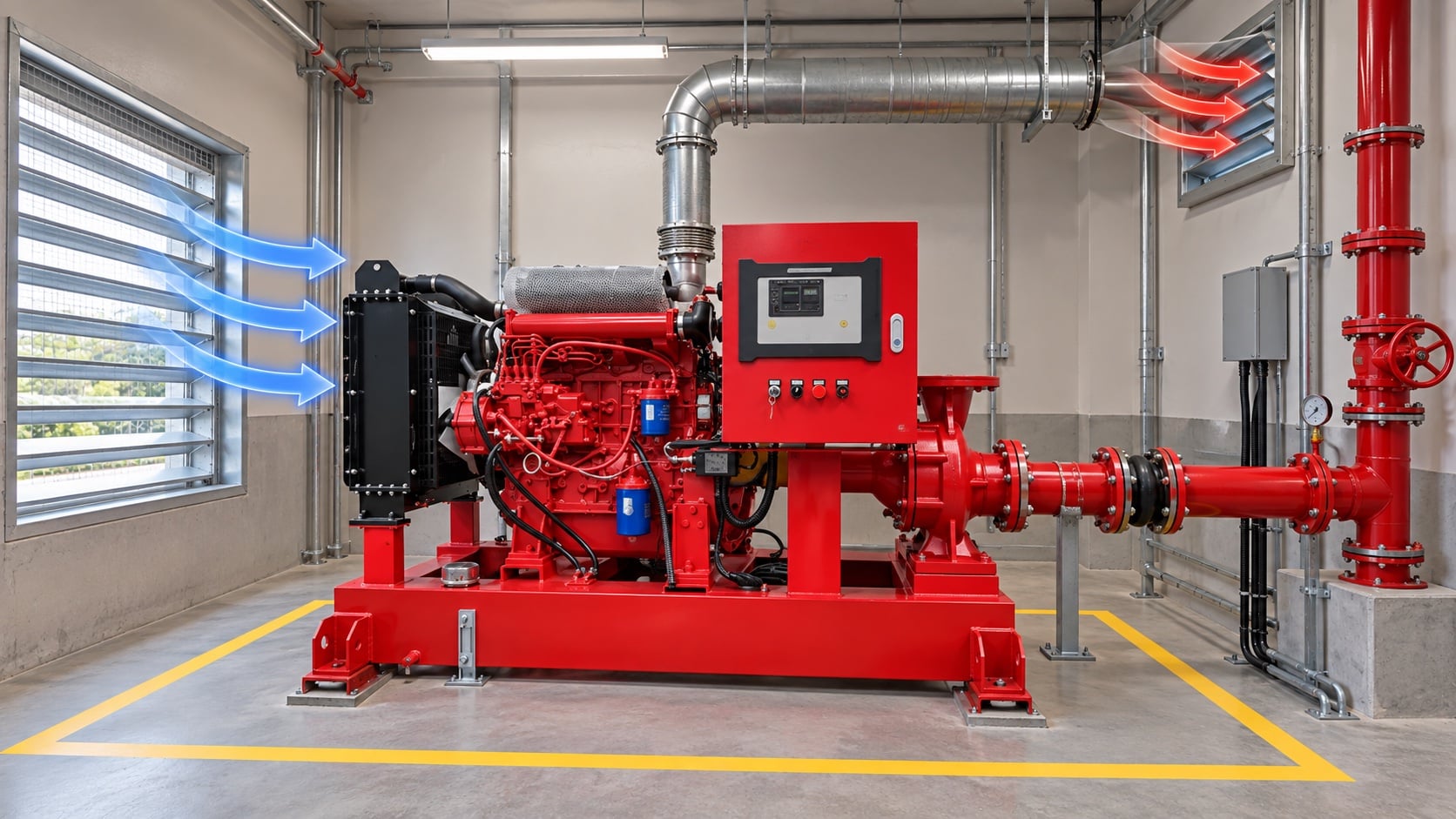
Account for free area, louver resistance, screens, ducts, dampers, wind, snow, and dirty-filter condition. Gross opening size is not free airflow. Review this condition at normal, test, and credible abnormal states before procurement. Identify the source of every input, the unit used, the operating condition it represents, and the person responsible for approval. If information is preliminary, mark the assumption and test how the decision changes at a conservative boundary. This prevents a neat calculation from hiding an uncertain water level, pressure, valve position, driver condition, or simultaneous demand.
For diesel fire pump room ventilation, verify this section against the selected pump curve, the actual site arrangement, manufacturer instructions, and the current requirements accepted by the authority having jurisdiction. Check the installed condition as well as the drawing because pipe routes, elevations, supports, controls, and access often change during construction. Record the result in a form that can be repeated during commissioning and later inspection. Do not change a safety-critical setting or isolate fire protection without the approved impairment and restoration process.
Control airflow direction
Bring clean air toward the engine intake and cooling inlet, then discharge hot air outdoors without short-circuiting back to the intake. The design team should turn this point into a traceable calculation or drawing note. Identify the source of every input, the unit used, the operating condition it represents, and the person responsible for approval. If information is preliminary, mark the assumption and test how the decision changes at a conservative boundary. This prevents a neat calculation from hiding an uncertain water level, pressure, valve position, driver condition, or simultaneous demand.
For diesel fire pump room ventilation, verify this section against the selected pump curve, the actual site arrangement, manufacturer instructions, and the current requirements accepted by the authority having jurisdiction. Check the installed condition as well as the drawing because pipe routes, elevations, supports, controls, and access often change during construction. Record the result in a form that can be repeated during commissioning and later inspection. Do not change a safety-critical setting or isolate fire protection without the approved impairment and restoration process.
Tabela de decisão prática
| Ventilation input | Origem | Design use |
|---|---|---|
| Combustion air | Engine manufacturer | Minimum air available to engine |
| Radiator airflow | Engine package data | Opening and duct resistance |
| Heat to room | Engine and exhaust data | Mechanical ventilation load |
| Outdoor design weather | Project climate data | Worst intake and discharge condition |
| Louver free area | Selected louver data | Actual airflow area |
| Allowable temperature | Equipment manufacturers | Acceptance limit |
Coordinate exhaust
Support and insulate exhaust piping, limit backpressure to engine requirements, protect penetrations, drain condensate where required, and keep exhaust away from air intakes. Treat this as a system condition rather than an isolated component choice. Identify the source of every input, the unit used, the operating condition it represents, and the person responsible for approval. If information is preliminary, mark the assumption and test how the decision changes at a conservative boundary. This prevents a neat calculation from hiding an uncertain water level, pressure, valve position, driver condition, or simultaneous demand.
For diesel fire pump room ventilation, verify this section against the selected pump curve, the actual site arrangement, manufacturer instructions, and the current requirements accepted by the authority having jurisdiction. Check the installed condition as well as the drawing because pipe routes, elevations, supports, controls, and access often change during construction. Record the result in a form that can be repeated during commissioning and later inspection. Do not change a safety-critical setting or isolate fire protection without the approved impairment and restoration process.
Protect cold-weather readiness
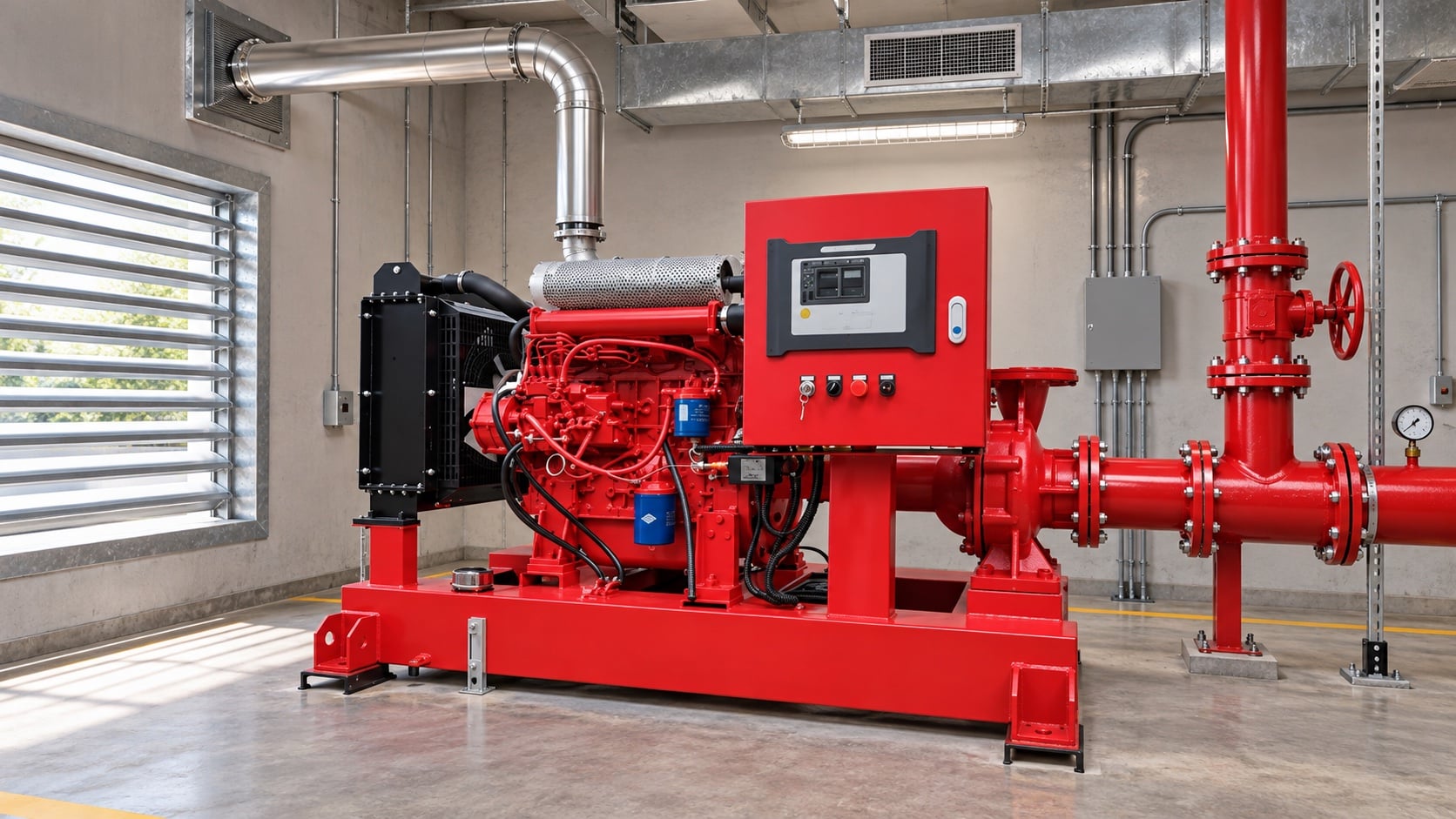
Use approved heating, damper, and freeze-protection arrangements that preserve starting and ventilation. Avoid controls that can leave the room sealed when the engine starts. The most useful evidence is measured or approved project data, not a copied rule of thumb. Identify the source of every input, the unit used, the operating condition it represents, and the person responsible for approval. If information is preliminary, mark the assumption and test how the decision changes at a conservative boundary. This prevents a neat calculation from hiding an uncertain water level, pressure, valve position, driver condition, or simultaneous demand.
For diesel fire pump room ventilation, verify this section against the selected pump curve, the actual site arrangement, manufacturer instructions, and the current requirements accepted by the authority having jurisdiction. Check the installed condition as well as the drawing because pipe routes, elevations, supports, controls, and access often change during construction. Record the result in a form that can be repeated during commissioning and later inspection. Do not change a safety-critical setting or isolate fire protection without the approved impairment and restoration process.
Check pressure and access
Excessive room pressure or vacuum can affect doors and airflow. Keep louvers, radiators, batteries, controllers, and service paths accessible. Review this condition at normal, test, and credible abnormal states before procurement. Identify the source of every input, the unit used, the operating condition it represents, and the person responsible for approval. If information is preliminary, mark the assumption and test how the decision changes at a conservative boundary. This prevents a neat calculation from hiding an uncertain water level, pressure, valve position, driver condition, or simultaneous demand.
For diesel fire pump room ventilation, verify this section against the selected pump curve, the actual site arrangement, manufacturer instructions, and the current requirements accepted by the authority having jurisdiction. Check the installed condition as well as the drawing because pipe routes, elevations, supports, controls, and access often change during construction. Record the result in a form that can be repeated during commissioning and later inspection. Do not change a safety-critical setting or isolate fire protection without the approved impairment and restoration process.
Commission at full load
Run the engine under the required test condition and trend room, intake, coolant, and exhaust-related temperatures while verifying damper and fan operation. The design team should turn this point into a traceable calculation or drawing note. Identify the source of every input, the unit used, the operating condition it represents, and the person responsible for approval. If information is preliminary, mark the assumption and test how the decision changes at a conservative boundary. This prevents a neat calculation from hiding an uncertain water level, pressure, valve position, driver condition, or simultaneous demand.
For diesel fire pump room ventilation, verify this section against the selected pump curve, the actual site arrangement, manufacturer instructions, and the current requirements accepted by the authority having jurisdiction. Check the installed condition as well as the drawing because pipe routes, elevations, supports, controls, and access often change during construction. Record the result in a form that can be repeated during commissioning and later inspection. Do not change a safety-critical setting or isolate fire protection without the approved impairment and restoration process.
How this relates to BORRAPUMP equipment
BORRAPUMP supplies engineered pump equipment for water and fire-protection projects. Review the relevant BORRAPUMP product configuration as a starting point, then submit the required flow, head, water source, driver, power, controls, site conditions, applicable requirements, quantity, and destination. Final selection must use the project hydraulic basis and approved submittal; this guide does not claim that one catalog arrangement fits every jurisdiction or risk.
Guias BORRAPUMP relacionados
- diesel versus electric fire pumps
- seleção do grupo gerador de incêndio
- guia de testes de aceitação da NFPA 20
Authoritative references
The following sources establish the standards boundary, fire-safety context, and pump-system principles used in this guide. Always apply the edition and local adoption accepted for the project.
- NFPA 20 standard development page
- U.S. Department of Energy pump systems resources
- NIST fire protection research
Educational video
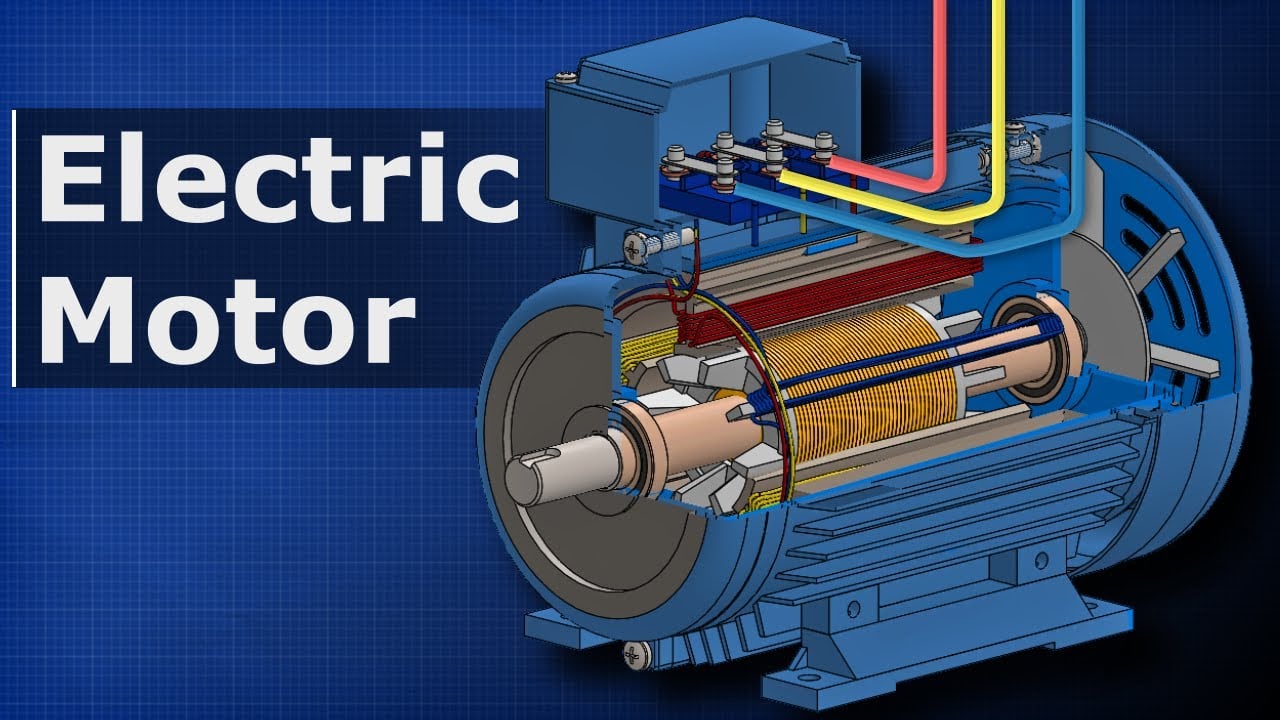
Habilitações literárias por The Engineering Mindset: Como Funcionam os Motores Elétricos: Motores de Indução CA Trifásicos. The video supports the underlying engineering concept and does not replace project-specific fire-protection requirements.
Perguntas frequentes
Can I size ventilation by air changes per hour?
Not by itself. Use engine combustion, airflow, and heat-rejection data plus room and weather conditions.
Does a heat exchanger eliminate ventilation?
No. Combustion air and heat from the engine, exhaust, and equipment still require management.
Should ventilation fans start with the engine?
Use the approved control philosophy and verify that required airflow exists whenever the engine operates.
How is ventilation tested?
Operate the engine under the required load and record airflow behavior and equipment-room temperatures in the worst practical condition.
Final verification checklist
Before approval, confirm the hydraulic basis, water-source condition, selected pump curve, driver and controller data, component pressure ratings, valve arrangement, test method, access, drainage, alarms, and restoration procedure. Resolve differences between drawings and the installed system. During commissioning, use calibrated instruments and record suction pressure, discharge pressure, flow, speed, driver condition, alarms, and abnormal observations at every required point. Keep the accepted results with the pump-room records so later inspections compare like with like.