
The best trash pump for flood control is the pump that meets the required emergency flow and total dynamic head while passing the expected debris, priming reliably, operating safely for the required duration, and discharging to an approved location. Start with flood inflow, water levels, suction lift, discharge elevation and hose length, solids and abrasiveness, fuel or power, access, deployment time, standby capacity, and operator availability. A large outlet or horsepower rating does not prove delivered flow. Use the certified curve and a complete field package, then test the setup before the emergency.
Este guia é uma estrutura preliminar de engenharia e aquisição, e não um substituto para o projeto de projeto aprovado, regulamentos atuais, instruções do fabricante ou supervisão qualificada no local. Trabalhos elétricos, testes com tensão, elevação, entrada em espaços confinados, trabalhos de proteção contra incêndio, escavação, líquidos perigosos, águas residuais e sistemas pressurizados exigem procedimentos específicos para a tarefa e pessoal competente. Preserve a proteção automática e a disponibilidade do sistema ao investigar avarias. Se o líquido real, a função, a condição do local ou o requisito aplicável diferirem das premissas, pare e obtenha uma revisão técnica revista.
- Define the flood-control objective and inflow
- Calculate head for the actual hose layout
- Match debris passage, wear, and cleanout access
- Choose priming, driver, controls, and runtime
- Deploy safely and control the discharge
- Exercise, inspect, and document readiness
- tabela de decisão
- Perguntas frequentes
Define the flood-control objective and inflow
State what must be protected, the maximum acceptable water level, available storage, expected inflow, deployment time, and consequence of pump failure. Sources can include rainfall runoff, river or tide intrusion, groundwater, drainage-system backup, firefighting water, or a breached barrier. Use the responsible engineer's hydrology and site plan for permanent or high-consequence protection. Temporary response plans should identify trigger levels, pump locations, access routes, fuel, operators, and the receiving outfall before a storm. A pump that begins after the only access road floods is not an effective plan. Divide capacity among lead and standby units when one failure would cause unacceptable damage. Consider whether pumps must operate while debris load, water level, and discharge route change.
Calculate head for the actual hose layout
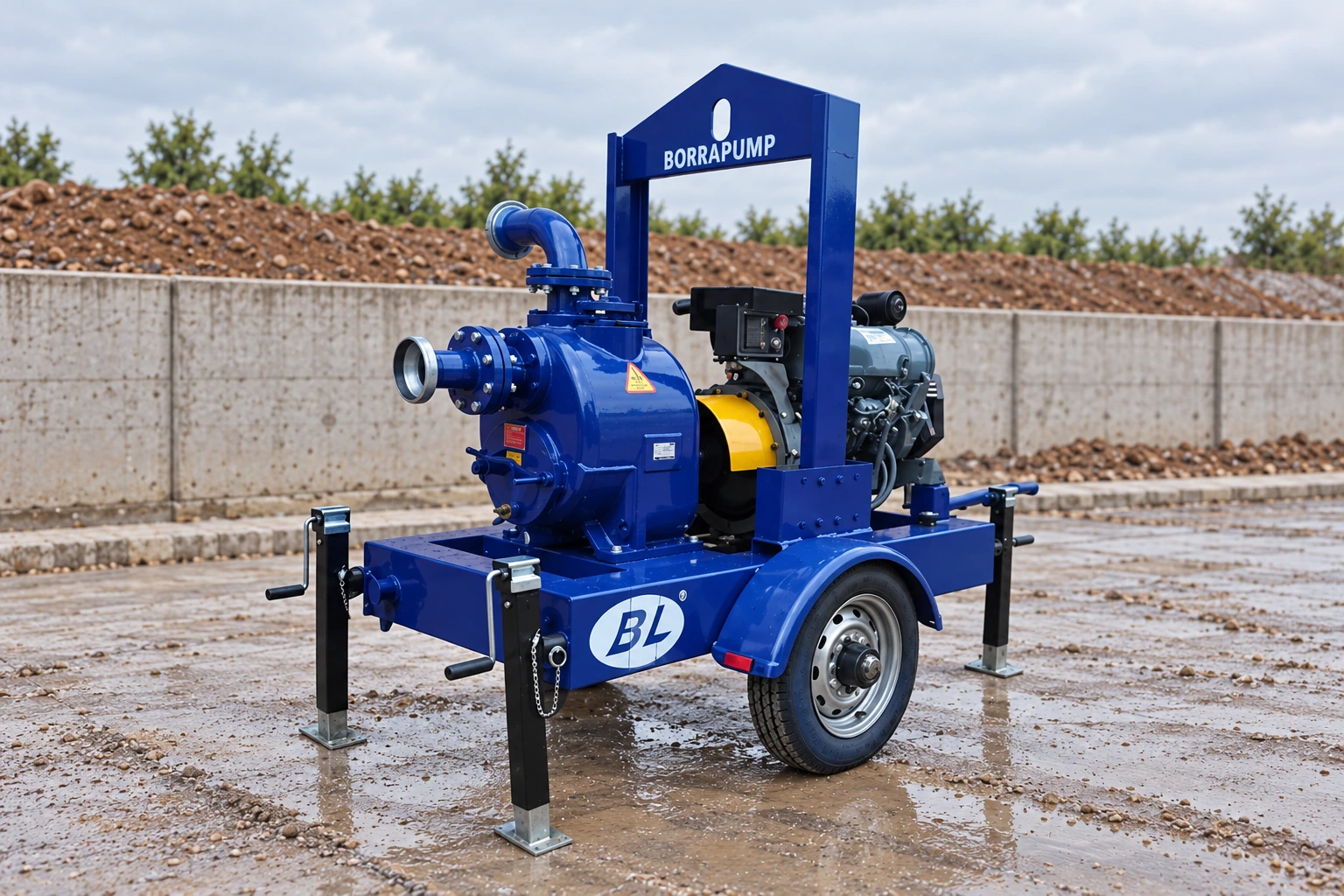
Total dynamic head includes vertical rise from the lowest operating water level to the outlet, pressure at the discharge point, and losses through suction hose, discharge hose, fittings, check valves, manifolds, and treatment equipment. Flexible hose inside diameter, length, bends, roughness, and kinks strongly affect loss. Suction lift also affects priming and net positive suction head available. Keep the pump close to water and the suction route short where safe placement allows. Calculate normal and worst routes, including falling source level and a relocated outlet. If multiple pumps share a header, model their interaction. Confirm hose and fitting pressure ratings at shutoff and transient conditions, not just during the expected flow.
Match debris passage, wear, and cleanout access
Floodwater can contain leaves, plastic, rags, gravel, silt, sewage, and construction debris. Describe the likely solids and compare strainer openings, pump solids passage, impeller arrangement, wear materials, cleanout covers, and access. A trash pump is not immune to blockage or abrasion. The suction strainer should prevent material larger than the pump can pass while providing enough free area to avoid excessive loss. Place it away from loose sediment and floating debris where possible, and inspect it during operation. Highly abrasive or contaminated water may require different equipment, materials, containment, and disposal. Record what the selected model can actually pass from its data sheet rather than using an unverified generic definition of semi-trash or full-trash.
Tabela de decisão do projeto
| Flood-control input | Selection check | Field evidence |
|---|---|---|
| Peak inflow and allowed level | Required duty and standby capacity | Hydrology or response plan |
| Suction lift and hose route | Priming and NPSH available | Site elevations and layout |
| Debris and sediment | Passage, strainer and wear design | Floodwater description |
| Discharge destination | Head, erosion and permit controls | Approved outfall plan |
| Required runtime | Fuel, power, staffing and service | Emergency operating plan |
| Failure consequence | Standby, alarms and response | Risk assessment and exercise |
Choose priming, driver, controls, and runtime
Self-priming centrifugal trash pumps require the casing to be filled initially and the suction line to be leak-tight; vacuum-assisted systems add priming equipment that must also be maintained. Ask for expected prime time at the proposed suction lift and hose. For diesel packages, confirm rating and site derating, fuel runtime, refueling method, battery, cooling, exhaust, noise, shutdowns, and weather protection. For electric units, confirm source capacity, motor starting, cable, grounding, water exposure, and generator compatibility. Critical unattended service may need level controls, remote alarms, automatic restart or changeover, and a standby pump. Define what happens after loss of prime, blocked intake, low fuel, high temperature, or power failure.
Deploy safely and control the discharge
Place the pump on stable ground outside the expected flood path and away from unstable banks or excavation collapse zones. Stabilize trailers, chock wheels, protect suction and discharge hoses from traffic, and restrain pressurized connections using approved methods. Direct exhaust away from workers and occupied areas, and control carbon monoxide exposure. Plan lighting, access, communication, refueling, spill control, and lifting. Confirm that the outfall can accept the water without erosion, backflow, downstream flooding, or environmental violation. Use energy dissipation, sediment control, or treatment where required. Never treat visibly clear water as proof that discharge is permitted. Update the route as flood levels and site access change.
Exercise, inspect, and document readiness
Run the complete pump, hose, strainer, driver, controls, and discharge arrangement before the flood season and after major maintenance. Measure prime time, suction and discharge pressures, flow estimate, engine speed or electrical current, fuel consumption, alarms, leaks, vibration, and hose movement. Verify spare hose, clamps, gaskets, fuel, batteries, tools, lighting, and communications. During an event, assign inspection intervals and record water level, runtime, fuel, intake condition, outfall erosion, and changes in sound or performance. After use, clean and dry equipment safely, inspect for abrasion and contamination, service the driver, repair hoses, replenish supplies, and capture lessons. Readiness is a maintained system, not a pump stored in a warehouse.
Registo de aquisição e aceitação
Uma comparação completa de fornecedores deve utilizar uma folha de dados comum. Coloque o ponto de dimensionamento e os pontos de serviço alternativos, o líquido, a temperatura, os sólidos, a altitude do local, a potência, os controlos, a instalação, as horas de funcionamento, a quantidade, o destino e os documentos exigidos na parte superior. Normalize as diferenças de âmbito antes de comparar o preço ou a eficiência. Solicite uma curva certificada ou dados de capacidade, potência absorvida, limites de funcionamento, materiais, dimensões, peso, ligações, motor ou acionamento, controlador, acessórios, ensaios, preservação, peças sobressalentes, instruções de instalação e os limites da garantia. Registe todos os desvios e pressupostos não resolvidos. Durante a análise técnica, faça corresponder cada característica proposta a um dado de entrada do projeto, em vez de atribuir pontos por características de que o serviço não necessita. Durante a comissão, meça as mesmas variáveis utilizadas para a seleção, para que o resultado instalado possa ser comparado com a base original. Se as condições de campo diferirem, atualize o cálculo e obtenha a aprovação dos responsáveis antes de alterar o equipamento ou as definições de proteção.
Como este tópico se conecta ao equipamento BORRAPUMP
Este guia apoia a revisão prévia do best trash pump for flood control applications percurso da aplicação. Não atribui um modelo final nem afirma que uma configuração padrão serve para todos os projetos. Envie os pontos de funcionamento, os dados do líquido, o desenho do local, a alimentação elétrica, os controlos, a quantidade, o destino, as aprovações necessárias e o âmbito de inspeção para que o produto proposto possa ser verificado face ao serviço real.
Manuais de engenharia BORRAPUMP relacionados
- trailer-mounted dewatering pump selection
- trash pump vs drainage pump
- mobile drainage pump for construction sites
Fontes autorizadas e aprendizagem adicional
FEMA flood information; Publicações da OSHA sobre monóxido de carbono; U.S. EPA stormwater program. Estes recursos fornecem contexto geral de segurança, ambiental ou de engenharia. As regras atualmente adotadas, as aprovações de projetos e as instruções dos equipamentos continuam a prevalecer.
Vídeo educativo por Practical Engineering: As bombas criam pressão ou caudal?. Explica os princípios de base e não substitui as instruções específicas do projeto.
Perguntas frequentes
Is a larger outlet always a better flood pump?
No. Delivered flow depends on the pump curve, total dynamic head, suction conditions, speed, hose, debris, and operating limits.
Does a self-priming trash pump need initial water?
Usually the casing must be filled according to the model instructions. The suction line must also be leak-tight.
How much standby capacity is required?
Base it on failure consequence, inflow uncertainty, repair and response time, access, and the responsible engineer or emergency plan.
Can floodwater be discharged to the nearest drain?
Not without checking capacity, backflow, erosion, downstream flooding, contamination, permits, and site approval.
Ponto de controlo do projeto final
Antes da colocação da encomenda ou alteração em campo, reconcilie o serviço e os desenhos aprovados com os dados do fornecedor, materiais, dimensões, pesos, ligações, acionador, controlos, acessórios, proteção, âmbito de ensaio, documentação, peças sobressalentes, método de instalação, acesso para manutenção e requisitos de destino. Registe as premissas remanescentes e atribua responsabilidade para as encerrar. A informação final aceite deve ser a mesma base utilizada para a instalação, comissionamento e futura manutenção.